
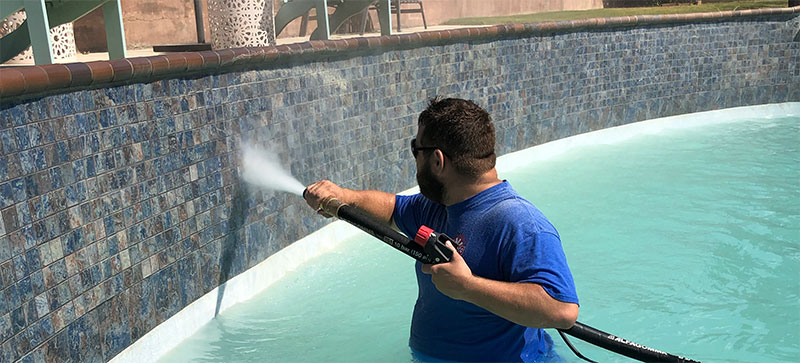
Calcium buildup on pool tiles can be removed with a pumice stone for light deposits, a vinegar solution for moderate scaling, muriatic acid for heavy calcium carbonate, and professional bead blasting for stubborn calcium silicate. The buildup forms when pool water has high calcium hardness, elevated pH, or high alkalinity, causing calcium carbonate or calcium silicate to separate from the water and stick to tile surfaces. According to data compiled by the U.S. Geological Survey, more than 85% of American homes have hard water, which makes calcium scaling one of the most common pool maintenance challenges nationwide. This guide shows homeowners in Jefferson, Georgia exactly how to identify, remove, and prevent calcium buildup to keep pool tiles looking clean all season.
What Causes Calcium Buildup on Pool Tiles?
Calcium buildup on pool tiles is caused by an imbalance between calcium hardness levels and pH in the pool water. When calcium hardness rises above 400 ppm or pH climbs above 7.8, calcium carbonate separates from the water and deposits itself on tile surfaces, especially at the waterline where evaporation is highest. According to Taylor Technologies, a leading pool water testing manufacturer, the ideal calcium hardness range for swimming pools is 200 to 400 ppm. When the Saturation Index (a formula that measures the relationship between calcium, pH, alkalinity, and temperature) tips positive, scaling conditions exist.
Pool Magazine reports that 85% of Americans have hard water, with the Southeastern United States, including parts of Georgia, falling into the moderate to hard range. Homeowners in the Jefferson, Georgia area who fill their pools from well water or municipal sources may start with calcium levels that are already near the upper end of the safe range. As water evaporates during hot North Georgia summers, the calcium concentration increases because the minerals stay behind while the water leaves. This makes the waterline tile the first place scaling appears.
High alkalinity compounds the problem. When total alkalinity exceeds 120 ppm, it pushes pH upward, which accelerates calcium precipitation. Keeping both pool water chemistry balanced is the single best way to prevent calcium deposits from forming in the first place.
What Does Calcium Buildup Look Like on Pool Tiles?
Calcium buildup on pool tiles looks like white, chalky, crusty, or scaly deposits along the waterline and on tile surfaces. There are two types of calcium scaling, and they look different. Calcium carbonate appears as a white, flaky film that builds up in thin layers. It is the more common type and is easier to remove. Calcium silicate appears as a thicker, harder, white-gray scale that feels rough to the touch and does not respond to mild acids.
According to Latham Pool Products, a national pool manufacturer, you can identify which type you have by placing a few drops of muriatic acid on a deposit. Calcium carbonate will fizz and react with the acid. Calcium silicate will not react at all. This test matters because the removal method depends entirely on the type of scaling. Calcium carbonate responds to vinegar, pumice stones, and mild acid treatments. Calcium silicate requires professional-grade tools like bead blasting or specialized chemical dissolvers.
If the calcium silicate has had time to build up over years, it has likely also deposited inside the pool’s pipes and filtration system. A professional pool inspection can determine how extensive the problem is.
How to Get Rid of Calcification on Pool Tiles
Getting rid of calcification on pool tiles requires choosing the right method based on the type and severity of the buildup. Light calcium carbonate comes off with scrubbing and household products. Heavy calcium carbonate needs muriatic acid. Calcium silicate requires professional equipment. Here are the most effective methods, ranked from gentlest to most aggressive.
Does Vinegar Remove Pool Calcium?
Yes, vinegar removes pool calcium, specifically light calcium carbonate deposits. White vinegar (acetic acid) is a mild acid that dissolves thin layers of calcium carbonate without damaging most tile surfaces. Mix equal parts white vinegar and water in a spray bottle. Spray the solution onto the affected tiles, let it sit for 5 to 10 minutes, then scrub with a pool brush or non-abrasive sponge. Rinse thoroughly with clean water.
Vinegar works best on fresh, thin deposits that have not had time to harden. For pool tiles that are cleaned regularly, vinegar is often enough to keep the waterline spotless. It is safe for ceramic, porcelain, and glass tile. However, vinegar is not strong enough for thick calcium carbonate buildup or calcium silicate. Homeowners in the Athens and Braselton area who clean their waterline tiles monthly with a vinegar solution can prevent most scaling from ever becoming a serious problem.
Will a Pumice Stone Remove Calcium From Pool Tiles?
Yes, a pumice stone will remove calcium from pool tiles, but only on hard surfaces like ceramic tile, concrete, and plaster. A pumice stone is a natural volcanic rock that gently abrades calcium deposits without scratching hard pool surfaces. According to National Pool Tile (NPT), a major pool tile manufacturer, wet the pumice stone and the tile surface before scrubbing in small circular motions. The water acts as a lubricant that prevents scratching.
Never use a pumice stone on fiberglass, vinyl, or soft natural stone surfaces. It will scratch and damage these materials. Pumice stones are affordable (usually a few dollars each), widely available at pool supply and hardware stores, and effective on moderate calcium carbonate buildup. For homeowners who prefer a chemical-free approach, a pumice stone combined with regular brushing is one of the safest options.
Does Magic Eraser Work on Pool Tile?
Yes, a Magic Eraser (melamine foam sponge) works on pool tile for light surface stains and very thin calcium film. The melamine foam acts as a micro-abrasive that lifts surface deposits without harsh chemicals. It is safe for most tile types, including glass and porcelain. However, a Magic Eraser is not effective on thick, hardened calcium buildup. It works best as a maintenance tool for keeping tiles clean between deeper cleanings, not as a heavy-duty calcium remover.
Will Muriatic Acid Remove Calcium From Pool Tile?
Yes, muriatic acid will remove calcium from pool tile. Muriatic acid (hydrochloric acid) is the most effective chemical for dissolving heavy calcium carbonate deposits on pool tiles. According to a pool industry expert quoted by JustAnswer, a 50/50 mixture of muriatic acid and water applied with a spray bottle and scrubbed with a stiff brush removes stubborn waterline scale that vinegar and pumice cannot touch.
Safety is critical when using muriatic acid. The CDC reports that pool chemical injuries led to an estimated 13,508 emergency department visits in the United States during 2015 to 2017, with about 36% involving children or teenagers. Always wear a respirator rated for acid fumes, chemical-resistant gloves, splash-proof goggles, and protective clothing. Work in small sections, rinse immediately and thoroughly, and never let acid sit on tile or grout for more than 30 seconds. Muriatic acid will not remove calcium silicate.
Will Muriatic Acid Dissolve Calcium Carbonate?
Yes, muriatic acid dissolves calcium carbonate effectively. When muriatic acid contacts calcium carbonate, it produces a chemical reaction that breaks the calcium down into water-soluble calcium chloride, water, and carbon dioxide gas (which is the fizzing you see). This reaction is fast and thorough, which is why muriatic acid is the industry standard for heavy calcium carbonate removal. Dilute the acid at a minimum 1:10 ratio (one part acid to ten parts water) for general tile cleaning, or up to 1:1 for severe deposits. Always add acid to water, never water to acid.
What Acid Breaks Down Calcium Deposits?
The acids that break down calcium deposits are muriatic acid (hydrochloric acid), phosphoric acid, and acetic acid (vinegar). Muriatic acid is the strongest and fastest acting. Phosphoric acid is found in many commercial calcium removers and is effective on moderate deposits with less fume risk. Acetic acid (vinegar) is the mildest and safest for homeowner use. Each works by reacting with calcium carbonate to dissolve it into a water-soluble form that can be rinsed away.
For pool tiles specifically, muriatic acid is the professional choice for heavy scaling. Commercial products like CLR (Calcium, Lime, Rust remover) contain a blend of acids that work on lighter deposits. Always check that any product you use is safe for your specific tile material and will not affect pool water chemistry if residue enters the pool.
Can I Use CLR on Pool Tile?
Yes, you can use CLR on pool tile, but with caution. CLR (Calcium, Lime, and Rust remover) is designed to dissolve calcium and mineral deposits. It works on ceramic, porcelain, and glass pool tile when applied to the tile surface above or at the waterline. However, CLR should not be poured directly into pool water, as it can alter water chemistry. Apply it to a sponge or brush, scrub the affected tiles, and rinse thoroughly with clean water. Do not use CLR on natural stone, marble, terrazzo, or colored grout, as the acid can discolor or damage these materials.
For pool-specific formulations, Halogen Supply recommends products like CLR Pool & Spa, which is designed to be compatible with pool environments. Always test a small, hidden area first to check for discoloration before cleaning all visible tiles.
How Much Does It Cost to Remove Calcium From Pool Tile?
The cost to remove calcium from pool tile ranges from under $20 for a DIY vinegar or pumice stone approach to $300 to $600 or more for professional bead blasting. According to Dreame Pool, a pool industry resource, professional bead blasting typically costs $5 to $10 per linear foot of tile. For a standard 60-foot pool perimeter, that works out to $300 to $600. Larger pools or pools with severe buildup can cost $800 to $1,200 or more.
DIY chemical cleaning with muriatic acid costs about $20 to $40 for the acid plus safety gear. Professional tile cleaning services in the North Georgia area may include calcium removal as part of a broader pool maintenance package. Routine pool cleaning services that include waterline scrubbing and chemistry management prevent most calcium buildup from ever reaching the point where bead blasting is needed.
What Are Common Mistakes When Cleaning Pool Tile?
Common mistakes when cleaning pool tile include using abrasive tools on soft surfaces, leaving acid on tiles too long, using a pressure washer on loose or damaged grout, skipping safety gear when handling chemicals, and failing to rebalance pool water chemistry after cleaning. Using a pumice stone on fiberglass or vinyl scratches the surface permanently. Leaving muriatic acid on tile for more than 30 seconds can etch the glaze and damage grout. Pressure washing with too much force dislodges tiles and blasts out grout.
The biggest mistake of all is cleaning the calcium without fixing the water chemistry that caused it. If calcium hardness is above 400 ppm, pH is above 7.8, or alkalinity is above 120 ppm, the scaling will return within weeks. According to Taylor Technologies, pool water must be balanced to a proper Saturation Index to prevent scaling. Cleaning the tiles without balancing the water is like mopping a floor while the faucet is still running.
Homeowners in Jefferson, Georgia who notice calcium returning quickly after cleaning should schedule a full water chemistry analysis. A pool repair professional can identify and fix the underlying cause, whether it is high calcium in the fill water, a malfunctioning heater, or a persistent chemical imbalance.
How Do Professionals Clean Pool Tiles?
Professionals clean pool tiles using bead blasting, chemical treatments, pressure washing, and in some cases ultrasonic cleaning. Bead blasting is the most common professional method for heavy calcium removal. It uses a compressor to blast fine media, such as glass beads, magnesium sulfate, or kieserite, at the tile surface under controlled pressure. The media breaks apart calcium deposits without damaging the tile underneath when done correctly.
According to SPS PoolCare, a professional pool cleaning company, the type of blasting media is matched to the tile type. Glass beads are used for hard ceramic and porcelain tile. Softer media like kieserite is used for glass tile and delicate mosaics. Chemical treatments use professional-grade calcium dissolvers that are stronger than consumer products but require training to apply safely. Some professionals also use steam cleaning for tile surfaces where chemical use is not desired.
Professional tile cleaning preserves the tile finish and removes buildup evenly across the entire waterline. DIY methods often leave inconsistent results, especially on large pools with heavy scaling. For homeowners in the Gainesville, Hoschton, and Jefferson area, hiring a professional for annual tile cleaning can extend the life of the tile and keep the pool looking new.
Can I Use Dawn Dish Soap to Clean My Pool Filter?
No, you should not use Dawn dish soap to clean your pool filter. Dish soap creates foam and suds that are very difficult to rinse completely from filter cartridges or grids. Any soap residue left in the filter will foam up when the pump runs, causing bubbles in the pool water and potentially clogging the filter media. According to Swim University, the correct way to clean a pool filter cartridge is with a garden hose and, for deep cleaning, a diluted muriatic acid soak (20 parts water to 1 part acid) or a commercial filter cleaning solution designed for pool use.
For D.E. (diatomaceous earth) filters, backwashing is the primary cleaning method, followed by an acid soak when needed. For sand filters, backwashing alone is usually sufficient. Keeping the filter clean is important for calcium control because a dirty filter cannot properly circulate and filter water, which allows minerals to precipitate and deposit on surfaces. Regular filter maintenance is part of any complete pool cleaning program.
What Will Dissolve Calcium Buildup?
Muriatic acid, phosphoric acid, white vinegar, and commercial calcium dissolving products will all dissolve calcium buildup to varying degrees. Muriatic acid is the strongest and fastest option for calcium carbonate. Phosphoric acid (found in many commercial cleaners) is effective with fewer fumes. White vinegar is the mildest and safest for light buildup. None of these dissolve calcium silicate effectively, which is why that type of deposit requires mechanical removal like bead blasting.
According to Latham Pool Products, calcium silicate is much harder and more resistant than calcium carbonate because it forms over a longer period and has a different chemical structure. By the time calcium silicate is visible on the tiles, it has typically also deposited inside the plumbing and filtration system. Addressing calcium silicate requires both surface cleaning and internal system maintenance.
How to Prevent Calcium Buildup on Pool Tiles
Preventing calcium buildup on pool tiles requires keeping pool water chemistry in balance and reducing the conditions that cause calcium to precipitate out of the water. The most effective prevention steps are maintaining calcium hardness between 200 and 400 ppm, keeping pH between 7.2 and 7.8, keeping total alkalinity between 80 and 120 ppm, brushing the waterline tiles weekly, using a pool cover to reduce evaporation, and running a sequestering agent to keep minerals dissolved in the water.
According to Taylor Technologies, the Saturation Index is the most accurate tool for predicting whether pool water will scale or corrode. When the SI is above +0.5, scaling is likely. When it is below -0.3, corrosion is likely. Keeping the SI near zero is the sweet spot that prevents both problems. A seasonal opening service includes water testing and chemistry adjustment that sets the right balance from day one.
Homeowners in North Georgia who deal with moderately hard fill water should test calcium hardness every time they add significant amounts of fresh water to the pool. Evaporation during the hot summer months concentrates calcium, so topping off with hard water repeatedly can push levels above 400 ppm quickly.
Calcium Removal Methods Comparison Table
| Method | Best For | Cost (DIY) | Safe Surfaces | Effectiveness |
|---|---|---|---|---|
| White Vinegar Solution | Light calcium carbonate | Under $5 | All tile types | Mild |
| Pumice Stone | Moderate calcium carbonate | $5 to $10 | Ceramic, concrete, plaster only | Moderate |
| Commercial Calcium Remover | Moderate to heavy carbonate | $10 to $25 | Check label for compatibility | Moderate to High |
| Muriatic Acid (diluted) | Heavy calcium carbonate | $20 to $40 | Ceramic, porcelain, concrete | High |
| Professional Bead Blasting | Calcium silicate, severe buildup | $300 to $600+ (professional) | All tile types (media matched) | Very High |
Sources: National Pool Tile, Taylor Technologies, Latham Pool Products, Dreame Pool, Halogen Supply
Does Vinegar Damage Porcelain Tiles?
No, vinegar does not damage porcelain tiles when used in a diluted solution and rinsed promptly. Porcelain is a very hard, non-porous material that resists mild acids well. A 50/50 vinegar and water solution is safe for regular cleaning. However, do not leave undiluted vinegar sitting on porcelain tile or grout for extended periods, as prolonged acid contact can weaken grout over time. Always rinse thoroughly with clean water after cleaning.
Vinegar should never be used on natural stone tiles like travertine, marble, or limestone. These materials are calcium-based and will be etched and damaged by any acid, including vinegar. If your pool has natural stone coping or tile, use only pH-neutral cleaners designed specifically for stone surfaces.
What’s the Fastest Way to Clear Up a Cloudy Pool?
The fastest way to clear up a cloudy pool is to test and balance the water chemistry (especially pH and alkalinity), shock the pool with chlorine, run the pump and filter 24 hours a day, and add a pool clarifier to clump small particles for the filter to catch. According to the CDC, cloudy pool water can indicate elevated levels of germs and should be addressed before swimming. If cloudiness is caused by calcium precipitation from high hardness and high pH, lowering the pH with muriatic acid will help dissolve some of the suspended calcium and clear the water faster.
Clean or backwash the filter before starting the clearing process. A clogged filter cannot remove the particles causing cloudiness. If the filter cartridge is coated with calcium scale, soak it in a diluted acid solution (20:1 water to acid) before reinstalling. For pools with persistent cloudiness tied to hard water, a partial drain and refill with softer water may be the most effective solution. Homeowners in the Winder, Buford, and Jefferson area can ask their pool service provider about water replacement options.
How to Remove Calcium Buildup in Pool DIY
To remove calcium buildup in a pool yourself, start with the gentlest method and work up to stronger treatments only if needed. First, lower the water level to expose the affected tiles. Spray a 50/50 white vinegar and water solution on the deposits and let it sit for 5 to 10 minutes. Scrub with a pool brush or non-abrasive sponge. Rinse with clean water. If vinegar does not work, try a wet pumice stone (on hard surfaces only) with gentle circular motions. For heavy deposits that resist both methods, mix muriatic acid at a 1:10 ratio with water, apply with a spray bottle or sponge, scrub for no more than 30 seconds, and rinse immediately and thoroughly.
Always wear gloves, goggles, and a respirator when working with muriatic acid. Work in small sections. Keep a running hose nearby to rinse at all times. After cleaning, refill the pool to the proper level and rebalance the water chemistry. Test calcium hardness, pH, and alkalinity, and adjust as needed to prevent the buildup from returning. Adding a sequestering agent after cleaning helps keep dissolved minerals from re-depositing on surfaces.
Frequently Asked Questions
How Often Should I Clean Calcium Off Pool Tiles in Jefferson, Georgia?
You should clean calcium off pool tiles in Jefferson, Georgia at least once a month during swim season. The warm summer climate causes significant evaporation, which concentrates calcium in the water and accelerates scaling at the waterline. A weekly light brushing of the waterline tiles and a monthly vinegar scrub prevents most calcium carbonate from hardening into a stubborn deposit.
Is Hard Water a Problem for Pools in North Georgia?
Yes, hard water is a moderate concern for pools in North Georgia. While the Southeast does not have the extreme hard water found in Arizona or Nevada, many areas around Jefferson, Athens, and Gainesville have municipal and well water with calcium hardness levels in the 100 to 250 ppm range. According to the U.S. Geological Survey, water hardness varies by region, and Georgia falls in the soft to moderately hard range. Even moderate hardness can cause scaling over time if pH and alkalinity are not kept in check.
Can Calcium Buildup Damage My Pool Filter?
Yes, calcium buildup can damage your pool filter. Calcium deposits clog filter cartridges, coat sand media, and reduce the efficiency of D.E. grids. When the filter is clogged with scale, water flow decreases, pressure increases, and the pump works harder, which can shorten the lifespan of both the filter and the pump. According to Taylor Technologies, calcium scaling is especially damaging to heater elements because calcium acts as an insulator that reduces heat transfer efficiency.
Will a Pressure Washer Remove Calcium From Pool Tile?
Yes, a pressure washer can remove some calcium from pool tile, but it must be used carefully. Low-pressure settings can dislodge loose scale without damaging grout or tiles. High-pressure settings can blast out grout, dislodge loose tiles, and spray acid-laced residue onto surrounding surfaces. According to SPS PoolCare, if you have loose tiles, a pressure washer can make the situation worse. Test a small area first and keep the nozzle at least 12 inches from the surface.
What Is the Best Pool Tile Material to Resist Calcium Buildup?
Glass tile is the best pool tile material to resist calcium buildup because its non-porous, smooth surface makes it harder for calcium to adhere compared to rough or textured materials. Porcelain tile is also highly resistant due to its dense, low-porosity finish. Natural stone tiles like travertine are the most susceptible to both calcium deposits and acid damage, making them the hardest to maintain in areas with hard water.
How Do I Prevent Calcium Scaling on My Pool’s Water Features in Braselton, Georgia?
To prevent calcium scaling on pool water features in Braselton, Georgia, turn off sheer descents, waterfalls, and bubblers when not in use. Water features create extra surface area for evaporation and aeration, both of which accelerate calcium precipitation. Keep pH below 7.6 and calcium hardness below 400 ppm. Use a sequestering agent monthly to keep dissolved minerals from depositing on surfaces.
Should I Hire a Professional to Remove Calcium From My Pool Tiles Near Athens, Georgia?
You should hire a professional to remove calcium from your pool tiles near Athens, Georgia if the deposits are thick, gray in color (indicating calcium silicate), cover a large area, or have not responded to vinegar or pumice stone treatment. Professional bead blasting removes heavy buildup quickly without damaging the tile. It also reaches areas like inside the skimmer and around water features that are difficult to clean by hand.
Final Thoughts
Calcium buildup on pool tiles is a common problem, but it does not have to be a permanent one. The key is identifying what type of calcium you are dealing with, choosing the right removal method, and then fixing the water chemistry so it does not come back. For homeowners in Jefferson, Georgia and across the North Georgia area, balancing calcium hardness, pH, and alkalinity is the foundation of a scale-free pool. Regular waterline brushing, monthly chemistry testing, and prompt correction of any imbalance keep tiles clean and equipment running efficiently for years.
If your pool tiles are coated with stubborn white scale, or if your water stays cloudy no matter what chemicals you add, it is time to call in a professional. Sandals Luxury Pools has been serving homeowners across Jefferson, Athens, Gainesville, Braselton, and the surrounding communities for over a decade. From custom pool construction to ongoing maintenance and tile cleaning, their experienced team can restore your pool to its best condition. Contact them today to schedule a consultation.
