
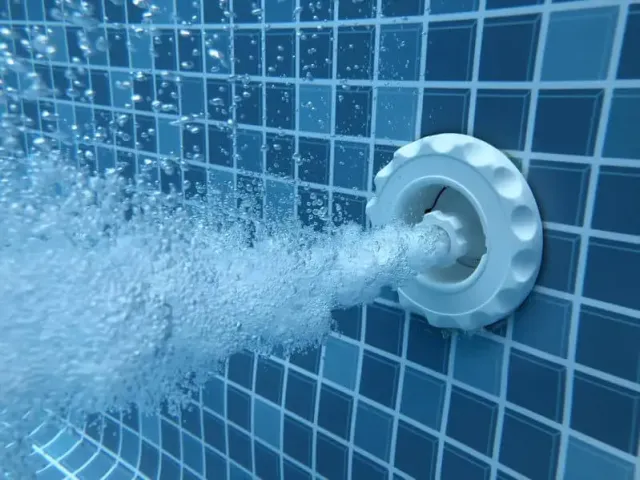
Low water pressure in a pool is caused by a blockage, air leak, or flow restriction somewhere on the suction side of the pump system. The most common culprits are a clogged skimmer basket, a dirty filter, a blocked pump impeller, or a low water level that allows air into the pump. In most cases, fixing low pressure is a matter of clearing the blockage and restoring proper water flow. This guide walks through every cause, how to diagnose it, and exactly what to do to get pressure back to normal.
How to Fix Low Water Pressure in a Pool
To fix low water pressure in a pool, work through the system from the water’s entry point to the pump, checking each component in order. Start with the easiest and most common causes first: water level, skimmer basket, pump strainer basket, and filter cleanliness. If those are all clear, move to the impeller, the pump lid O-ring, suction side fittings, and finally the plumbing lines. According to INYOPools, blockages on the suction side of the system are always the source of low pressure because restrictions after the pump create high pressure, not low pressure.
The key distinction to understand is this: low pressure on the filter gauge means water is not reaching the pump fast enough. High pressure on the filter gauge means water is struggling to get through the filter. They are opposite problems with different causes. Everything in this article addresses the low-pressure scenario specifically.
Pool owners across Jefferson, Braselton, Gainesville, and the rest of North Georgia deal with low pressure most often at the start of swim season, after heavy debris falls into the pool, or when equipment begins to age. Most cases are resolved without professional help. Some require a trained technician. Knowing which situation you are in is half the battle.
What Causes a Pool Pump to Lose Pressure?
A pool pump loses pressure when there is a restriction in water flow before it reaches the pump, when air enters the suction side of the system, or when the pump itself is worn out or failing. There are seven primary causes, and each one has a specific fix.
According to Pool Research, a normal pressure reading on a pool filter gauge is between 10 and 25 PSI, though the exact baseline varies by pump size and filter type. The right approach is to record the normal reading when the filter is clean and freshly installed, then treat any reading 5 PSI or more below that number as low pressure that needs attention.
Is 5 PSI Too Low for a Pool Pump?
Yes, 5 PSI is too low for a pool pump in most cases. According to Pool Research, any pressure reading 5 PSI or more below the established baseline for your specific system indicates that water is not flowing to the pump efficiently. This points to a blockage, a suction leak, or a water level problem somewhere before the pump. A reading of 5 PSI or lower is a sign to start troubleshooting immediately. Running a pump at very low pressure for an extended period stresses the motor, reduces filtration effectiveness, and can lead to equipment damage that is far more expensive to fix than the original blockage.
Is 30 PSI Too Low for Water Pressure in a Pool?
Whether 30 PSI is too low for a pool depends entirely on the baseline reading for that specific system. For most standard residential pools, 30 PSI is actually at or above the normal operating range. According to Pool Research, normal readings typically fall between 10 and 25 PSI when the filter is clean. If your system normally reads 35 to 40 PSI and has dropped to 30, then yes, that drop signals a flow restriction worth investigating. Context and your personal baseline are what matter, not a universal target number.
What Causes Low Water Pressure in a Pool? The 7 Most Common Causes
1. Low Pool Water Level
Low pool water level is the first and simplest cause of low pressure to check. When the water drops below the halfway point on the skimmer opening, the skimmer begins to draw in air along with water. Air in the system causes the pump to lose its prime, which drops pressure immediately and can cause the pump to run dry. According to Angi, a pool naturally loses about a quarter inch of water per day to evaporation in warm weather, which adds up to roughly 1.5 to 3 inches per week. In hot Georgia summers, pools in Jefferson and Gainesville can lose water faster than expected, especially without a pool cover.
The fix is simple. Add water to the pool until the level sits at the midpoint of the skimmer opening. Then check the pressure gauge. If the reading recovers, water level was the cause.
2. Clogged Skimmer Basket
A clogged skimmer basket causes low pressure by blocking the pipe that feeds water from the pool to the pump. When the basket fills with leaves, debris, or insects, it effectively shuts off the flow to the pump. The pump receives less water, does less work, and produces lower pressure at the return lines and jets. According to INYOPools, this is one of the most common and most overlooked causes of low pressure because many pool owners check the filter before checking the basket.
Turn off the pump first. Remove the skimmer basket, clean out all debris, rinse the basket, and reinstall it. Make sure no debris falls into the suction pipe beneath the basket when you pull it out. Restart the pump and check the gauge.
3. Dirty or Clogged Pool Filter
A dirty pool filter reduces water flow and drops the pressure reading on the gauge. As debris accumulates in a cartridge, sand, or diatomaceous earth filter, it restricts the passage of water. The pump works harder but moves less water, which shows up as a lower-than-normal pressure reading on the gauge alongside visibly weaker return jets.
For a cartridge filter, remove the cartridge and rinse it thoroughly with a garden hose, directing the water against the grain of the pleats to flush debris out. According to Pool Research, cartridge filters last 3 to 5 years, but they need cleaning every 6 months or more frequently if the pool sees heavy use. For sand filters, backwash as needed and replace the sand every 5 to 7 years, according to INYOPools. For DE filters, backwash the grids and add fresh diatomaceous earth to restore filtration capacity.
Consistent pool cleaning services through the season keep the filter from reaching the point where it causes a pressure drop in the first place.
4. Clogged Pump Impeller
A clogged pump impeller is one of the most commonly overlooked causes of low pool pressure. The impeller is a spinning disc inside the pump that pulls water in and pushes it through the system. When debris bypasses the pump basket and collects on the impeller, the spinning slows down. Less water moves through the pump, and pressure drops at the return lines. According to ABC Home and Commercial, the impeller clog issue is frequently missed because it requires opening the pump housing to diagnose, which most pool owners do not do regularly.
To clear a clogged impeller, turn off the pump and cut power at the breaker. Remove the pump basket and use a stiff wire to reach into the impeller port and pull out any debris lodged inside. Restart the pump and check whether pressure has recovered. If the impeller is damaged or heavily worn, a replacement part may be needed. A pool pump’s impeller is part of a pump assembly that typically lasts 8 to 12 years with regular maintenance, according to Prestige Pools.
5. Air Leak on the Suction Side
An air leak on the suction side of the pump is a more serious cause of low pressure. When air enters through a cracked pump lid, a worn O-ring, a loose fitting, or a damaged pipe on the intake side, it disrupts the pump’s ability to prime properly. Air and water compete for space inside the system, which reduces water flow and drops pressure. Bubbles coming out of the return jets are a strong sign that air is entering the suction side.
To find a suction-side air leak, run the pump and apply soapy water around the pump lid, suction fittings, valves, and intake port. According to Angi, bubbles will be visibly drawn into any spot where a leak exists. The most common fix is replacing the pump lid O-ring, which is an inexpensive and straightforward repair. A cracked fitting requires cutting out the damaged section and replacing it with new PVC pipe, primer, and glue. After any repair, wait 30 minutes for the glue to cure fully before restarting the pump.
6. Clogged Plumbing Lines
Clogged plumbing lines between the skimmer, main drain, and pump reduce water flow and create low pressure. This is less common than a basket or impeller clog but does happen in pools that have not been professionally serviced in years, particularly in yards with heavy leaf fall or fine debris. According to INYOPools, pushing a stiff wire into the skimmer or suction ports can check for a clog near the entrance. A blockage deeper in the pipe requires a professional with the equipment to clear or inspect underground plumbing. Homeowners in Braselton, Winder, and Commerce who have older pools with trees near the equipment pad are more likely to encounter this issue.
7. Worn or Undersized Pump
A worn pump that has reached the end of its usable life simply cannot generate adequate pressure anymore. According to Wave Tech Pools and Spa, a well-maintained pool pump lasts 8 to 12 years. Single-speed pumps typically last 7 to 10 years. Variable-speed pumps last 10 to 15 years. When a pump is beyond its useful life, motor components wear out and the impeller degrades to the point where no cleaning will restore normal flow.
Signs of a failing pump include unusual grinding or screeching sounds, the pump turning off on its own due to overheating, visible warping of the plastic pump housing, or persistent low pressure even after all other causes have been eliminated. At this stage, pump replacement is the right call. Upgrading to a variable-speed pump reduces energy consumption, extends the life of the new unit, and integrates cleanly with modern pool automation systems.
If the pump appears functional but pressure is still low, a faulty pressure gauge may be the culprit. A gauge that has stopped reading correctly can make the system appear to have a pressure problem when everything is actually working fine. Replacing a pressure gauge is inexpensive and quick, so it is worth testing before diagnosing more serious issues.
Why Is My Pool Pump Barely Pumping Water?
A pool pump that is barely pumping water has a severe blockage or has lost its prime entirely. Lost prime means the pump has air in the system instead of water, and it is spinning without moving fluid effectively. This can happen after the pump is turned off and restarted, after a water level drop that allowed air into the skimmer, or after an air leak develops. According to Ever-Care Pool and Spa, the process to reprime a pump involves ensuring the water level is correct, cleaning all baskets, closing the air relief valve on the filter, and filling the pump housing with water through the strainer lid before restarting. If the pump primes and pressure holds, the fix was successful. If pressure drops again within minutes, an air leak is continuously pulling air back into the system and needs to be found and sealed.
Why Is My Pool Filter Running but Has No Pressure?
A pool filter running with no pressure reading means the pressure gauge itself has failed or water is not reaching the filter at all. If the gauge needle does not move when the pump runs, the gauge port may be clogged with debris or the gauge diaphragm may have failed. Replacing the pressure gauge is a five-minute fix. If the gauge is confirmed working and still reads zero, the pump has completely lost prime or a valve on the suction side is fully closed. Check that all diverter valves are fully open, confirming water has a clear path from the pool to the pump. According to Ever-Care Pool and Spa, verifying that all valves are in their proper open position is one of the first steps in diagnosing a completely pressureless system.
How to Tell When a Pool Pump Is Going Bad
A pool pump is going bad when it produces unusual noises, loses pressure frequently, overheats and shuts off repeatedly, shows visible wear or warping on the housing, or takes noticeably longer than 8 to 10 hours to cycle all the water through the filter. According to Noisy Pool, pool owners should run the pump long enough to filter all pool water within an 8-hour window as a standard performance benchmark. If filtration takes longer, the pump is moving less water than it should.
Grinding and screeching sounds indicate that internal bearings or the motor are wearing out. A pump that runs, shuts off, cools down, and restarts on its own is overheating, often because of poor ventilation, debris around the motor housing, or a dying motor. Catching these signs early allows for a planned pump replacement rather than an emergency one mid-swim season. A scheduled pool inspection each spring is the most reliable way to catch a pump that is nearing the end of its life before it fails entirely.
How to Tell If a Pool Pump Impeller Is Clogged
A pool pump impeller is clogged when the pump is running, the motor sounds normal, but the return jets are significantly weaker than usual and the pressure gauge reads below baseline. The key indicator is that the motor sounds fine but water flow is poor. This differentiates an impeller clog from a motor failure, where the motor sounds abnormal or does not run at all. According to INYOPools, a clogged impeller is often overlooked because pool owners check the filter and baskets first, see that they are clean, and assume the problem must be something more serious.
To confirm an impeller clog, cut power at the breaker, open the pump housing, remove the strainer basket, and look into the impeller port with a flashlight. Debris packed into the impeller vanes will be visible. Use a stiff wire or small hook to pull the material out carefully. This fix takes less than 10 minutes and restores full pressure in most cases.
How Much Water Should a Pool Lose in a Week?
A pool should lose no more than 1.5 to 3 inches of water per week under normal conditions through evaporation. According to Pool Guard USA’s pool water evaporation data, daily evaporation in humid climates like North Georgia typically ranges from one-eighth to one-quarter inch per day, which translates to roughly 1 to 1.5 inches per week. If a pool is losing more than 3 inches per week, especially during cooler periods or when it is not in heavy use, a plumbing leak is likely and should be investigated with a bucket test.
The bucket test works like this: fill a 5-gallon bucket with pool water, place it on the pool step, and mark the water level inside the bucket and at the pool edge. Wait 24 hours without swimming. If both levels dropped by the same amount, the loss is from evaporation. If the pool dropped more than the bucket, a leak is present. A pool losing water only while the pump runs points to a pressure-side plumbing leak. A pool losing water whether the pump is on or off points to a structural leak in the shell or fittings.
How to Bleed Air Out of a Pool Pump
To bleed air out of a pool pump, locate the air relief valve on the top of the filter tank. With the pump running, slowly open the valve by turning it counterclockwise until you hear air escaping. Hold it open until water begins to spray from the valve instead of air. Then close the valve by turning it clockwise. This process releases the trapped air in the filter tank and returns the system to proper water-filled operation.
If the system keeps accumulating air between bleeds, the cause is an ongoing suction-side air leak that needs to be located and sealed. Air does not enter a properly sealed system during normal operation. Recurring air buildup is always a symptom, not a standalone problem.
Will Shocking a Pool Raise the pH?
Yes, shocking a pool can raise the pH, depending on the type of shock used. Cal-hypo (calcium hypochlorite) shock, which is one of the most common types, raises pH when added to the pool. According to pool chemistry guidelines, the pH of a pool should be tested and adjusted after shocking because both the chlorine level and pH shift during the process. Sodium hypochlorite (liquid chlorine) also raises pH slightly. Dichlor shock, by contrast, lowers pH because it is acidic. After shocking with any product, wait for the chlorine to drop back into the normal 1 to 4 ppm range and then test and adjust pH before allowing swimmers back into the water.
Low Pool Water Pressure: Causes and Fixes at a Glance
| Cause | Symptom | Fix | Difficulty |
|---|---|---|---|
| Low water level | Pump gulping air, bubbles from returns | Add water to midpoint of skimmer | Easy (DIY) |
| Clogged skimmer basket | Slow return jets, low gauge reading | Remove and clean basket | Easy (DIY) |
| Dirty filter | Low gauge, cloudy water, weak jets | Clean or backwash filter | Easy (DIY) |
| Clogged impeller | Motor running, very weak water flow | Clear debris from impeller port | Moderate (DIY) |
| Suction-side air leak | Bubbles in water, pump loses prime | Replace O-ring or repair fitting | Moderate (DIY/Pro) |
| Clogged plumbing lines | Very low flow even with clean baskets | Professional pipe clearing | Professional |
| Worn or undersized pump | Persistent low pressure, noise, overheating | Replace pump | Professional |
| Faulty pressure gauge | Gauge reads zero or erratically | Replace gauge | Easy (DIY) |
Sources: INYOPools, ABC Home and Commercial, Pool Research, Swim University, Wave Tech Pools and Spa, Prestige Pools, Ever-Care Pool and Spa, Angi.
Frequently Asked Questions
How to increase PSI on a pool pump in Jefferson, GA?
To increase PSI on a pool pump in Jefferson, start by checking the water level, cleaning the skimmer basket and pump strainer basket, and cleaning the filter. These three steps resolve most low-pressure issues for homeowners across Jackson County. If pressure stays low after those steps, check the impeller for debris and inspect the pump lid O-ring for wear. The warm North Georgia climate and heavy tree coverage in neighborhoods around Jefferson and Braselton mean baskets and filters clog faster during peak summer, so checking them more frequently in July and August is a good habit.
Why is my pool pump losing pressure after a few hours?
A pool pump that loses pressure after a few hours has an ongoing issue rather than a one-time blockage. The most common causes are a slow suction-side air leak that lets air build up over time, a filter that loads up with debris quickly because it needs cleaning or replacement, or a water level that keeps dropping below the skimmer. If the pump loses pressure consistently a few hours after being cleaned or primed, trace the suction side for air leaks using soapy water while the pump is running. Bubbles drawn toward any fitting confirm the leak location. For pools in Hoschton and Commerce that sit under large trees, the filter may simply be loading with debris faster than normal and need cleaning more often during peak debris seasons.
Should a pool pump basket be full of water?
Yes, a pool pump basket should be full of water when the pump is running. A basket that is full of water indicates the pump is properly primed and water is flowing freely through the system. If the basket looks mostly empty or has only a small amount of water even while the pump runs, the pump has lost its prime. This usually means air is entering the suction side, the water level is too low, or a basket or pipe is so severely clogged that water cannot reach the pump at sufficient volume. Checking the pump basket window is a quick visual confirmation that the system is running correctly.
How to increase water flow in a pool pump?
To increase water flow in a pool pump, clean the skimmer basket, clean the pump strainer basket, and clean or backwash the filter. These three steps remove the most common restrictions on water flow. If flow is still weak after all baskets and the filter are clean, check the impeller for debris and inspect the suction-side fittings for air leaks. If the pump is 10 or more years old and weak flow persists despite maintenance, the pump motor may be worn out and a replacement will restore full flow. Upgrading to a variable-speed pump is the best long-term option for homeowners in Gainesville, Winder, and Lawrenceville because it maintains optimal flow while using significantly less energy.
What causes pool water level to drop rapidly?
A rapidly dropping pool water level is caused by either excessive evaporation or a plumbing or structural leak. In warm Georgia summers, pools can lose one-quarter to one-half inch of water per day to evaporation alone, according to Pool Guard USA’s evaporation data. More than that consistently points to a leak. Use the bucket test to determine which is the cause: if the pool drops faster than a bucket of water placed on the steps, a leak is present. Water loss that occurs only while the pump is running points to a pressure-side plumbing leak, while constant water loss whether the pump is on or off suggests a crack in the pool shell or a fitting leak.
Can a dirty pool filter cause low pressure?
Yes, a dirty pool filter can cause low pressure. When the filter media becomes loaded with debris, water struggles to pass through it freely. The reduced flow rate shows up as a lower-than-normal reading on the pressure gauge, alongside weaker return jets and slower automatic pool cleaners. For cartridge filters, remove and rinse the cartridge when the pressure reading drops 5 PSI or more below the clean baseline. For sand filters, backwash when the reading climbs 8 to 10 PSI above normal. According to Pool Research, cartridge filters typically need replacement every 3 to 5 years when cleaning alone is no longer enough to restore proper flow.
When should a pool owner in North Georgia call a professional for low pressure?
A pool owner in North Georgia should call a professional for low pressure when the easy fixes, such as cleaning baskets, cleaning the filter, and adding water, have all been tried without improvement. Suspected underground plumbing leaks, a pump that shows signs of motor failure, an impeller that cannot be cleared by hand, or recurring air leaks that keep coming back are all situations where professional diagnosis and repair are the right call. Homeowners across Jefferson, Braselton, and the surrounding Jackson County area can schedule a pool repair visit to have a trained technician diagnose and fix the root cause efficiently.
Final Thoughts
Low water pressure in a pool is almost always fixable, and the cause is almost always on the suction side of the system. Start with the simplest checks first: water level, skimmer basket, pump basket, and filter cleanliness. These four steps resolve the majority of low-pressure complaints. If those are all clear, move to the impeller, suction-side fittings, and plumbing. A faulty pressure gauge can also mimic a pressure problem when the system is actually fine, so confirming the gauge works before diving into major repairs saves time. Persistent pressure problems that do not respond to these steps, or a pump that is more than 10 years old and showing wear, are signals to bring in a professional.
Keeping your pool running at full pressure through the swim season means cleaner water, more efficient filtration, and a longer life for your pump and filter equipment. If you need hands-on help diagnosing or repairing a low-pressure issue in Jefferson, Braselton, Gainesville, or anywhere else in North Georgia, reach out to Sandals Luxury Pools. Our team is experienced with all types of pool systems and will get your pressure back where it belongs. If you are thinking about building a new inground pool designed with a properly sized, high-efficiency circulation system from day one, explore our custom inground pool options and let us build something that performs season after season.
