
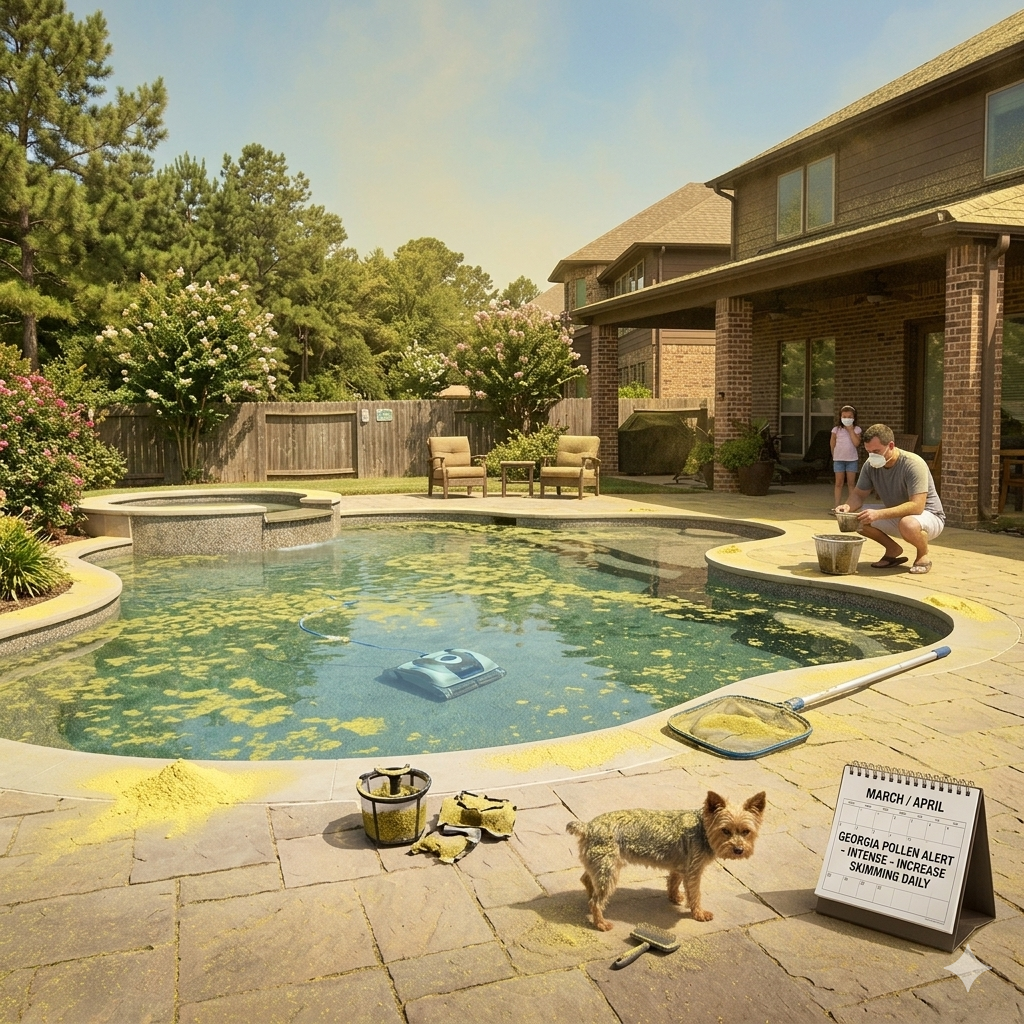
Georgia Pollen Season Creates Unique Pool Maintenance Challenges for Jefferson and Jackson County Homeowners
Every spring in Jefferson, Braselton, and Hoschton along GA-53 and I-85, pool owners in the 30549, 30517, and 30548 zip codes face the same frustrating problem. Yellow pollen blankets pool surfaces, clogs skimmer baskets, and overwhelms filtration systems from March through May. According to the Pool and Hot Tub Alliance, approximately 8% of US households own a swimming pool, and Georgia’s extended pollen season forces these homeowners to double their maintenance frequency during peak bloom months. Pool owners near Jefferson High School, Chateau Elan in Braselton, and Mill Creek High in Hoschton discover that standard weekly pool service schedules fall short when pine, oak, and sweetgum trees dump millions of grains into pool water throughout Jackson County.
The problem hits hardest in neighborhoods along Winder Highway between Jefferson and Commerce, where mature oak trees line established subdivisions like Traditions of Braselton and Sterling on the Lake near Flowery Branch in Hall County. Pollen accumulates faster on fiberglass pool surfaces and vinyl liner pools than on gunite pools with pebble finishes, but every pool type struggles during Georgia’s notoriously heavy pollen drops. Sandals Luxury Pools has tracked pollen-related service calls across Jefferson, Pendergrass, Nicholson, and surrounding areas in the 30567 and 30565 zip codes, finding that skimmer basket cleaning frequency jumps from once weekly to every other day during peak pollen season between mid-March and early May.
How Georgia’s Extended Pollen Season Disrupts Normal Pool Chemical Balance in Jackson County
Pine and Oak Pollen Overwhelm Standard Filtration Systems
Pool filtration systems in Jefferson, Hoschton, and Braselton face unique challenges when Georgia’s pine trees begin releasing pollen in early March, followed by oak trees through April and May. Cartridge filters and DE filters clog within days instead of lasting their typical two-week cycle, while sand filters require backwashing every three to four days rather than weekly. According to Arizton, the US pool maintenance and cleaning services market was valued at $8.08 billion in 2023, with seasonal pollen management representing a significant portion of spring service calls. Pool owners near Crawford W. Long Museum in Jefferson and along Mark Dodd Road discover that standard pool pump runtime schedules of 8 to 10 hours daily aren’t sufficient when pollen counts spike above 1,000 grains per cubic meter, which happens regularly in Jackson County from mid-March through early May.
Variable-speed pool pumps and dual-speed pump systems help, but even these efficient units struggle when pollen coats pool surfaces faster than skimmers can remove it. Properties in Riverstone Park near Braselton, Creekside Village in Hoschton, and neighborhoods off US-129 between Jefferson and Commerce report that robotic pool cleaners and automatic pool cleaners work overtime during pollen season but still can’t keep pace with daily accumulation. Pool owners learn quickly that is there so much pollen in my pool in spring becomes a daily concern rather than an occasional nuisance, particularly in wooded lots near Hurricane Shoals Park in Maysville and Fort Yargo State Park near Winder in Barrow County.
Chlorine Demand Increases During Heavy Pollen Drops
Pollen acts as organic debris that consumes free chlorine, forcing pool owners throughout Jefferson, Jackson County, and nearby areas in Gwinnett and Hall Counties to adjust their chemical treatment schedules. Pool chemical feeders and automatic chlorinators designed for standard organic loads can’t compensate for the sudden chlorine demand created when oak and pine pollen decomposes in pool water. According to Thumbtack, chlorine pool chemical costs run $300 to $800 per year, but Georgia pool owners often exceed these estimates during extended pollen seasons that stretch from March through May. Salt chlorinator systems and salt cell generators help maintain consistent chlorine production, but even saltwater pools near Lake Lanier in Hall County and around Chateau Elan Winery require shock treatments when pollen accumulation overwhelms normal sanitizer levels.
Pool owners along GA-347 between Braselton and Buford, near Interstate 985 toward Gainesville, and throughout the Flowery Branch and Oakwood areas in the 30542 and 30566 zip codes find that calcium hypochlorite shock and dichlor shock treatments become weekly necessities instead of monthly maintenance tasks. Water testing reveals that combined chlorine levels spike when pollen breaks down, creating chloramine formation that causes eye irritation and that distinctive “pool smell” that indicates poor water chemistry. Professional pool maintenance services in Jefferson and surrounding Jackson County communities typically double shock treatment frequency during peak pollen months, adding $150 to $300 to seasonal chemical costs for most residential pool owners.
Adjusting Pool Cleaning Frequency During Peak Pollen Season in Jefferson Area
Daily Skimming Becomes Essential from March Through May
Pool owners in Jefferson, Braselton, Hoschton, and Pendergrass quickly discover that weekly pool service isn’t sufficient during Georgia’s heavy pollen season. Daily skimming with pool nets and leaf rakes becomes necessary to prevent pollen from settling to pool bottoms and staining plaster finishes or vinyl liner surfaces. Properties near Jefferson City Lake, along Athens Highway toward Commerce, and in subdivisions off GA-53 like Trilogy Park and Reunion in Hoschton see pollen accumulation that can cover entire pool surfaces within 24 hours during peak bloom periods. According to Business Research Insights, robotic pool cleaners account for 51% of the global pool cleaners market, but even these automated units require daily emptying of debris bags and filter cartridges during Georgia’s worst pollen drops.
Pool skimmer baskets throughout Jackson County neighborhoods require cleaning every other day instead of weekly, while main drain covers and return jet fittings collect yellow-green pollen debris that restricts water circulation. Homeowners near Mill Creek High in Hoschton, Jefferson High School, and East Jackson Comprehensive High discover that pool brush attachments and tile brushes help dislodge pollen that sticks to waterline tiles and pool coping materials. The combination of Georgia’s humid subtropical climate and extended pollen season means that pool surfaces stay damp longer, allowing pollen to adhere more stubbornly than in drier climates, particularly on textured pool finishes like pebble surfaces and exposed aggregate materials.
Filter Maintenance Requirements Double During Heavy Pollen Months
Cartridge filter systems serving pools in Jefferson, along Winder Highway, and throughout the 30549 and 30680 zip codes require cleaning or replacement every week during peak pollen season instead of the standard two-week cycle. Sand filter systems need backwashing every three days when pollen counts exceed normal levels, while DE filter grids require teardown and cleaning weekly rather than monthly. According to HomeAdvisor, pool filter cartridge replacement costs $75 to $200, and Georgia pool owners often go through twice as many cartridges during March through May compared to summer months. Pool equipment pads near homes along US-129, GA-11, and Interstate 85 between Jefferson and Braselton house filter systems that work overtime when oak, pine, sweetgum, and maple trees release their seasonal pollen loads.
Pool pump motors and impeller assemblies face additional strain when filter systems restrict water flow due to pollen accumulation, leading to higher electricity costs and potential equipment failure during peak season. According to HomeGuide, annual pool electricity costs run $800 to $1,200, but these estimates increase by 20% to 30% when pumps run longer cycles to compensate for reduced filtration efficiency during pollen season. Pool owners in Traditions of Braselton, Sterling on the Lake near Flowery Branch, and neighborhoods around Gainesville in Hall County learn that preventive filter maintenance prevents costly pump motor burnout and impeller damage that occurs when systems work too hard to circulate water through clogged filtration media.
Cost Impact of Pollen Season on Pool Maintenance Budgets in Jackson County
Chemical Costs Increase 40% to 60% During Peak Pollen Months
Pool owners throughout Jefferson, Braselton, Hoschton, and surrounding Jackson County communities see significant spikes in chemical expenses when Georgia’s pollen season peaks between mid-March and early May. Standard chlorine consumption doubles when organic pollen debris overwhelms sanitizer levels, while shock treatments become weekly necessities instead of monthly maintenance tasks. According to Jobera, pool owners spend an average of $87.50 per month on pool chemicals, but this figure jumps to $125 to $140 during heavy pollen months for pools near Jefferson Downtown Square, Chateau Elan, and wooded neighborhoods along GA-53 and US-129. Algaecide treatments become more frequent as pollen provides nutrients that feed algae growth, particularly in shaded pools around Hurricane Shoals Park in Maysville and Fort Yargo State Park areas.
Pool clarifier and pool flocculant usage increases dramatically as fine pollen particles create perpetually cloudy water that standard filtration can’t clear. Salt chlorinator systems help reduce chemical costs somewhat, but even saltwater pools in the 30517, 30548, and 30549 zip codes require additional shock treatments when pollen loads exceed normal organic debris levels. Phosphate remover products become essential during pollen season, as decomposing organic matter introduces phosphates that fuel algae blooms and resist standard chlorine treatments. Pool owners near Lake Lanier, along GA-347 toward Buford, and in Hall County areas like Flowery Branch and Oakwood budget an extra $60 to $100 monthly for pollen-related chemical increases during Georgia’s extended spring bloom period.
Labor and Service Call Frequency Doubles for Professional Pool Maintenance
According to Angi, the average pool cleaning visit costs $235, but Georgia pool owners often require twice-weekly service during peak pollen season instead of standard weekly maintenance schedules. Pool service companies serving Jefferson, Jackson County, and surrounding areas in Barrow, Hall, and Gwinnett Counties adjust their pricing and scheduling to accommodate the increased labor demands of pollen season. Properties along Winder Highway, near Jefferson City Lake, and in neighborhoods off Interstate 85 between Jefferson and Commerce typically add $80 to $120 monthly to their pool service costs during March, April, and May to cover additional skimming, filter cleaning, and chemical balancing requirements.
Professional pool technicians spend 60% to 80% more time per visit during heavy pollen periods, as skimmer baskets require multiple cleanings, filter systems need frequent backwashing or cartridge replacement, and water chemistry demands constant adjustment. According to Angi, pool cleaning labor rates run $75 to $150 per hour, making the increased service time a significant cost factor for pool owners in Braselton, Hoschton, Pendergrass, and Nicholson who maintain their pools professionally. Many pool service companies offer pollen season packages that include daily skimming and twice-weekly chemical balancing for properties near Mill Creek High, Jefferson High School, and heavily wooded areas throughout Jackson County where pollen accumulation reaches its worst levels.
Equipment and Filter Modifications That Help Georgia Pool Owners During Pollen Season
Upgrading to Variable-Speed Pumps Improves Pollen Management
Variable-speed pool pumps provide significant advantages during Georgia’s extended pollen season, allowing pool owners in Jefferson, Braselton, and Hoschton to run longer filtration cycles at lower speeds without dramatically increasing electricity costs. Single-speed pumps typically run 8 to 10 hours daily, but pollen season requires 12 to 16 hours of circulation to keep pool water clear and properly filtered. According to HomeAdvisor, pool pump electricity costs average $300 per year, but variable-speed units can extend runtime by 50% while using only 20% to 30% more electricity than standard single-speed systems. Pool owners near Chateau Elan, along GA-53, and in neighborhoods around Jefferson City Lake find that variable-speed pumps can run continuous low-speed circulation during peak pollen drops while switching to high-speed modes for equipment cleaning and backwashing cycles.
Dual-speed pump systems offer a middle-ground solution for pools throughout Jackson County, providing high-speed operation for daily cleaning cycles and low-speed runtime for continuous circulation during heavy pollen periods. Properties in Sterling on the Lake near Flowery Branch, Traditions of Braselton, and subdivisions off US-129 and Athens Highway benefit from extended circulation that prevents pollen from settling on pool bottoms and staining plaster or vinyl liner surfaces. Pool automation systems and smart pool controllers help optimize pump schedules during pollen season, automatically adjusting runtime based on local pollen forecasts and pool usage patterns common in the 30549, 30517, and 30548 zip code areas.
Adding Secondary Skimmers and Automatic Pool Covers
Pool owners in Jefferson, Hoschton, and surrounding Jackson County areas discover that additional wall skimmers significantly improve pollen removal capacity during peak bloom periods. Standard pools typically have one or two skimmers, but adding a third skimmer or upgrading to larger skimmer throats helps capture more surface debris before it sinks and stains pool surfaces. Automatic pool covers provide the most effective protection against pollen accumulation, though the initial investment ranges from $12,000 to $18,000 for most residential pools in Braselton, Pendergrass, and Nicholson. According to Thursday Pools dealer survey, an automatic pool cover in Georgia costs approximately $16,000, but the long-term savings in chemical costs and reduced maintenance make it cost-effective for pool owners who face heavy pollen exposure near wooded areas around Fort Yargo State Park and Hurricane Shoals Park.
Manual safety covers and solar pool covers offer budget-friendly alternatives for pool owners along GA-347, Interstate 985, and neighborhoods near Lake Lanier who want pollen protection without the expense of automatic systems. Pool owners near Jefferson High School, Mill Creek High in Hoschton, and East Jackson Comprehensive High learn that covering pools overnight and during windy days when pollen dispersal peaks can reduce daily accumulation by 70% to 80%. Mesh safety covers allow rainwater drainage while blocking most pollen, though they require more labor to install and remove compared to solid covers that provide complete protection during non-use periods throughout Georgia’s extended pollen season.
Regional Pollen Patterns That Affect Pool Maintenance Timing in North Georgia
Pine Pollen Arrives First in March Throughout Jackson and Surrounding Counties
Pine trees throughout Jefferson, Braselton, Hoschton, and surrounding areas in Jackson, Hall, and Gwinnett Counties begin releasing pollen in early March when daytime temperatures consistently reach 65°F to 70°F. Pine pollen creates the characteristic yellow dust that coats pool surfaces, outdoor furniture, and vehicles throughout the I-85 corridor from Jefferson through Commerce and down to Buford and Suwanee. Pool owners near Jefferson Downtown Square, along Winder Highway, and in neighborhoods off GA-53 and US-129 typically see the first significant pollen accumulation between March 10 and March 20, depending on winter weather patterns and spring temperature trends. According to Business Research Insights, 68% of residential and commercial pool purchases are driven by demand for efficient cleaning solutions, and Georgia’s early pine pollen season tests every pool cleaning system to its limits.
Pine pollen grains are larger and heavier than other tree pollens, causing them to settle quickly on pool bottoms and cling to waterline tiles, pool coping, and skimmer throats. Properties near Lake Lanier, throughout the 30518 and 30519 zip codes around Buford, and along GA-400 toward Cumming and Dawsonville see dense pine pollen accumulation that requires daily skimming and increased filter maintenance. Pool owners in Flowery Branch, Oakwood, and Gainesville areas of Hall County adjust their how often should you clean your swimming pool schedules when pine pollen begins coating surfaces faster than standard weekly maintenance can remove it, typically requiring daily attention from mid-March through early April.
Oak Pollen Peak Creates Worst Pool Maintenance Period from April Through May
Oak trees dominate the landscape throughout Jefferson, Jackson County, and surrounding areas, making April and May the most challenging months for pool maintenance when these mature trees release massive pollen loads. Oak pollen is finer than pine pollen and stays suspended in pool water longer, creating persistent cloudiness that overwhelms standard filtration systems and requires frequent shock treatments to break down organic debris. Pool owners near Chateau Elan Winery, Hurricane Shoals Park in Maysville, and wooded neighborhoods along Athens Highway toward Commerce face the worst oak pollen accumulation in North Georgia, often seeing pool surfaces covered within hours of cleaning during peak bloom periods.
Wind patterns carry oak pollen from heavily forested areas around Fort Yargo State Park, Lake Lanier, and the North Oconee River basin, depositing concentrated pollen loads on pools throughout Braselton, Hoschton, Pendergrass, and Nicholson. According to Pool and Spa News, 63% of pool owners underestimate the long-term costs of pool ownership, and Georgia’s intense oak pollen season adds unexpected maintenance expenses that catch many homeowners unprepared. Pool owners in the 30567, 30565, and 30529 zip codes learn that oak pollen season demands twice-weekly professional service or daily owner maintenance to prevent staining and chemical imbalances that develop when organic debris overwhelms sanitizer systems and creates conditions favorable for get rid of green algae in your pool fast treatments.
Professional Pool Service Adjustments During Georgia Pollen Season
Service Companies Modify Routes and Pricing for Pollen Season
Pool service companies throughout Jefferson, Jackson County, and surrounding areas in Barrow, Hall, and Gwinnett Counties restructure their operations during Georgia’s March through May pollen season to accommodate increased maintenance demands. Standard weekly service routes become twice-weekly schedules for heavily wooded properties near Hurricane Shoals Park, Fort Yargo State Park, and neighborhoods along GA-53, US-129, and Winder Highway where oak and pine trees create the worst pollen accumulation. According to Angi, pool cleaning costs range from $55 to $776 per visit, with Georgia companies charging premium rates during peak pollen periods when technicians spend 70% to 90% more time per stop cleaning skimmer baskets, backwashing filters, and rebalancing water chemistry.
Professional pool technicians serving Braselton, Hoschton, Pendergrass, and Nicholson carry extra shock chemicals, algaecide treatments, and replacement filter cartridges during pollen season to handle the increased demand for chemical treatments and equipment maintenance. Pool service trucks stock additional skimmer baskets, pool nets, and cleaning equipment because standard weekly supplies aren’t sufficient when pollen accumulation requires multiple cleanings per visit. Companies serving properties near Chateau Elan, Sterling on the Lake, and Traditions of Braselton often implement pollen season surcharges of $25 to $40 per visit to cover the additional labor and chemical costs associated with maintaining pools during Georgia’s heaviest bloom periods from mid-March through early May.
Specialized Equipment and Techniques for Heavy Pollen Management
Pool service professionals working in Jefferson, the 30549 zip code, and surrounding Jackson County areas use specialized equipment during pollen season that isn’t necessary during normal maintenance periods. Commercial-grade pool vacuums with fine mesh bags capture pollen debris that settles on pool bottoms, while high-capacity skimmer nets remove surface accumulation more efficiently than standard equipment. Professional-grade flocculant treatments and clarifier chemicals designed for heavy organic loads help clear the persistent cloudiness that develops when fine oak pollen overwhelms standard filtration systems throughout the I-85 corridor from Jefferson through Braselton to Buford.
Pool technicians serving areas near Mill Creek High in Hoschton, Jefferson High School, and wooded neighborhoods along GA-347 and Interstate 985 use compressed air equipment to clear pollen from skimmer throats and return jet fittings that become clogged during heavy accumulation periods. Specialized brushing techniques help remove pollen that adheres to textured pool surfaces like pebble finishes and exposed aggregate materials common in luxury pools around Lake Lanier and Chateau Elan areas. According to the National Pool Foundation, 68% of pool maintenance issues are preventable with consistent care, but Georgia’s intense pollen season requires professional expertise and specialized equipment that goes beyond standard weekly maintenance to prevent long-term staining and equipment damage that occurs when is my pool water cloudy and how do i fix it problems persist throughout the extended pollen season.
Long-Term Pool Health Impacts of Georgia’s Extended Pollen Season
Pool owners throughout Jefferson, Braselton, Hoschton, and surrounding Jackson County communities who neglect proper pollen season maintenance face long-term consequences that extend well beyond the March through May bloom period. Pollen that settles on plaster surfaces and vinyl liners can cause permanent staining, particularly on white plaster finishes and light-colored liner patterns common in pools near Jefferson City Lake, Chateau Elan, and neighborhoods along GA-53 and US-129. According to HomeAdvisor, concrete pool resurfacing costs $10,000 to $20,000, making preventive pollen management a critical investment for pool owners in the 30549, 30517, and 30548 zip codes. Filter systems that become chronically overloaded during pollen season suffer reduced lifespan and efficiency, leading to premature replacement costs that range from $200 to $800 for cartridge systems and $1,500 to $3,000 for complete sand filter renovations.
Pool equipment throughout the I-85 corridor from Jefferson through Commerce faces accelerated wear when pump motors work harder to circulate water through clogged filtration systems during Georgia’s extended pollen season. Salt chlorinator cells and chemical feeders become fouled more quickly when organic debris overwhelms their capacity, requiring more frequent cleaning and earlier replacement than normal maintenance schedules anticipate. Pool owners near Fort Yargo State Park, Hurricane Shoals Park in Maysville, and heavily wooded areas around Lake Lanier who maintain proper how do you balance pool water chemistry properly during pollen season protect their investment and avoid the costly repairs and premature equipment replacement that result from neglecting the unique maintenance demands of Georgia’s notorious spring pollen drops.
