
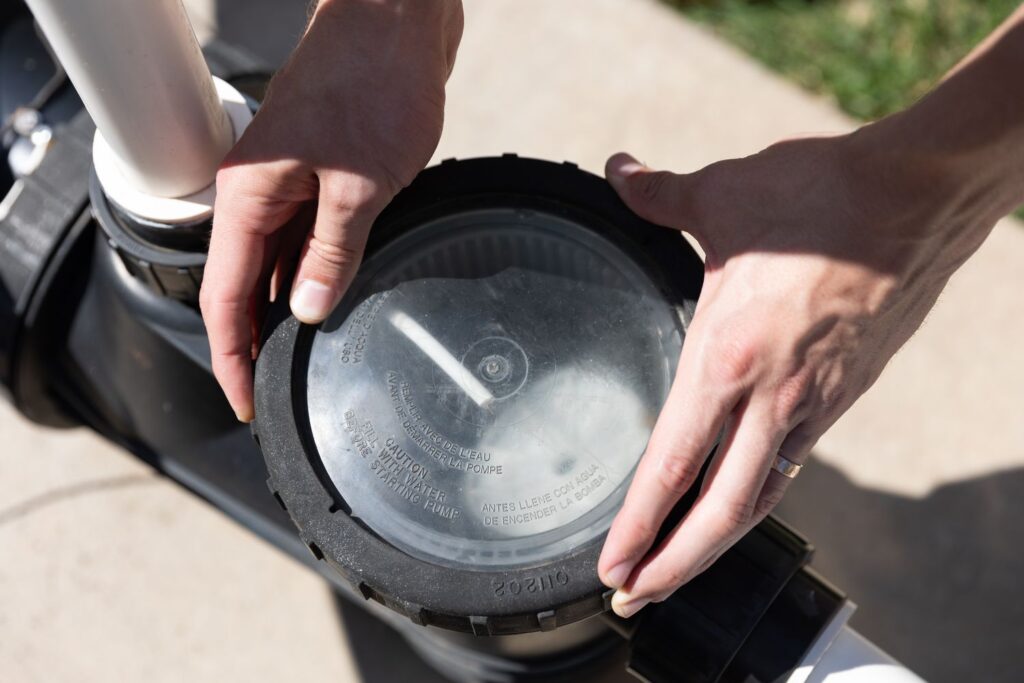
A pool pump that won’t turn on is usually caused by an electrical issue, not a dead pump. The most common reasons are a tripped circuit breaker, a bad capacitor, a jammed impeller, faulty wiring, or an overheated motor. In many cases, you can diagnose and even fix the problem yourself before calling a professional. According to the U.S. Department of Energy, there are more than 8.5 million residential pools in the United States, and the pool pump is the second largest energy consumer in most pool-owning homes, right behind the HVAC system. When that pump stops running, your pool water stops circulating, and bacteria and algae can take hold within 24 to 48 hours. This guide walks through every common cause, how to troubleshoot each one, when to repair versus replace, and what pool owners in Jefferson, Georgia and across North Georgia need to know to get their pump running again fast.
Why Is the Pool Pump Not Turning On?
The pool pump is not turning on because of a problem with the power supply, the capacitor, the motor, or a mechanical jam inside the pump. According to the Association of Aquatic Professionals, the electrical system of a pool pump includes the motor, capacitor, wiring, circuit breaker, and ground fault circuit interrupter (GFCI). A failure in any one of these components can stop the pump from starting.
The first thing to check is the simplest. Make sure the pump switch is in the ON position. If your pump runs on a timer, confirm the timer is set correctly and that the clock is actually running. According to Swim University, checking the timer is one of the most commonly overlooked steps, and it is actually one of the most frequent reasons pool pumps appear to fail. It sounds obvious, but it solves the problem more often than you would expect.
If the timer is fine and the switch is on, the issue is deeper. Pool owners across North Georgia, from Jefferson to Athens and Braselton, deal with summer thunderstorms that trip breakers and power surges that damage capacitors. Getting familiar with these basic components will save you time, money, and frustration. If you are not comfortable working around electrical equipment, a professional pool repair service can diagnose the problem safely.
How to Reset a Pool Pump Breaker?
To reset a pool pump breaker, go to your home’s electrical panel, find the breaker labeled for the pool pump, flip it fully to the OFF position, wait 30 seconds, and then flip it back to ON. If the breaker is in a middle position between ON and OFF, it has tripped. You must push it all the way to OFF before switching it back ON for the reset to work.
According to Leslie’s Pool, you should check the circuit breaker first any time the pump won’t start. A tripped breaker does not always mean there is a serious problem. Power surges during storms, brief electrical overloads, and even a momentary voltage spike can trip the breaker without any damage to the pump itself. In the Jefferson, Georgia area, summer storms are frequent from May through September, and tripped pool pump breakers are one of the most common service calls during that time.
If the breaker trips again immediately after you reset it, do not keep flipping it back on. That is a sign of a short circuit, an overloaded electrical panel, or a failing motor that is drawing too much current. According to the Association of Aquatic Professionals, repeated tripping can indicate moisture near electrical components, loose connections, or damaged wiring. At that point, stop troubleshooting and call a licensed electrician or a pool professional.
How to Tell If a Pool Pump Is Burned Out?
You can tell if a pool pump is burned out if the motor makes no sound at all when power reaches it, if you smell a strong burning or electrical odor near the motor housing, or if you see scorch marks or discolored paint on the motor body. According to In The Swim, pool pump motors run at around 150 degrees Fahrenheit during normal operation, which is too hot to touch. A motor that has overheated beyond its limits may show burned spots, but the clearest sign is complete silence with confirmed power at the motor leads.
A burned-out motor means the internal windings have failed. According to Shasta Pool Supply, pool pump motors typically last about 6 to 10 years before they need attention. Dead spots or hot spots on the motor windings will cause the thermal overload switch to trip repeatedly, and eventually the motor will stop responding entirely. If you have a multimeter and feel comfortable testing, you can check for continuity across the motor leads. No continuity confirms the windings are dead.
Homeowners in Gainesville, Georgia and Oakwood who notice a burning smell should immediately turn off the breaker and do not attempt to restart the pump. A burned motor cannot be fixed with a simple part swap. It requires a full motor replacement or, depending on the age of the pump, a complete pump replacement. Pool owners who invest in routine pool inspections can often catch early warning signs like unusual heat, grinding noises, or sluggish startups before the motor fails completely.
Why Is My Pool Pump Humming but Not Starting?
Your pool pump is humming but not starting because the motor is getting power but cannot spin. The two most common causes are a bad capacitor or a jammed impeller. According to Leslie’s Pool, a humming sound without the pump starting is a classic sign of a failed capacitor, which is the component that gives the motor its initial jolt of electricity to begin spinning.
The capacitor works like a starter battery. It stores energy and releases it in a burst to get the motor up to operating speed, which is typically around 3,450 RPM for a standard single-speed pump. According to KS Capacitor, pool pump capacitors cost as little as $9 and no more than about $25 in most cases. A $20 part replacement can save you from buying a $500 to $2,000 motor. According to All Pool Filters 4 Less, a start capacitor costs less than $20 and can be tested and replaced as a DIY project, compared to a new motor that ranges from $130 to $300 or more.
If the capacitor looks bulged, cracked, or is leaking an oily substance, it is bad and needs to be replaced. Before touching a capacitor, always turn off the power at the breaker. Capacitors store electrical charge even when the power is off and can shock you. Short out the terminals with an insulated screwdriver before handling it.
The other possibility is a jammed impeller. With the pump powered off at the breaker, try spinning the motor shaft by hand. If it does not rotate, debris has likely built up around the impeller. According to Swim University, you can remove the screws on the pump housing, pull out the motor assembly, clear the debris from the impeller, and reassemble. Pool owners in Winder and Hoschton who have trees near their pool equipment should check for leaf and twig buildup in the pump basket and impeller regularly to prevent jams.
How to Tell If a Capacitor Is Bad on a Pool Pump?
You can tell if a capacitor is bad on a pool pump if the pump hums but does not start, if the capacitor is visibly bulged or cracked, if there is a white powdery residue or oily discharge on the capacitor body, or if the motor starts briefly and then shuts off. According to Trouble Free Pool, a common reason pumps do not start is the failure of the start capacitor, and replacing it is one of the cheapest and easiest fixes in pool maintenance.
To test a capacitor properly, you need a multimeter set to the capacitance or lowest ohms setting. According to INYOPools, if you touch the meter leads to the capacitor terminals and the reading stays at zero, the capacitor is bad. A good capacitor will show the needle jump to one end and then slowly return, or the digital reading will start low and rapidly increase. A reading that stays flat means no charge is being stored.
Some pool pumps have two capacitors: a start capacitor and a run capacitor. According to Trouble Free Pool, start capacitors typically range between 108 and 300 MFD, while run capacitors range from 15 to 50 MFD. When replacing, always match the MFD and voltage rating on the old capacitor. You can use a slightly higher MFD rating if an exact match is not available, but never use a lower one.
Families in Dacula and Monroe who hear their pool pump humming each morning should check the capacitor before assuming the worst. A $15 to $25 capacitor swap, done in about 20 minutes, is one of the most cost-effective pool pump repairs you can make.
What Happens If Your Pool Pump Stops Working?
If your pool pump stops working, your pool water stops circulating through the filter, and the water will begin to turn green with algae within 24 to 48 hours in warm weather. According to In The Swim, when the pool pump is not working, nothing in the pool system works, and maintaining water clarity is only possible for a few days without circulation.
Stagnant water is a breeding ground for bacteria, algae, and mosquitoes. The pump is what pushes water through the filter, the heater, and the chlorinator. Without it, chemicals cannot distribute evenly, and dead spots form where algae and pathogens thrive. According to the Centers for Disease Control and Prevention, proper pool circulation and filtration are essential for preventing waterborne illnesses.
For pool owners in Jefferson, Georgia, where summer temperatures regularly climb into the 90s and humidity stays high, a non-functioning pump becomes an urgent problem fast. Even a single day without circulation during peak summer can turn clear water murky. If your pump goes down and you cannot fix it immediately, manually brush the walls and add extra chlorine to buy yourself a day or two while you arrange pool cleaning or repair service.
How Long Can I Go Without Running My Pool Pump?
You can go without running your pool pump for about 24 to 48 hours before water quality starts to decline, depending on the temperature, sunlight, and current chemical balance. In hot, sunny weather like North Georgia summers, you may see green tinting within a single day. In cooler weather or with a freshly shocked and well-balanced pool, you may get 3 to 4 days.
The general industry recommendation is that a pool pump should circulate the entire volume of water at least once every 24 hours. This is called the turnover rate. According to a report from the National Renewable Energy Laboratory, a standard 25,000-gallon pool with a single-speed pump running at 66 gallons per minute needs about 6.3 hours to complete one full turnover. Missing even one turnover cycle allows chemical distribution to become uneven and filtration to fall behind.
If your pump is down for repairs, keep the pool covered if possible, brush the walls daily, and maintain chlorine levels manually. Pool owners near Braselton and Commerce who use a pool closing service before extended trips already know the value of proper chemical treatment and coverage when the pump is not running daily.
How Do I Restart a Pool Pump?
To restart a pool pump, first check the circuit breaker and reset it if tripped. Next, confirm the timer is set correctly. Open the pump lid, fill the strainer basket with water to prime the pump, close the lid tightly, and turn the pump on. If the pump does not catch prime within 30 to 60 seconds, turn it off and repeat the priming process.
Priming is important because a pool pump cannot move water if there is air in the system. The pump needs a solid column of water from the skimmer through the strainer basket to function. According to GPS Pools, if your pump area is taking on extra water or air, try re-priming the pump and observing the water levels to determine whether air is entering from the suction side.
Make sure the pool water level is at least halfway up the skimmer opening. If the water level has dropped below the skimmer, the pump will suck air instead of water. This is one of the most common causes of startup problems, especially after heavy evaporation during hot spells in Athens, Georgia and across Jackson County. Simply topping off the pool with a garden hose may be all you need before restarting.
What Would Cause a Pump to Stop Working?
A pump stops working due to electrical failure, mechanical wear, overheating, or a loss of prime. The most common specific causes are a tripped breaker, a failed capacitor, a clogged impeller, corroded wiring, worn-out bearings, or a burned motor. According to Hunker, less common causes include a faulty thermal overload switch, a bad centrifugal switch inside the motor, or a voltage mismatch between the pump and the circuit.
Environmental factors play a role too. According to Varmin Pool, pumps in hot states that run 12 months a year accumulate thousands more operating hours than seasonal pumps, and continuous heat plus UV exposure can shorten motor lifespan by several years. In North Georgia, most pools run from April through October, giving the pump some rest during winter. But Georgia’s humid summers put extra strain on electrical connections and can promote corrosion on terminals and wiring.
Rodents chewing through wires is another surprisingly common cause. According to Swim University, rodents love chewing on pool pump wiring, and a severed wire can cut all power to the motor. If you have seen evidence of rodents near your pool equipment in Nicholson or Statham, inspect the wiring carefully with the breaker off.
Is It Worth Fixing a Pool Pump?
It is worth fixing a pool pump if the pump is less than 8 years old, the problem is isolated to a single component like a capacitor or seal, and the repair cost is less than 50% of the price of a new pump. According to Deep Blue Pool and Spa, the general rule of thumb is that if the repair bill exceeds 50% of the replacement cost, replacing the entire pump is the smarter financial decision.
Here is how the numbers break down. According to Angi, minor pool pump repairs range from $150 to $500. Bearing replacements cost between $65 and $300. A full motor replacement costs $250 to $2,000. A brand new pool pump installation ranges from $700 to $6,000 depending on the type and features. If you need a $25 capacitor and your pump is only 4 years old, it makes zero sense to replace the whole unit. But if your 12-year-old pump needs a $600 motor and the housing is cracked, a replacement is the clear winner.
When it is time for a new pump, consider upgrading to a variable-speed model. According to the U.S. Department of Energy, since July 2021, most new inground pool pumps manufactured in the United States must meet minimum efficiency standards that are essentially only satisfied by variable-speed pumps. A professional pool inspection can help you determine whether repair or replacement is the best path for your specific situation.
What Is the Average Lifespan of a Pool Pump?
The average lifespan of a pool pump is 8 to 12 years with proper maintenance. According to Deep Blue Pool and Spa, the pump housing typically lasts 8 to 10 years, while the motor inside usually runs for about 6 to 10 years before it needs attention. With excellent care, some pumps reach 15 years, but if a pump is over a decade old and showing problems, replacement is usually the better choice.
Variable-speed pumps tend to last longer than older single-speed models because they operate at lower RPMs, generating less heat and mechanical stress. According to Shasta Pool Supply, manufacturers aim for variable-speed pumps to run well for about 5 years before they might need service, though many last significantly longer. Premium brands like Pentair and Hayward are known to last 8 to 12 years and can even reach 15 years under ideal conditions with consistent maintenance.
The biggest factors that shorten pump life are heat, poor water chemistry, oversizing or undersizing the pump for the pool, and lack of regular maintenance. According to Varmin Pool, cheaper or off-brand pumps that use thinner casings or inferior bearings can fail in just 4 to 6 years. Pool owners in Buford and Lawrenceville who invest in quality equipment and schedule regular service calls get significantly more years out of their pump investment.
| Problem | Likely Cause | Typical Fix | Estimated Cost |
|---|---|---|---|
| No sound at all when turned on | Tripped breaker, faulty wiring, dead motor | Reset breaker; check wiring; replace motor if needed | $0 (breaker reset) to $250-$2,000 (motor) |
| Humming but not starting | Bad capacitor or jammed impeller | Replace capacitor; clear impeller debris | $9-$25 (capacitor); $0 if DIY impeller clean |
| Starts then shuts off quickly | Overheating motor, overloaded circuit, bad capacitor | Improve ventilation; check circuit load; replace capacitor | $25-$500 |
| Trips breaker repeatedly | Short circuit, moisture, failing motor | Call electrician; inspect for moisture; replace motor | $150-$2,000 |
| Runs but no water flow | Clogged impeller, air leak, low water level | Clear impeller; check O-rings; raise water level | $0-$150 |
| Loud grinding or screeching | Worn bearings | Replace bearings or full motor | $65-$300 (bearings); $250-$2,000 (motor) |
Sources: Angi, Deep Blue Pool and Spa, Leslie’s Pool, Swim University, In The Swim, Association of Aquatic Professionals, KS Capacitor, All Pool Filters 4 Less
Should I Replace My Entire Pool Pump or Just the Motor?
You should replace just the motor if the pump housing, plumbing connections, and other components are still in good condition and the pump is less than 8 to 10 years old. You should replace the entire pump if the housing is cracked, multiple components are failing, or the pump is old enough that upgrading to a variable-speed model makes financial sense.
According to Angi, a motor-only replacement typically costs $200 to $800, with some high-end motors reaching $2,000. A full pump replacement ranges from $700 to $6,000 including installation. If your pump is a standard single-speed model from before 2021, the U.S. Department of Energy’s efficiency regulations mean that most replacement options will now be variable-speed pumps anyway.
Variable-speed pumps save up to 80 to 90% on energy costs compared to old single-speed models. According to Pentair, variable-speed pumps typically pay for themselves within 2 years or less through lower electric bills. According to ElectricityPlans, switching from a 2,000-watt single-speed pump to a 300-watt variable-speed pump can cut your pool’s electricity use by 80%. For pool owners in the Jefferson, Georgia area looking to build or upgrade, a variable-speed pump is the clear choice for long-term savings.
How Long Should You Run a Pool Pump Every Day?
You should run a pool pump for 6 to 8 hours per day to achieve at least one full water turnover. According to the U.S. Department of Energy’s Energy.gov, reducing pool filtration time to 6 hours per day instead of the standard 8 hours is a recommended starting point. If the water appears cloudy, increase the run time in 30-minute increments until it clears up.
The amount of time needed depends on your pump’s flow rate and your pool’s total volume. According to the National Renewable Energy Laboratory, a standard single-speed pump at 66 gallons per minute can turn over a 25,000-gallon pool in about 6.3 hours. A variable-speed pump running at a lower speed of 22 gallons per minute takes about 19 hours to achieve the same turnover, but uses dramatically less electricity in the process, just 2.2 kWh compared to 12.6 kWh.
Running a pump 24 hours a day is unnecessary for most residential pools and wastes energy. But running it too little, less than 4 to 6 hours, can lead to poor filtration, algae growth, and uneven chemical distribution. Pool owners in Athens, Georgia and the surrounding area should run their pumps on the longer end during the hottest months and can reduce run time during cooler fall and winter weeks.
Why Isn’t My Pool Pump Turning On After a Storm?
Your pool pump isn’t turning on after a storm because the storm likely tripped the circuit breaker, popped the GFCI outlet, or caused a power surge that damaged the capacitor or motor. According to In The Swim, the first step is always to check the breaker and flip it off and back on. For above-ground pumps plugged into a GFCI outlet, check the test and reset buttons on the outlet itself.
Power surges during thunderstorms are a leading cause of capacitor failure. The surge sends a spike of voltage through the system that can fry the capacitor instantly. If the breaker resets fine but the pump only hums without starting, the capacitor is the prime suspect. In North Georgia, where severe thunderstorms roll through frequently during spring and summer, a surge protector installed on the pool pump circuit can prevent this type of damage.
Also check for water intrusion around the motor and electrical connections. Heavy rain can push water into junction boxes, timer housings, and around wire connections, causing shorts and corrosion. According to the Association of Aquatic Professionals, keeping the pump area dry and clean reduces the possibility of electrical faults caused by moisture. If your pump took a direct hit of rain or flooding, let everything dry completely before attempting to restart, or call a professional for a pool repair assessment.
Can a Pool Pump Be Repaired?
Yes, a pool pump can be repaired in most cases. The most common repairable components are the capacitor, the impeller, the motor shaft seal, the O-rings, and the bearings. According to Angi, minor repairs range from $150 to $500, and bearing replacements specifically cost between $65 and $300. These are straightforward fixes that a qualified pool technician can complete in an hour or two.
The only time a pool pump truly cannot be repaired is when the motor windings have burned out completely, the pump housing has cracked beyond sealing, or so many components have failed at once that individual repairs would cost more than a new pump. According to Deep Blue Pool and Spa, if the pump is under 8 years old and the issue is isolated, repair is almost always the right call.
Pool owners in Loganville and Auburn should get a diagnosis before assuming the worst. Many homeowners replace an entire pump when a $20 capacitor or a $10 O-ring was the only problem. A proper inspection by a trained technician will identify the exact failed component and give you an honest comparison of repair cost versus replacement cost.
What Not to Do With a Pool Pump?
Do not run a pool pump without water, do not keep flipping a tripped breaker repeatedly, do not ignore unusual noises, and do not attempt electrical work without turning off the breaker first. According to GPS Pools, a pump that runs dry will overheat and can destroy the motor shaft seal and internal components within minutes.
Never use the circuit breaker as an on/off switch for the pump. According to Mr Pool Man, circuit breakers are not designed for frequent switching and will wear out much faster if used this way. Always use a dedicated switch or timer to control the pump. If your pump randomly shuts off after a few minutes of operation, that is a sign of an overheated motor or an electrical overload, not a cue to keep restarting it.
Do not ignore a humming noise. It will not fix itself. The longer a motor hums without spinning, the more heat builds up in the windings, and the closer you get to a full motor failure. A quick diagnosis and a cheap part replacement now can prevent a $1,000+ replacement later. The seasonal opening service from a professional pool company includes pump inspection as part of the startup process, which catches these issues before they become expensive problems.
How Do You Troubleshoot a Motor That Is Not Starting?
You troubleshoot a motor that is not starting by following a step-by-step elimination process. Start with the power source and work toward the motor itself. According to In The Swim, this is the correct diagnostic order: check the breaker, check the timer, check the GFCI, check the wiring connections, test the capacitor, check the impeller, spin the motor shaft by hand, and finally test the motor windings with a multimeter.
If the motor makes no noise at all, power is likely not reaching it. Test for voltage at the motor leads with a multimeter. If voltage is present and the motor is silent, the motor is dead. If there is no voltage at the leads, the problem is upstream in the breaker, timer, or wiring. According to Trouble Free Pool, a jammed pump would still produce a humming sound, and even seized bearings would create some noise. Complete silence with confirmed voltage almost always means the motor needs replacement.
If the motor hums, try spinning the shaft by hand with the power off. If it spins freely, the capacitor is likely the problem. If it does not spin, debris may be jamming the impeller, or the bearings may be frozen from corrosion. According to Trouble Free Pool, if you do change out the motor, you should also change all the seals at the same time to prevent leaks when the new motor is installed.
What Happens If a Circuit Breaker Won’t Reset?
If a circuit breaker won’t reset, there is a short circuit, a ground fault, or a mechanical failure in the breaker itself. Do not force it. According to the Association of Aquatic Professionals, a pool pump that repeatedly trips the breaker may be drawing too much power due to a damaged motor, moisture in the electrical components, or loose wiring connections.
A breaker that physically will not stay in the ON position likely has a dead short somewhere in the circuit. This could be a pinched wire, water in a junction box, or a motor winding that has shorted to ground. This is not a DIY situation. Call a licensed electrician to test the circuit and identify the fault. Working with live electrical panels without proper training and equipment is dangerous.
In rare cases, the breaker itself has failed. Breakers wear out over time, especially if they have been tripped and reset many times. A qualified electrician can test the breaker independently and replace it if needed. Pool homeowners in Watkinsville and Winterville should treat a non-resetting breaker as a safety issue and address it immediately.
Frequently Asked Questions
How Much Does It Cost to Fix a Pool Pump in Jefferson, Georgia?
The cost to fix a pool pump in Jefferson, Georgia depends on the specific problem. A capacitor replacement costs $9 to $25 for the part alone, or $100 to $200 with a professional service call. According to Angi, minor pump repairs average $150 to $500, bearing replacements run $65 to $300, and a full motor replacement costs $250 to $2,000. Getting a diagnosis from a local North Georgia pool technician before committing to any repair is the smartest first step.
Do I Need a Variable-Speed Pump if I Replace My Old One?
Yes, in most cases you will need a variable-speed pump if you replace your old single-speed model. According to the U.S. Department of Energy, regulations effective since July 2021 require that most inground pool pumps manufactured meet minimum efficiency standards that only variable-speed pumps can satisfy. Homeowners in Jefferson, Athens, and Gainesville who need a replacement will find that variable-speed options dominate the market and offer energy savings of up to 80 to 90% over old single-speed pumps.
Can I Fix a Pool Pump Capacitor Myself?
Yes, you can fix a pool pump capacitor yourself if you are comfortable working with electrical components. According to INYOPools, the process involves turning off all power at the breaker, removing the capacitor cover, discharging the old capacitor, checking its rating, and installing a matching replacement. The part itself costs under $25 in most cases. However, capacitors store electrical charge and can shock you even when disconnected, so use proper safety precautions. If you are unsure, a pool professional can do it quickly and safely.
Why Does My Pool Pump Keep Shutting Off in Hot Weather in North Georgia?
Your pool pump keeps shutting off in hot weather because the motor is overheating and the built-in thermal overload switch is protecting it from damage. According to In The Swim, the thermal overload switch is located at the top rear of the motor and automatically shuts the pump down when the internal temperature gets too high. It resets itself after the motor cools for about 10 minutes. To prevent this in North Georgia’s summer heat, make sure the pump has good airflow around it, clear any debris from the motor’s ventilation openings, and consider adding shade over the equipment pad.
Where Is the Breaker for a Pool Pump?
The breaker for a pool pump is in your home’s main electrical panel, which is usually located in the garage, basement, or on an exterior wall. It will typically be labeled “Pool Pump,” “Pool,” or “Pool Equipment.” Some pool setups also have a separate sub-panel or disconnect box mounted near the pool equipment pad itself. If you cannot find it, check for a GFCI outlet near the pump, which may have its own test and reset buttons. Homeowners in Loganville and Sugar Hill with older homes may have unlabeled panels, so consider having an electrician label your breakers if they are not already marked.
How Often Should Pool Equipment Be Inspected in the Jefferson, Georgia Area?
Pool equipment in the Jefferson, Georgia area should be professionally inspected at least once a year, ideally during the spring before the pool season begins. According to Shasta Pool Supply, a professional inspection can catch problems early before they lead to a complete system failure. This is especially important in North Georgia where winter freezing, spring storms, and summer heat all put stress on pool pumps, wiring, and seals throughout the year. Scheduling a yearly inspection alongside your seasonal opening service keeps small issues from turning into expensive emergency repairs.
Final Thoughts
A pool pump that won’t turn on is stressful, but in most cases the fix is simpler and cheaper than you might think. Start with the basics: check the breaker, check the timer, and listen for a hum. A humming motor with a $20 capacitor swap is one of the easiest and most common fixes in pool maintenance. If the motor is silent with power confirmed, you are likely looking at a motor replacement. And if the pump is over 10 years old with multiple issues, a full replacement with a modern variable-speed pump will save you hundreds of dollars a year in energy costs while giving you quieter, more reliable operation.
Pool owners across North Georgia, from Jefferson and Athens to Braselton, Winder, and Gainesville, can count on Sandals Luxury Pools for expert diagnosis and repair. With over a decade of experience building and maintaining luxury pools in the area, our team knows exactly what North Georgia pools need to stay running strong through every season. If your pool pump won’t turn on and you want a fast, honest assessment, contact Sandals Luxury Pools today to schedule a service call and get your pool back in action.
