
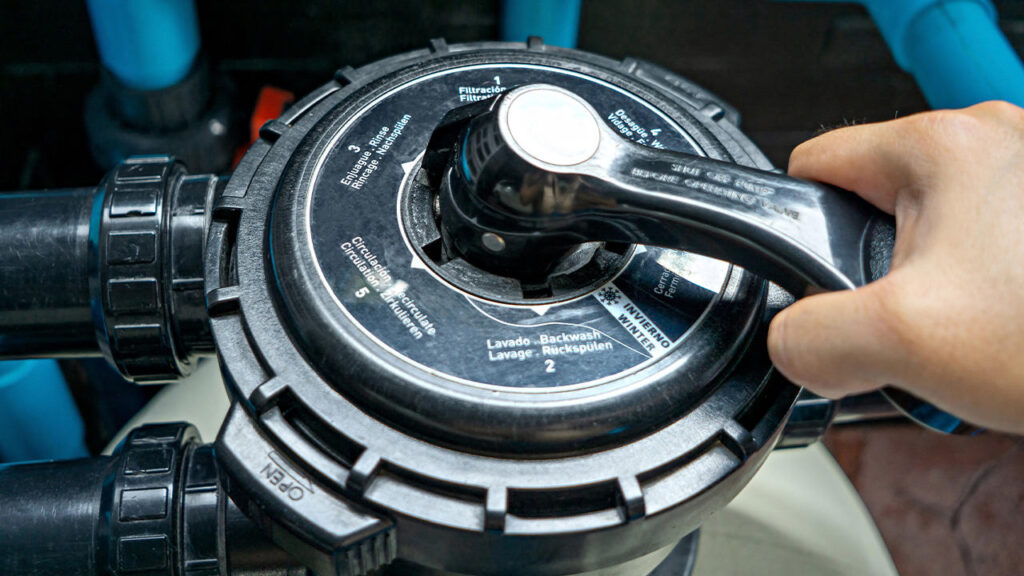
Backwashing a pool filter correctly means turning off the pump, setting the multiport or slide valve to the backwash position, running the pump for 2 to 3 minutes until the water runs clear, then rinsing for about 1 minute before returning the valve to the filter setting. This process reverses the water flow through your sand or DE filter to flush out trapped dirt, debris, and contaminants. Pool owners in Jefferson, Georgia and across North Georgia should backwash whenever the pressure gauge reads 8 to 10 PSI above the normal baseline. This article covers every step of the backwash process, explains when and how often to do it, and answers the most common questions pool owners ask about filter maintenance.
What Is the Proper Way to Backwash a Pool Filter?
The proper way to backwash a pool filter is to reverse the water flow through the filter media to flush out accumulated dirt and debris. This process applies to sand filters and diatomaceous earth (DE) filters only. Cartridge filters cannot be backwashed and must be removed and hosed clean instead.
According to the U.S. Department of Energy, pool pumps are often the second largest energy user in a home, costing up to $310 per year in electricity. A dirty filter forces the pump to work harder. Data from Pentair Aquatic Systems shows that the difference between a clean and dirty filter can nearly double the pump’s energy use. Regular backwashing keeps your system running at peak performance and saves money on your electricity bill.
Homeowners in Jefferson, GA and the surrounding communities of Athens, Braselton, and Gainesville benefit from keeping their filters clean, especially during the hot Georgia summers when pools see heavy use. If your pool equipment needs attention beyond basic maintenance, professional pool cleaning services can help keep your water crystal clear all season long.
How Do You Backwash a Sand Filter Step by Step?
You backwash a sand filter step by step by following this process:
- Turn off the pool pump completely. Never move the multiport valve handle while the pump is running. This can damage the rubber diverter gasket inside the valve.
- Attach a backwash hose to the waste port if one is not already connected. Direct the hose to a proper drainage area.
- Turn the multiport valve handle to the “Backwash” position. Press the handle down firmly as you rotate it.
- Turn the pump back on. Let it run for 2 to 3 minutes, or until the water flowing through the sight glass turns clear.
- Turn the pump off again.
- Move the valve handle to the “Rinse” position.
- Turn the pump on and run it for 30 seconds to 1 minute. This settles the sand bed and flushes out any remaining loose debris.
- Turn the pump off. Set the valve back to “Filter.”
- Turn the pump on and resume normal operation.
According to Leslie’s Pool Supplies, a good rule of thumb is to backwash once the pressure gauge shows 8 to 10 PSI above the starting level. Sand filters generally need backwashing every 1 to 4 weeks depending on pool usage and how much debris enters the water.
How Do You Backwash a DE Filter Step by Step?
You backwash a DE filter step by step by following the same basic valve procedure as a sand filter, but with one important extra step: you must add fresh DE powder after every backwash. According to Swimmingpool.com, you should expect to replace about 4 to 6 pounds of DE powder each time you backwash. The powder is mixed with water and poured directly into the pool skimmer while the pump is running.
DE filters can also be backwashed 2 or 3 times in a row for a deeper clean. According to In The Swim, after backwashing a DE filter for 2 to 3 minutes, return the valve to the filter position, run the pump for 15 seconds, then repeat the backwash cycle. This method removes more debris than a single pass.
Pool owners across the Jefferson, Georgia area who are not comfortable handling DE powder or performing multi-cycle backwashes can rely on a trusted local team for help. A routine pool inspection can also reveal whether your filter grids need a full teardown cleaning, which most manufacturers recommend at least once per season.
How Long Should You Backwash a Pool Filter?
You should backwash a pool filter for 2 to 3 minutes for most residential sand and DE filters. Larger filters may require 3 to 5 minutes. The key indicator is the sight glass on the multiport valve. When the water flowing through it changes from cloudy to clear, the backwash is done.
According to In The Swim’s backwashing best practices guide, small to medium filters are usually clean in 2 to 3 minutes, while larger commercial filters may need up to 5 minutes. Backwashing for too long wastes water and can push fine particles deeper into the filter bed. Backwashing for too short a time leaves contaminants behind and reduces filtration efficiency.
Each backwash cycle uses several hundred gallons of water. Data from a California Urban Water Conservation Council study found that a typical 35,000-gallon residential pool uses anywhere from several hundred to over 1,000 gallons of water per backwash, depending on the filter size and pump flow rate. That adds up over a full season, so backwashing at the right time and for the right length is important for water conservation.
What Is the Filter Backwash Rule?
The filter backwash rule is simple: backwash when your pressure gauge reads 8 to 10 PSI above your clean starting pressure. This is the industry standard recommended by pool equipment manufacturers like Hayward, Pentair, and most pool professionals.
According to Swim University, the normal operating pressure for most residential pool filters falls somewhere between 10 and 25 PSI. There is no single magic number that works for every pool. The correct approach is to record your baseline pressure right after a fresh backwash or a new filter media installation. That number becomes your reference point. When the gauge climbs 8 to 10 PSI above that baseline, it is time to backwash.
For example, if your clean pressure is 12 PSI, you should backwash when the gauge reaches 20 to 22 PSI. Waiting too long, such as letting the pressure climb 15 or 20 PSI above normal, wastes energy and can damage your filter system. Some pool experts recommend backwashing even sooner, at just 4 to 5 PSI above normal, for pools that see heavy use. Families in Braselton and Hoschton, Georgia with kids using the pool daily during summer may need to backwash more frequently than the standard schedule.
Do You Backwash First or Rinse?
You backwash first, then rinse. The backwash cycle reverses the water flow to push out the trapped dirt and debris. The rinse cycle that follows re-settles the filter media and flushes any remaining loose particles out through the waste line instead of back into the pool.
Skipping the rinse step is one of the most common backwashing mistakes. Without a rinse, dirty water and loose sand or DE particles can flow back into the pool the moment you return the valve to the filter position. The rinse cycle typically takes only 30 seconds to 1 minute, so there is no good reason to skip it.
Should You Rinse Every Time You Backwash?
Yes, you should rinse every time you backwash. The rinse cycle is a critical final step that clears dirty water from the plumbing lines and resettles the filter media inside the tank. Without rinsing, contaminated water can be pushed back into the pool when filtration resumes.
The rinse step is especially important for sand filters. Backwashing loosens the sand bed, and the rinse cycle packs it back down into a firm, even layer that traps particles effectively. For DE filters, the rinse helps clear any remaining DE powder from the lines before you add fresh powder through the skimmer.
Can You Backwash a Pool Filter Too Much?
Yes, you can backwash a pool filter too much. Over-backwashing wastes water, wastes energy, and can actually make your filtration less effective. Sand and DE filters both work better with a thin layer of trapped debris, because those particles help the filter catch even smaller contaminants.
According to the U.S. Department of Energy, backwashing too frequently wastes water, while not backwashing wastes energy by forcing the pump to work harder. The sweet spot is following the 8 to 10 PSI rule rather than backwashing on a rigid weekly schedule.
Pool owners in North Georgia who backwash every few days “just to be safe” are actually hurting their water quality. A slight buildup of debris on the filter media improves particle capture. Think of it like a coffee filter: a little buildup actually helps strain out more of the fine grounds. Only backwash when the pressure gauge tells you it is time.
When Should You Not Backwash a Pool?
You should not backwash a pool when the pressure gauge is still within the normal range, when the pool water level is too low, or when you are in the middle of a chemical treatment that has not finished circulating. You should also not backwash a cartridge filter, because cartridge filters are not designed for the backwash process and must be cleaned by hand.
If your pool water is low, backwashing can pull air into the pump, which can cause the pump to lose prime and run dry. This can damage the pump motor and seals. Always check your water level before starting a backwash cycle. The water should be at the midpoint of the skimmer opening.
After adding algaecide, clarifier, or shock treatment to your pool, let the chemicals circulate for at least 24 hours before backwashing. Backwashing too soon will flush the treatment chemicals out of the system before they can do their job. This is a common mistake among pool owners in the Jefferson, GA area during the peak of algae season in July and August.
What Happens if You Don’t Rinse After Backwashing a Pool?
If you don’t rinse after backwashing a pool, dirty water and loose filter media particles will flow back into the pool when you return the valve to the filter position. This can cause cloudy water, and in the case of DE filters, it can send white DE powder directly into the pool.
The rinse cycle takes only 30 seconds to 1 minute and uses a small amount of water. It is a small step that prevents a much bigger headache. Skipping the rinse is one of the top reasons pool owners see cloudy water right after they backwash.
Should I Backwash My Pool Every Time I Vacuum?
No, you should not backwash your pool every time you vacuum, unless you are vacuuming to waste. Standard vacuuming sends debris through the filter, and a single vacuum session usually does not add enough debris to justify a full backwash. Check your pressure gauge after vacuuming. If it has risen 8 to 10 PSI above your baseline, then backwash. Otherwise, leave the filter alone.
If you are vacuuming heavy debris like leaves, algae, or dirt after a storm, set the multiport valve to “Waste” instead of “Filter.” This sends the dirty water directly out through the backwash hose and bypasses the filter entirely. This is the best approach for large amounts of debris because it prevents the filter from clogging. Homeowners in Athens and Winder, Georgia often deal with heavy pollen and leaf debris in the spring, making the vacuum-to-waste method especially useful.
How Soon After Shocking the Pool Can I Backwash?
You can backwash 24 to 48 hours after shocking the pool. Shocking raises the chlorine level to kill bacteria, algae, and other contaminants. The pump needs to run during this time to circulate the shock treatment throughout the entire pool. Backwashing too soon will flush the concentrated chemicals out of the system before they can work.
After the shock treatment has circulated and the chlorine level drops back to a normal range of 1 to 3 parts per million (ppm), it is safe to check the pressure gauge and backwash if needed. According to the Centers for Disease Control and Prevention (CDC), proper chlorine levels of 1 to 3 ppm are needed to keep recreational water safe for swimming.
Does Backwashing Remove Sand From a Filter?
Yes, backwashing can remove a small amount of sand from a filter over time. Each backwash cycle washes away a tiny bit of fine sand particles. This is normal and expected. Over several years, the sand level in the filter will gradually drop and will need to be topped off or replaced entirely.
According to pool industry data, sand filter media should be replaced every 5 to 7 years for standard silica sand. Over time, the sand grains become smooth and rounded, which reduces their ability to trap small particles. Glass filter media is an alternative that lasts longer, often 7 to 15 years, according to data from 1st Direct Pools.
If you notice sand returning to your pool through the return jets, that is a sign of a broken lateral or standpipe inside the filter tank. This is a pool repair issue that should be addressed right away to prevent further damage.
Where Does the Water Go When I Backwash My Pool?
The water goes out through the backwash hose or waste port and is discharged away from the pool. Most homeowners direct the backwash hose onto their lawn, garden, or into a designated drainage area. Some connect it to the home’s sanitary sewer cleanout.
Pool backwash water contains chlorine and other treatment chemicals, so it should never be dumped into storm drains, creeks, or natural waterways. Most local governments have rules about where backwash water can go. In Georgia, pool owners should check with their local county regulations before discharging backwash water. According to data from the Alliance for Water Efficiency, even minor pool plumbing leaks can waste nearly 970 gallons of water per day, so responsible water management during backwashing matters.
Can I Use Dawn Dish Soap to Clean My Pool Filter?
No, you should not use Dawn dish soap to clean your pool filter. Dish soap will create excessive foam and suds that are very difficult to remove from the filter and the pool plumbing. The soap residue can interfere with your pool’s water chemistry and create persistent foaming in the pool water.
Instead, use a product specifically designed for pool filter cleaning. Sand filter cleaners are poured into the filter tank and allowed to soak overnight before a thorough backwash the next morning. For DE and cartridge filters, use a filter degreaser spray or a diluted muriatic acid solution, following the manufacturer’s instructions carefully. These products are formulated to break down oils, lotions, and organic buildup without leaving residue behind.
How Long Do Glass Beads Last in a Pool Filter?
Glass beads last up to 15 years in a pool filter, which is roughly double the lifespan of standard silica sand. Glass media has smoother, more uniform surfaces that resist the clumping and channeling that sand develops over time. According to 1st Direct Pools, glass filter media lasts about 7 to 15 years, compared to 3 to 7 years for traditional sand.
Glass media also filters particles down to about 5 microns, compared to sand which catches particles around 20 microns or larger. That means clearer water with fewer chemicals needed to keep it clean. Pool owners in Jefferson, Georgia who want to reduce their maintenance workload over the long term may find glass media worth the slightly higher upfront investment.
What Will Clear a Cloudy Pool Fast?
The fastest way to clear a cloudy pool is to check and correct the water chemistry, run the pump and filter continuously for 24 hours, and backwash the filter once the pressure rises. If the cloudiness is severe, add a pool clarifier or flocculant to help clump tiny particles together so the filter can catch them.
Cloudy water is usually caused by poor filtration, low chlorine, high pH, or a recent algae bloom. According to the CDC, maintaining a free chlorine level of 1 to 3 ppm and a pH between 7.2 and 7.8 is the foundation of clear, safe pool water. If your filter is dirty, start by backwashing it. If backwashing does not solve the problem, the filter media may need to be replaced.
For pool owners near Gainesville and Oakwood, Georgia, heavy summer thunderstorms can dump organic debris and dilute pool chemicals quickly. Running the pump continuously after a big storm and backwashing the filter is usually the fastest path back to clear water. If your pool stays cloudy after taking these steps, a professional pool cleaning can diagnose and fix the issue.
Is It Safe to Use Clorox Bleach in a Pool?
Yes, it is safe to use plain, unscented Clorox bleach (sodium hypochlorite) in a pool as a chlorine source. Many pool owners use regular liquid bleach as a cost-effective alternative to granular shock or liquid pool chlorine. The active ingredient is the same: sodium hypochlorite.
The key is to use only plain, unscented bleach with no added surfactants, fragrances, or thickeners. Standard household bleach is typically 6% to 8.25% sodium hypochlorite. Pool-grade liquid chlorine is usually around 10% to 12.5%. You will need to use more household bleach to achieve the same chlorine level, but the result is the same. Always test your water after adding bleach to confirm the free chlorine level is in the safe range of 1 to 3 ppm.
What Should I Soak My Pool Filter in to Clean It?
You should soak your pool filter in a filter cleaning solution made for pool use. For cartridge filters, soak the cartridge in a diluted filter cleaner or a mixture of one part muriatic acid to twenty parts water for several hours. For sand filters, pour a sand filter cleaner directly into the filter tank and let it soak overnight before backwashing the next morning.
According to In The Swim, soaking a sand filter with a cleaning product overnight and then performing a full backwash the next morning removes oils, lotions, and calcified buildup that regular backwashing leaves behind. This deep cleaning should be done at least once per year for sand filters and at least once per season for DE filter grids.
Many pool professionals in the Jefferson and Athens, Georgia area recommend this annual deep clean as part of a seasonal pool opening routine to start the swimming season with a filter that is as clean as possible.
What Is the Backwash Setting on a Pool Pump?
The backwash setting on a pool pump is actually a setting on the multiport valve, not the pump itself. The multiport valve is a 6-position rotary valve typically mounted on the top or side of sand and DE filters. The “Backwash” position reverses the flow of water through the filter, sending dirty water out through the waste port.
The six standard positions on a multiport valve are Filter, Backwash, Rinse, Waste, Recirculate, and Closed. Each position directs water through a different path inside the valve. Always turn the pump off before changing the valve position. Turning the valve with the pump running can crack the internal diverter gasket, which leads to leaks and poor filtration performance.
How Many Minutes Should I Backwash My Pool?
You should backwash your pool for 2 to 3 minutes for a standard residential sand or DE filter. Larger commercial filters may need 3 to 5 minutes. The best way to know when to stop is to watch the sight glass on the multiport valve. When the water in the sight glass changes from cloudy or dirty to clear, the backwash is complete.
Running the backwash for more than 5 minutes on a residential filter is usually unnecessary and wastes water. According to data from a Rancho California Water District study, a backwash cycle on a typical residential pool uses several hundred gallons of water. Over a full season, a pool that is backwashed every two weeks can use 10,000 to 60,000 gallons of water per year on backwashing alone, depending on filter size and pump flow rate.
Pool Filter Comparison: Sand vs. DE vs. Cartridge
| Feature | Sand Filter | DE Filter | Cartridge Filter |
|---|---|---|---|
| Filtration Size | 20-40 microns | 2-5 microns | 10-15 microns |
| Backwash Required | Yes, every 1-4 weeks | Yes, monthly or by PSI | No (hand clean) |
| Media Replacement | Every 5-7 years | After every backwash (powder) | Every 2-3 years (element) |
| Tank Lifespan | 7-20 years | 10+ years | 5-10 years |
| Maintenance Level | Low | Moderate to High | Low to Moderate |
| Water Usage (Cleaning) | High (backwash water) | Moderate (backwash water) | Low (hose rinse) |
| Backwash PSI Trigger | 8-10 PSI above baseline | 8-10 PSI above baseline | N/A (clean at 8-10 PSI rise) |
Sources: Leslie’s Pool Supplies, Swim University, Hurricane Pool Filters, ePoolSupply, 1st Direct Pools, Hy-Clor
Frequently Asked Questions
How Often Should I Backwash My Pool in Jefferson, Georgia?
You should backwash your pool in Jefferson, Georgia every 1 to 4 weeks during the swimming season, or whenever the pressure gauge rises 8 to 10 PSI above the clean baseline. The hot Georgia summers increase pool usage and debris load, especially from pollen, storms, and heavy swim activity. During June through August, checking your pressure gauge once a week is a smart habit.
Can I Backwash My Pool Filter With the Pump On?
No, you cannot safely change the multiport valve position with the pump on. Always turn the pump off before moving the valve to Backwash, Rinse, or any other setting. Switching the valve while water is flowing under pressure can crack or dislodge the rubber diverter gasket inside the valve, which causes leaks and reduces filtration performance.
How Do I Know When My Pool Filter Needs Backwashing in North Georgia?
You know your pool filter needs backwashing in North Georgia when the pressure gauge reads 8 to 10 PSI above your recorded clean baseline pressure. Other signs include reduced water flow from the return jets, visibly cloudy pool water, and the pump straining or making more noise than usual. Pool owners in areas like Athens, Braselton, and Gainesville should check the gauge at least once a week during summer.
Is Backwashing a Pool Filter Bad for My Lawn?
Backwashing a pool filter can affect your lawn if chlorine levels in the discharged water are high. Small amounts of diluted pool water are generally safe for grass, but large volumes of heavily chlorinated water can burn plants and grass. Let chlorine levels drop below 0.1 ppm before directing backwash water onto sensitive landscaping. You can also direct it to a gravel area or a sanitary sewer cleanout instead.
What Happens if I Never Backwash My Pool Filter?
If you never backwash your pool filter, the filter media will become so clogged that water can barely pass through. This causes extremely high pressure inside the filter tank, which strains the pump motor and can even crack the filter tank in severe cases. According to Pentair Aquatic Systems, a dirty filter can nearly double the pump’s energy consumption. Over time, your pool water will turn cloudy and become a breeding ground for algae and bacteria.
Should I Hire a Professional for Pool Filter Maintenance in Jefferson, GA?
Hiring a professional for pool filter maintenance in Jefferson, GA is a good idea if you are unsure about the process, if your filter pressure stays high after backwashing, or if your pool water remains cloudy despite regular maintenance. A trained pool technician can inspect filter internals, replace worn media, and diagnose issues that are hard to spot without experience. Data from a South West Pools study of 500 pools found that professionally maintained filters lasted about 40% longer than filters maintained only by homeowners.
Do I Need to Add Water to My Pool After Backwashing?
Yes, you typically need to add water to your pool after backwashing because the process sends several hundred gallons of water out through the waste line. Check the water level after every backwash cycle. If it has dropped below the midpoint of the skimmer, add water with a garden hose until it reaches the proper level. Running the pump with a low water level can cause it to pull in air and lose prime, which can damage the motor.
Final Thoughts
Backwashing your pool filter correctly is one of the easiest and most important maintenance tasks you can do as a pool owner. It keeps your water clean, protects your pump and filter from damage, and saves money on energy bills. The process takes less than 10 minutes: turn off the pump, set the valve to backwash, run for 2 to 3 minutes, rinse for 1 minute, and return to the filter setting. Let your pressure gauge be your guide, and backwash when it rises 8 to 10 PSI above your clean baseline.
For homeowners in Jefferson, Georgia and across the North Georgia area, from Athens to Braselton to Gainesville, keeping up with regular filter maintenance makes a big difference in water quality and equipment longevity. If you would rather leave the backwashing, chemical balancing, and filter inspections to the pros, Sandals Luxury Pools is here to help. Contact the team today to schedule a pool cleaning service and keep your pool running at its best all year long.
