
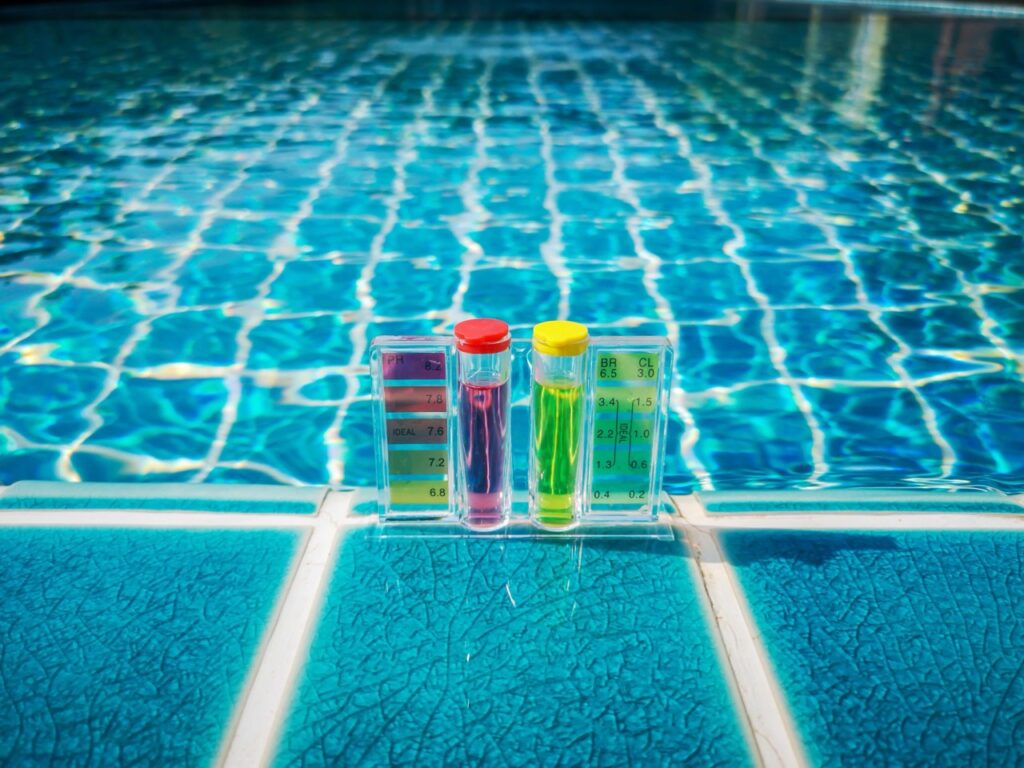
To balance pool chemicals as a beginner, you test your water first, then adjust alkalinity, pH, calcium hardness, and chlorine in that specific order. Getting this right keeps the water safe, protects your pool surfaces and equipment, and prevents costly damage. According to the CDC, pool chemical injuries send an estimated 4,535 people to U.S. emergency rooms every year, and many of those incidents come from mishandling chemicals or swimming in poorly balanced water. This guide walks you through every step of balancing pool chemicals, from testing your water to knowing exactly which chemical to add first.
In What Order Should I Balance My Pool Chemicals?
The order you should balance your pool chemicals is alkalinity first, pH second, calcium hardness third, and then chlorine (sanitizer) last. This order matters because each chemical affects the others. If you skip ahead or add them out of sequence, you will waste chemicals and time trying to correct levels that keep shifting.
According to Latham Pool Products, one of the largest pool manufacturers in North America, following the correct chemical sequence is just as important as the quantities you use. Alkalinity acts as a buffer that stabilizes pH. If you try to fix pH before alkalinity is in range, your pH will bounce around and refuse to stay put. Once alkalinity is steady, pH adjustments hold. After pH, you set calcium hardness to protect surfaces. Chlorine goes last because its effectiveness depends on all the other levels being correct first.
Pool owners in Jefferson, Georgia and across North Georgia who follow this order spend less money on chemicals and deal with fewer water problems throughout the swim season. A consistent routine also helps you avoid emergency situations that require professional pool cleaning to fix.
What Is the First Chemical You Put in a Pool?
The first chemical you put in a pool when balancing is an alkalinity adjuster, typically sodium bicarbonate (baking soda) to raise alkalinity. Total alkalinity should sit between 80 and 120 parts per million (ppm) before you touch anything else.
Sodium bicarbonate is one of the safest and most affordable pool chemicals. According to In The Swim, adding about 1.25 pounds of sodium bicarbonate per 10,000 gallons of water raises total alkalinity by approximately 10 ppm. Always add chemicals to water, never pour water over chemicals. Dissolve the sodium bicarbonate in a bucket of pool water first, then pour it around the perimeter of the pool with the pump running.
After adding any chemical, let the pump circulate for at least 6 hours before retesting. Homeowners in Athens and Braselton, Georgia who rush the process and retest too soon often get inaccurate readings, which leads to overcorrecting and throwing everything off balance.
What Pool Chemical Should You Balance First?
The pool chemical you should balance first is total alkalinity. Total alkalinity is the foundation of your entire water chemistry because it controls how stable your pH stays. Think of alkalinity as the anchor that holds pH in place.
According to Browning Pools, a respected industry resource, low alkalinity (under 80 ppm) causes pH to swing wildly. Those swings can etch concrete surfaces, corrode metal equipment, and irritate swimmers’ skin and eyes. High alkalinity (above 120 ppm) makes it nearly impossible to adjust pH and leads to cloudy water and calcium scaling. Getting alkalinity right first saves you from chasing your tail with every other chemical.
Should You Fix pH or Alkalinity First?
You should fix alkalinity first, then pH. Alkalinity acts as a buffer that holds pH steady. If you adjust pH while alkalinity is out of range, your pH will not stay where you set it. You will keep adding chemicals over and over without lasting results.
The ideal pH range for a swimming pool is 7.2 to 7.6, according to the Association of Pool and Spa Professionals. Human eyes and skin have a natural pH of about 7.4, so keeping pool water in that range prevents irritation. According to the Better Health Channel (an Australian government health resource), a pH higher than 8 puts swimmers at risk for skin rashes, while a pH below 7 causes stinging eyes.
After alkalinity is balanced, use a pH increaser (sodium carbonate, also called soda ash) to raise pH or a pH decreaser (sodium bisulfate or muriatic acid) to lower it. Add small amounts at a time. According to Leslie’s Pool Supplies, it is better to undershoot and adjust up than to overshoot and have to correct in the opposite direction. Pool owners in Gainesville and Hoschton, Georgia who add chemicals in small increments get better results with less product.
What’s More Important, pH or Alkalinity?
Alkalinity and pH are both critically important, but alkalinity is what you address first because it directly controls how stable your pH stays. Without proper alkalinity, pH becomes impossible to manage.
According to Orenda Technologies, a leading pool water chemistry company, the relationship between pH and alkalinity is governed by the Langelier Saturation Index (LSI). This formula takes into account pH, temperature, calcium hardness, and total alkalinity to determine whether pool water is corrosive or scale-forming. When alkalinity is in its proper range, pH adjustments become predictable and stable. When alkalinity is too low or too high, pH swings become erratic regardless of how much acid or base you add.
For pool owners across Jackson County, Georgia, where summer temperatures regularly push into the 90s, water chemistry shifts faster because heat accelerates chemical reactions. Higher water temperatures mean chlorine gets used up more quickly and pH tends to drift upward. Testing more often during July and August helps catch problems before they get out of hand.
What Are the Signs of High pH in a Pool?
The signs of high pH in a pool are cloudy water, reduced chlorine effectiveness, calcium scaling on surfaces and equipment, skin rashes, and irritated eyes. When pH climbs above 7.8, chlorine becomes sluggish and cannot sanitize the water properly.
According to In The Swim, chlorine is very slow to react at high pH levels. At a pH of 8.0, chlorine is only about 20% as effective as it is at a pH of 7.2. That means you could have plenty of chlorine in your pool, but it is barely doing its job. This is one of the biggest reasons pools turn green even when owners are adding chlorine regularly. The problem is not low chlorine; it is high pH making the chlorine useless.
Calcium scaling is another telltale sign. White, crusty deposits form along the waterline, on tile, inside pipes, and around equipment. Over time, scaling restricts water flow, clogs filters, and shortens the life of pumps and heaters. According to RenoSys, annual pool maintenance averages $3,000 to $6,000, and a big portion of that goes toward fixing problems that proper water balance would have prevented.
What Are the Signs of Low pH in a Pool?
The signs of low pH in a pool are stinging eyes, itchy or dry skin, corroded metal fixtures like ladders and handrails, etched plaster or concrete surfaces, and rapid chlorine loss. Low pH means the water is too acidic, and acidic water is aggressive.
According to Pioneer Family Pools, acidic water corrodes everything it touches, including pool ladders, light fixtures, pump components, filter housings, and heater elements. Vinyl liners become brittle and prone to cracking. Plaster and grout erode, creating rough surfaces that can scrape swimmers’ feet. All of those dissolved minerals end up floating in the water, which causes staining and cloudiness.
If you notice green or brown stains forming on your pool walls or floor, low pH could be the cause. A professional pool inspection can identify whether the staining is from chemical imbalance, metals in the water, or another issue entirely.
Can I Add Pool Shock and Alkalinity at the Same Time?
No, you should not add pool shock and alkalinity at the same time. Adding multiple chemicals at once can cause dangerous reactions, reduce the effectiveness of both products, and make it impossible to know which adjustment actually worked. Always add one chemical, let it circulate, and then move on to the next.
According to the CDC, mixing incompatible pool chemicals is one of the top causes of pool chemical injuries in the United States. Their data shows that roughly 4,535 emergency department visits occur each year due to pool chemical incidents. Almost half of those injuries happen to people under 18 years old. Many of these incidents stem from mixing chemicals, not wearing protective gear, or adding chemicals in the wrong order.
The safest practice is to adjust alkalinity first, wait at least 6 hours, then adjust pH, wait again, and then shock the pool. After shocking, wait a full 24 hours before adding algaecide. According to ARM and HAMMER, shocking eliminates bacteria while algaecide kills algae, but adding them at the same time causes the shock to neutralize the algaecide before it can work.
What Two Pool Chemicals Should Not Be Mixed?
The two pool chemicals that should never be mixed are chlorine and acid (such as muriatic acid or sodium bisulfate). Combining chlorine and acid creates toxic chlorine gas, which can cause serious respiratory injury and even death.
According to a CDC Morbidity and Mortality Weekly Report, a pool chemical mixing incident in upstate New York created toxic chlorine gas when a chemical feeder malfunction allowed concentrated chlorine and acid to combine in the recirculation system. Multiple people experienced blisters, nausea, vomiting, and eye irritation. The investigation found that the pool’s water flow monitoring system had failed, allowing the chemicals to mix unchecked.
Other dangerous combinations include mixing different types of chlorine together (like calcium hypochlorite and trichlor) and mixing chlorine with algaecide. The CDC’s Model Aquatic Health Code recommends that pool operators never mix different pool chemicals with each other or with any other substance. Always store chemicals in separate, clearly labeled containers away from heat and moisture. Pool owners in Jefferson, Georgia who store chemicals in a hot shed during summer should be extra careful, since heat increases the risk of chemical reactions.
How Long Does It Take for a Pool to Clear Up After Chemicals?
It takes 24 to 48 hours for a pool to clear up after chemicals in most cases. After shocking, the water may look cloudy or hazy at first. That is normal. The pump needs time to circulate the treated water through the filter, and the chemicals need time to do their work.
According to Latham Pool Products, it can take up to 24 hours to fully balance pool chemicals. Several factors affect how long it takes: pool size and volume, the severity of the imbalance, water temperature, and how well the filtration system is working. A larger pool takes longer to circulate. Warmer water speeds up chemical reactions but also burns through chlorine faster.
If your pool does not clear up within 48 hours, the problem may be a clogged filter, insufficient chlorine, or an underlying issue like high phosphate levels feeding algae. Homeowners in Winder and Dacula, Georgia who deal with persistent cloudiness after chemical treatment often find that a thorough filter cleaning solves the problem. If pool equipment repair is needed, catching it early prevents bigger issues later.
How Can I Balance My pH Quickly?
You can balance your pH quickly by adding small, measured doses of pH increaser (soda ash) to raise pH or pH decreaser (muriatic acid or sodium bisulfate) to lower pH, with the pump running on high speed. Retesting after 4 to 6 hours gives you the most accurate reading.
According to Leslie’s Pool Supplies, the key to fast pH correction is not adding a large amount of chemical all at once. Large doses overshoot the target and force you to correct in the opposite direction. Instead, add about 75% of the calculated dose, circulate for several hours, retest, and then fine-tune. This approach gets you to the target faster with less waste.
For lowering pH, muriatic acid is the most common and affordable choice. According to Orenda Technologies, always dilute acid in a bucket of water before adding it to the pool. Pour the diluted acid evenly around the deep end while the pump is running. Never pour concentrated acid in one spot, as this creates a localized area of extremely low pH that can etch pool surfaces instantly.
Can I Add Alkalinity and pH at the Same Time?
No, you should not add alkalinity and pH adjusters at the same time. Alkalinity and pH are closely connected, and adjusting one almost always moves the other. If you add both at once, you cannot control which direction each level goes, and you will likely overshoot one or both targets.
According to In The Swim, the chemical used to lower both pH and alkalinity is the same: muriatic acid or sodium bisulfate. The difference is in how you add it. To lower pH, you pour the diluted acid around the perimeter of the pool (called “walking the acid”). To lower alkalinity, you pour the acid in one calm, still area of the pool (called “pooling the acid”). This concentrated application increases the chemical exchange at the surface and reduces alkalinity more effectively.
Raising alkalinity without dramatically raising pH is easier. Sodium bicarbonate (baking soda) has a pH of about 8.3, which is close to neutral compared to soda ash at 11.6. So baking soda raises alkalinity with a smaller impact on pH. Add it slowly, test after 6 hours, and adjust from there.
What Are the Signs of Too Much Chlorine in a Pool?
The signs of too much chlorine in a pool are a strong chemical smell, burning or red eyes, itchy or irritated skin, bleached swimwear, and faded pool surfaces. Free chlorine levels above 5 ppm are considered too high for safe swimming.
Contrary to what many people believe, a strong “chlorine smell” at the pool does not mean there is too much chlorine. According to the CDC, that harsh chemical odor actually comes from chloramines, which are formed when chlorine reacts with sweat, urine, and body oils. Chloramines are a sign that the pool needs more chlorine (via shocking), not less. However, if you test your water and free chlorine is genuinely above 5 ppm, you should wait for levels to drop before swimming.
The ideal free chlorine range is 1 to 3 ppm for most residential pools. According to the Association of Pool and Spa Professionals, maintaining chlorine in this range provides effective sanitation without irritation. Chlorine levels above 10 ppm can cause serious skin and respiratory problems, especially for children. Always test before swimming, especially after shocking the pool.
What Cancels Out Chlorine in a Pool?
What cancels out chlorine in a pool is sunlight (UV rays), high water temperature, heavy swimmer loads, organic debris, and low cyanuric acid (stabilizer) levels. Without protection, sunlight can destroy up to 90% of the chlorine in an unstabilized outdoor pool within just a few hours.
Cyanuric acid (CYA), also called chlorine stabilizer or conditioner, acts like sunscreen for chlorine. According to the Association of Pool and Spa Professionals, the ideal CYA range is 30 to 50 ppm for chlorine pools. Below 30 ppm, chlorine burns off too quickly under the Georgia sun. Above 50 ppm, chlorine becomes less effective at killing bacteria and algae, a problem known as “chlorine lock.”
Homeowners in North Georgia who use liquid chlorine (bleach) or calcium hypochlorite need to add stabilizer separately because those products do not contain CYA. Trichlor tablets contain built-in stabilizer, which is convenient but can cause CYA to creep up over time. Testing CYA monthly helps you stay ahead of this issue.
Does My Pool Really Need Stabilizer?
Yes, your pool really needs stabilizer (cyanuric acid) if it is an outdoor pool that gets direct sunlight. Without stabilizer, UV rays from the sun break down chlorine extremely fast, leaving your pool unprotected against bacteria and algae.
According to research published by the Water Quality and Health Council, unstabilized chlorine in an outdoor pool can lose half its concentration in as little as 45 minutes under direct summer sunlight. That means you could add chlorine in the morning and have almost none left by noon. With proper stabilizer levels (30 to 50 ppm), chlorine lasts significantly longer and your chemical costs go down.
There are 10.7 million swimming pools in the United States, according to Jobera. The majority of those are outdoor residential pools that need stabilizer. For pool owners in Jefferson, Georgia, where summer sunshine is intense and swim season runs from May through September, stabilizer is not optional. It is a must-have chemical that saves you money on chlorine all season long.
How Much Stabilizer Do You Add to a 10,000 Gallon Pool?
To raise the stabilizer (cyanuric acid) level by 10 ppm in a 10,000 gallon pool, you add about 13 ounces of granular cyanuric acid. To reach a target of 30 to 50 ppm from zero, you would need roughly 2.5 to 4 pounds of stabilizer.
CYA dissolves slowly. According to In The Swim, the best method is to place the granular stabilizer in a mesh sock or old pantyhose and hang it in front of a return jet, or place it in the skimmer basket. Let it dissolve over 2 to 3 days. Do not dump it directly into the pool, as undissolved granules can bleach vinyl liners or stain plaster.
Important: CYA is easy to add but very hard to remove. The only reliable way to lower CYA is to drain and replace a portion of the pool water. Because of this, add stabilizer gradually and test frequently. If you use trichlor tablets as your primary sanitizer, your CYA will rise on its own over time without any additional stabilizer needed.
What Happens If You Swim in a Pool With Unbalanced Chemicals?
If you swim in a pool with unbalanced chemicals, you risk skin rashes, red or burning eyes, ear infections, respiratory irritation, and gastrointestinal illness from bacteria that chlorine failed to kill. Children and people with sensitive skin are especially vulnerable.
According to the CDC, an estimated 4,535 people visit emergency rooms every year due to pool chemical injuries. About two-thirds of these incidents happen during the summer swim season between Memorial Day and Labor Day. The most common diagnosis is poisoning from inhaling chemical fumes, but skin burns and eye injuries are also frequent. Many of these cases involve pools where chemical levels were not properly monitored or balanced.
Unbalanced water is also a breeding ground for harmful bacteria. According to the CDC, improperly treated recreational water is one of the top causes of waterborne illness outbreaks in the United States. Cryptosporidium, E. coli, and Legionella are among the pathogens that can survive in pools where chlorine levels are too low or pH is out of range. Regular testing and proper chemical balance is the best defense for your family.
What Happens If Alkaline Is Too High in the Pool?
If alkaline is too high in the pool, the water becomes cloudy, chlorine becomes less effective, calcium scaling builds up on surfaces and inside equipment, and pH becomes nearly impossible to adjust downward. High alkalinity locks your water chemistry in a bad cycle.
According to Swim University, when total alkalinity is too high, it pushes pH upward. High pH then reduces chlorine’s ability to sanitize. Swimmers experience itchy skin and burning eyes. Meanwhile, dissolved calcium starts dropping out of the water and forming white, crusty deposits on tile, inside pipes, and on filter elements. Those deposits restrict water flow, reduce filtration efficiency, and can shorten the life of expensive equipment like heaters and pumps.
To lower alkalinity, add muriatic acid in small doses. According to In The Swim, pour the diluted acid slowly into one calm area of the pool (the deep end, with the pump off for about 30 minutes) to maximize the alkalinity reduction. Then turn the pump back on and let it circulate for 6 hours before retesting. This process may need to be repeated several times to bring alkalinity into range without crashing pH too far.
What Are the 5 Rules in a Swimming Pool for Chemical Safety?
The 5 rules in a swimming pool for chemical safety are: always add chemicals to water (never water to chemicals), never mix different pool chemicals together, wear protective gloves and goggles when handling chemicals, store chemicals in a cool and dry place away from each other, and always follow the product label instructions.
According to the CDC’s Model Aquatic Health Code, pool chemical safety should be a core part of every pool owner’s routine. The most common causes of pool chemical injuries are mixing incompatible products, spills and splashes during handling, and inhaling fumes when opening chemical containers. All of these are preventable with basic safety practices.
Pool owners in Commerce and Monroe, Georgia should pay special attention to chemical storage during hot summer months. Heat accelerates chemical breakdown and increases the risk of dangerous reactions. Never store chlorine and acid in the same container or on the same shelf. Keep all pool chemicals locked away from children and pets. According to CDC data, almost half of pool chemical injuries involve people under 18 years old.
Ideal Pool Chemical Levels: Quick Reference Chart
| Chemical Parameter | Ideal Range | What Happens If Too Low | What Happens If Too High |
|---|---|---|---|
| Total Alkalinity | 80 – 120 ppm | pH swings wildly, corrosion, etching | Cloudy water, scaling, pH hard to lower |
| pH | 7.2 – 7.6 | Eye/skin irritation, corrosion, chlorine loss | Cloudy water, scaling, chlorine ineffective |
| Calcium Hardness | 200 – 400 ppm | Corrosive water, plaster damage | Scaling, cloudy water, clogged equipment |
| Free Chlorine | 1 – 3 ppm | Bacteria/algae growth, unsafe water | Skin/eye irritation, bleaching |
| Cyanuric Acid (CYA) | 30 – 50 ppm | Chlorine destroyed by sunlight quickly | Chlorine less effective (“chlorine lock”) |
Sources: Association of Pool and Spa Professionals, CDC, Latham Pool Products, In The Swim
How Often Should You Test Pool Water?
You should test pool water at least 2 to 3 times per week during swim season, and once a week during the off-season. According to Leslie’s Pool Supplies, frequent testing catches small imbalances before they turn into big, expensive problems.
At-home test strips or liquid test kits are fine for regular checks of chlorine, pH, and alkalinity. Once a month, bring a water sample to a local pool supply store for a more detailed analysis that includes calcium hardness, CYA, total dissolved solids, and metals. This monthly deep test gives you a complete picture of your water chemistry.
For the most accurate at-home results, collect your sample after the pump has been running for at least an hour. Dip about 12 to 18 inches below the surface, away from return jets and floating chemical dispensers. Test in the morning before anyone swims, since swimmer activity changes the chemistry temporarily. Pool owners near Lawrenceville and Sugar Hill, Georgia who test consistently spend less on chemicals overall because they catch and correct small problems early.
Can You Add Stabilizer and Shock at the Same Time?
No, you should not add stabilizer and shock at the same time. Shocking raises chlorine levels dramatically, and stabilizer needs calm, consistent conditions to dissolve properly. Adding both at once makes it difficult to get accurate test readings and can reduce the effectiveness of both products.
According to pool industry experts, the best practice is to add stabilizer first, let it dissolve over 2 to 3 days, then test your CYA level. Once CYA is in range, shock the pool as needed. If you use dichlor or trichlor shock products, those already contain built-in stabilizer. Using them repeatedly will raise your CYA over time, so keep an eye on that level.
Should You Balance Chlorine or pH First?
You should balance pH first, then chlorine. Chlorine’s effectiveness depends directly on pH. At a pH of 7.2, chlorine is highly active and sanitizes quickly. At a pH of 8.0, chlorine loses roughly 80% of its killing power, according to In The Swim. Adding chlorine to a pool with high pH is like throwing money away because the chlorine cannot do its job.
However, remember the full order: alkalinity first, then pH, then calcium hardness, and then chlorine. pH comes before chlorine, but after alkalinity. Many beginners jump straight to chlorine because that is the chemical they hear about most. But chlorine is actually the last piece of the puzzle, not the first. Getting regular professional pool cleaning can help new pool owners learn the right routine while keeping their water in safe condition.
Is It Normal to Lose Half an Inch of Water a Day in a Pool?
Yes, it is normal to lose up to half an inch of water a day from a pool due to evaporation, wind, and splash-out, especially during hot Georgia summers. According to the U.S. Department of Energy, an uncovered pool can lose about 1 inch of water per week from evaporation alone in warm climates.
However, if water loss is happening faster than that, or if it continues when the pool is covered and not in use, you may have a leak. Pool leaks change your water chemistry because fresh fill water has different mineral content and pH. If you notice that you are constantly adding chemicals to rebalance after topping off the pool, a leak could be the underlying cause. A pool inspection can determine whether you are dealing with normal evaporation or a hidden leak.
What Is the Golden Rule When Using Pool Water Chemicals?
The golden rule when using pool water chemicals is to always add chemicals to water, never add water to chemicals. Pouring water over concentrated pool chemicals can cause violent, dangerous reactions including splashing, boiling, or even explosions.
According to the CDC, this simple rule prevents a significant number of pool chemical injuries every year. When you need to dissolve or dilute a granular chemical, start with a large bucket filled with pool water. Then slowly add the chemical to the water while stirring with a plastic utensil. Never use metal tools, as some chemicals react with metal.
This rule applies to every pool chemical you handle, from shock to pH adjusters to algaecide. According to CDC data from their Morbidity and Mortality Weekly Report, the most common contributing factors in pool chemical injuries include mixing incompatible products, spills during handling, and fume exposure when opening containers. Wearing gloves and safety goggles every time you handle pool chemicals is a simple step that protects you and your family.
Frequently Asked Questions
How Often Should I Balance My Pool Chemicals in Jefferson, Georgia?
You should balance your pool chemicals 2 to 3 times per week during swim season in Jefferson, Georgia. The hot North Georgia summers cause chlorine to deplete faster and pH to drift higher. During the cooler months from October through March, testing once a week is usually enough. Homeowners near the Jefferson area who test regularly spend less on chemicals and deal with fewer surprise problems when it is time to open the pool in spring.
Do I Need to Test My Pool Water Before Adding Any Chemicals?
Yes, you always need to test your pool water before adding any chemicals. Adding chemicals without testing is guessing, and guessing leads to imbalances that cost more to fix. According to the Association of Pool and Spa Professionals, testing before treatment is the most important step in pool maintenance. A basic test kit that measures chlorine, pH, and alkalinity costs under $20 and takes about 60 seconds to use.
Can High Alkalinity Make My Pool Green in North Georgia?
Yes, high alkalinity can make your pool green indirectly. High alkalinity pushes pH up, and high pH makes chlorine far less effective at killing algae. Even if your chlorine level tests normal, the chlorine cannot do its job in high-pH water. Pool owners in Athens and Gainesville, Georgia who see green water despite adding chlorine should test alkalinity and pH first before adding more chlorine.
What Is the Cheapest Way to Balance Pool Chemicals?
The cheapest way to balance pool chemicals is to test frequently and make small adjustments before problems grow. Baking soda (sodium bicarbonate) raises alkalinity for a fraction of the cost of branded pool products. Regular household bleach (with no additives) works as a chlorine source. Muriatic acid, available at most hardware stores, lowers pH and alkalinity affordably. According to HomeGuide, annual pool maintenance costs average $960 to $1,800, and regular at-home testing with affordable chemicals keeps you on the lower end of that range.
Should I Hire a Professional to Balance My Pool in North Georgia?
Hiring a professional to balance your pool is a smart choice for beginners, first-time pool owners, or anyone dealing with persistent water problems. A professional can test your water comprehensively, identify hidden issues, and get your chemistry right quickly. Pool owners in Nicholson and Statham, Georgia who start with professional guidance learn the routine faster and avoid costly mistakes. Once you are comfortable with the process, you can handle most routine testing and balancing yourself.
How Do I Know If My Pool Chemicals Are Balanced?
You know your pool chemicals are balanced when your test results fall within these ranges: total alkalinity 80 to 120 ppm, pH 7.2 to 7.6, calcium hardness 200 to 400 ppm, free chlorine 1 to 3 ppm, and cyanuric acid 30 to 50 ppm. According to the Association of Pool and Spa Professionals, water that meets all five targets is considered balanced and safe for swimming. Visually, balanced water is clear, has no odor, and does not cause eye or skin irritation.
What Is the Best Time of Day to Add Pool Chemicals in Georgia?
The best time of day to add pool chemicals in Georgia is in the evening after the sun goes down. UV rays from sunlight break down chlorine rapidly. According to the Water Quality and Health Council, adding chlorine in the evening gives it all night to circulate and work without sunlight degrading it. This is especially important for pool owners in Jefferson, Georgia and the surrounding areas where summer sun exposure is intense from early morning through late afternoon. Adding chemicals at dusk maximizes their effectiveness and stretches your chemical budget further.
Final Thoughts
Balancing pool chemicals does not have to be hard, even if you are a complete beginner. The key is to follow the right order: alkalinity first, pH second, calcium hardness third, and chlorine last. Test your water at least 2 to 3 times per week, make small adjustments, and give chemicals time to circulate before retesting. With more than 10.7 million pools across the United States and an average annual maintenance cost of $3,000 to $6,000 according to RenoSys, keeping your water balanced is one of the most effective ways to protect your investment and keep your family safe.
Pool owners in Jefferson, Georgia and across North Georgia can count on Sandals Luxury Pools for expert guidance on pool maintenance, water chemistry, and everything in between. Whether you need a one-time water analysis, a professional pool cleaning service, or help getting your pool opened for the season, the team at Sandals Luxury Pools has over a decade of experience serving North Georgia families. Call (770) 771-1839 or visit their website to schedule your consultation today. Your pool deserves the right chemistry, and so does your peace of mind.
