
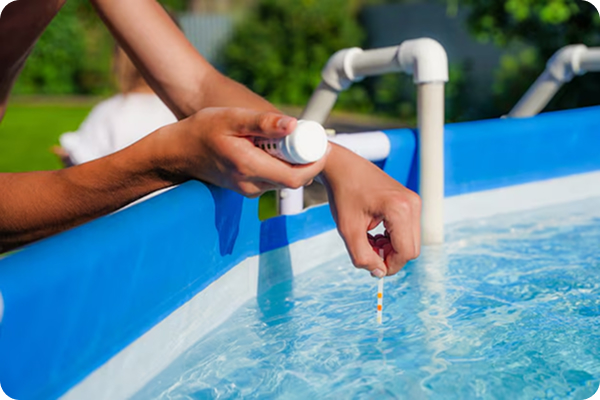
To raise pH in a pool safely, add soda ash (sodium carbonate) or baking soda (sodium bicarbonate) to the water while the pump is running. Soda ash is the best choice if you only need to raise pH, while baking soda works better when both pH and total alkalinity are low. The ideal pool pH sits between 7.2 and 7.8, according to the Centers for Disease Control and Prevention (CDC). This guide covers exactly how to raise your pool’s pH step by step, what chemicals to use, how much to add, and common mistakes pool owners in Jefferson, Georgia and across North Georgia should avoid.
What Is the Ideal pH Level for a Pool?
The ideal pH level for a pool is between 7.2 and 7.8, with the sweet spot being 7.4 to 7.6. The CDC’s Model Aquatic Health Code (MAHC) recommends maintaining pH between 7.2 and 7.8 for both public and residential pools. The human eye has a natural pH of about 7.5, which is why this range feels the most comfortable for swimmers.
A pH of 7.0 is neutral on the scale. Anything below 7.0 is acidic, and anything above 7.0 is alkaline. Pool water that falls outside the 7.2 to 7.8 range can cause real problems for both swimmers and equipment. Homeowners in Jefferson, Georgia and the surrounding areas should test their pH at least two to three times per week during swim season to catch problems early.
According to the ANSI/APSP 11-2019 national standard for water quality in public pools and spas, published by the Pool and Hot Tub Alliance (PHTA), the ideal pH range of 7.2 to 7.8 prevents water from irritating swimmers’ eyes and skin. Keeping your water in this range also helps chlorine work at its best, which is critical for killing germs and bacteria.
If your pool needs professional pool cleaning or chemical balancing, getting expert help can save you time and prevent costly mistakes.
What Happens if Pool pH Is Too Low?
If pool pH is too low, the water becomes acidic and can damage your pool’s surfaces, corrode metal parts, and irritate swimmers’ skin and eyes. Low pH is one of the most common water chemistry problems pool owners face, especially in areas like North Georgia where heavy rainfall is frequent.
According to a CDC report published in the Morbidity and Mortality Weekly Report (MMWR), pool chemical injuries led to an estimated 4,535 U.S. emergency department visits per year during 2008 to 2017. Many of these injuries came from improper chemical handling, but swimming in poorly balanced water also contributes to skin burns and eye irritation. About one third of those patients were under 18 years old.
When pH drops below 7.0, the acidic water starts eating away at metal components like ladders, railings, light fixtures, heater elements, and pump parts. Over time, this corrosion leads to leaks, equipment failure, and expensive repairs. Acidic water can also etch plaster surfaces, fade vinyl liners, and dissolve tile grout.
Pool owners near Athens, Georgia and across the Jefferson area often see pH drop after storms because rainwater is naturally acidic. According to the U.S. Environmental Protection Agency (EPA), normal rainwater in the United States has an average pH of about 5.6. Heavy rain can lower your pool’s pH noticeably, especially after prolonged storms.
A pool inspection can help identify pH-related damage before it gets worse.
What Causes a Low pH in Pool Water?
A low pH in pool water is caused by acidic contaminants, heavy rain, certain sanitizers, high bather loads, and organic debris. Several factors work together to pull your pH downward, and it helps to know what they are so you can prevent the problem before it starts.
Here are the most common causes of low pool pH:
Heavy rainfall. Rainwater across the United States is acidic, typically falling in the 5.0 to 6.5 pH range according to U.S. Geological Survey (USGS) data. In North Georgia, where summer storms are common, rain can lower your pool’s pH and dilute total alkalinity by 5 to 10 ppm per day of heavy rain. Pool owners in Braselton, Hoschton, and throughout Jackson County should test water chemistry after every major storm.
Chlorine type. Trichlor tablets and dichlor granules are acidic sanitizers. Trichlor has a pH of about 2.8, so regular use steadily drives down your pool’s pH. According to the Pool Chemistry Training Institute, every trichlor tablet used requires about 4 ounces of soda ash to offset the pH drop it causes.
Swimmer waste and debris. Sweat, sunscreen, body oils, and organic debris like leaves all introduce acidic compounds into the water. The CDC notes that pee, poop, sweat, and dirt from swimmers’ bodies react with chlorine, reducing its effectiveness and shifting pH downward.
Low total alkalinity. When total alkalinity drops below 80 ppm, your pH becomes unstable and more likely to swing into the acidic range. Alkalinity acts as a buffer that protects pH from sudden changes.
How to Raise pH in a Pool Quickly?
To raise pH in a pool quickly, add soda ash (sodium carbonate) directly to the pool while the pump and filter are running. Soda ash is the fastest and most effective chemical for raising pH without drastically increasing total alkalinity.
According to Pool and Spa News, a leading industry publication, 6 ounces of soda ash per 10,000 gallons of water raises pH by about 0.2 and total alkalinity by only 5 ppm. This makes soda ash the right tool when you need a quick pH boost. By comparison, you would need nearly 21 pounds of baking soda to achieve the same 0.4 pH increase in 10,000 gallons, and it would spike your alkalinity by about 150 ppm.
Here is a step-by-step process for raising pH quickly:
Step 1: Test your water. Use a liquid test kit or digital pH meter for the most accurate reading. Test strips work but are less precise. The CDC recommends DPD test kits for the most accurate results.
Step 2: Calculate the dose. Figure out your pool’s volume in gallons first. For every 0.2 increase in pH you need, add 6 ounces of soda ash per 10,000 gallons.
Step 3: Pre-dissolve the soda ash. Fill a 5-gallon bucket halfway with pool water. Add the measured soda ash and stir until dissolved. This prevents cloudiness.
Step 4: Pour it in. Walk around the pool’s perimeter and pour the solution evenly across the surface. Keep the pump running so the chemical circulates.
Step 5: Wait and retest. Allow at least 4 to 6 hours for the chemical to fully circulate. Retest and add more if needed. Do not add more than 1 pound of soda ash per 10,000 gallons at one time to avoid clouding the water.
Families in Jefferson, Georgia and nearby communities like Gainesville and Winder should keep soda ash on hand during summer so they can respond fast when pH drops after a storm or heavy pool use.
Is pH Increaser Just Baking Soda?
No, pH increaser is not just baking soda. Most products sold as “pH Increaser” or “pH Up” at pool stores contain soda ash (sodium carbonate), not baking soda (sodium bicarbonate). Products labeled “Alkalinity Increaser” are the ones that contain baking soda.
These two chemicals work very differently. Soda ash has a pH of about 11.3 to 11.6, making it roughly 1,000 to 1,200 times more alkaline than baking soda, which has a pH of about 8 to 9. According to Atlas Scientific, soda ash has a much stronger effect on pH with a smaller dose, while baking soda mainly raises total alkalinity with only a slight bump in pH.
The industry standard, as reported by Pool and Spa News, is to use baking soda to raise total alkalinity and soda ash to raise pH. The exception is when both pH and alkalinity are low at the same time, in which case soda ash can address both.
Keeping your water chemistry balanced is just one part of maintaining a healthy pool. Routine pool cleaning services help prevent the buildup of contaminants that throw off your chemistry in the first place.
How to Raise Pool pH Without Raising Alkalinity?
To raise pool pH without raising alkalinity, use soda ash (sodium carbonate) or aerate the water. Both methods increase pH while keeping total alkalinity changes to a minimum.
Soda ash is the go-to chemical here. According to Pool and Spa News, 6 ounces of soda ash per 10,000 gallons raises pH by 0.2 and only bumps alkalinity by about 5 ppm. That is a very small alkalinity increase compared to baking soda, which would raise alkalinity by about 150 ppm for the same pH change.
Aeration is the chemical-free option. When you add air to the water through fountains, waterfalls, return jets pointed upward, or even by running a spa spillover, carbon dioxide (CO2) escapes from the water. According to the Pool Chemistry Training Institute, the loss of CO2 from water raises pH naturally without affecting total alkalinity at all. This is because CO2 forms carbonic acid in water, and when it leaves, the acid goes with it.
Pool owners in North Georgia who have waterfalls or water features on their pool already have a built-in aeration system that helps keep pH stable.
Does Adding Chlorine Increase pH?
Yes, some forms of chlorine increase pH. Liquid chlorine (sodium hypochlorite), calcium hypochlorite (cal hypo), and salt chlorine generators all tend to raise pool pH. However, trichlor tablets and dichlor granules are acidic and lower pH.
According to water chemistry expert Robert Lowry of the Pool Chemistry Training Institute, the pH impact of liquid chlorine is often overstated. The chemical reactions that occur when liquid chlorine enters the water create both high-pH and low-pH byproducts that partially cancel each other out. The bigger driver of pH increase in salt pools is actually the hydrogen gas bubbles released by the salt cell, which cause CO2 to escape and pH to rise.
Will Shocking a Pool Raise the pH?
Yes, shocking a pool can raise the pH depending on the type of shock used. Calcium hypochlorite (cal hypo) shock has a pH of about 11.8 and will raise your pool’s pH. Liquid chlorine shock (sodium hypochlorite) also tends to push pH upward.
However, dichlor shock has a nearly neutral pH and will not significantly change your pool’s pH. If you are using trichlor-based products, those will actually lower pH since trichlor is highly acidic.
The key takeaway is to always test your pH after shocking. According to pool industry best practices, you should wait at least 24 hours after shocking before retesting and adjusting pH. This gives the chemicals time to fully react and settle.
If your pool equipment shows signs of damage from poor water chemistry, scheduling a pool repair sooner rather than later can prevent small issues from becoming big expenses.
Is pH or Alkalinity More Important?
pH and alkalinity are both important, but alkalinity should be adjusted first because it directly affects pH stability. Total alkalinity acts as a buffer that prevents pH from swinging wildly up and down. Without proper alkalinity, your pH will be nearly impossible to control.
The recommended total alkalinity range for pools is 80 to 120 ppm, according to the CDC and the Pool and Hot Tub Alliance. When alkalinity sits in this range, your pH stays much more stable and responds predictably to chemical adjustments.
Think of alkalinity as the foundation and pH as the house. If the foundation is shaky, the house will not stand straight no matter what you do. Pool professionals in the Jefferson, Georgia area always recommend correcting alkalinity first, then adjusting pH once the buffer is in place.
A study published in the Journal of Environmental Health by Bastian et al. found that increasing pH decreases the oxidation reduction potential (ORP) of pool water, which reduces its germ-killing power. This is why keeping pH in the 7.2 to 7.8 range is not just about comfort; it is about keeping swimmers healthy.
Will Low pH Make My Pool Green?
Low pH alone will not make your pool green, but it creates conditions that can lead to algae growth. Green pool water is caused by algae, and algae thrive when chlorine is not working properly. Low pH reduces chlorine’s effectiveness, which gives algae an opening to bloom.
Interestingly, extremely high pH is actually a bigger direct cause of green water. According to the Pool Chemistry Training Institute, algae consume CO2 from the water, which raises pH even higher. In severe cases, algae blooms have pushed pool pH above 10.0, creating a cycle where the algae keep growing because the high pH makes chlorine almost useless.
The CDC’s research on metro-Atlanta pool water quality found that E. coli was detected in 58% of filter backwash samples from 127 pools during the 2012 summer swim season. This shows how quickly bacteria can build up even in pools that appear to be maintained. Proper pH balance is essential for chlorine to kill these pathogens.
Pool owners across Barrow County, Jackson County, and the greater Jefferson area should treat pH correction as a first line of defense against algae and bacteria.
How Long Does It Take for Baking Soda to Raise Pool pH?
Baking soda takes about 6 to 24 hours to fully dissolve, circulate, and raise pool pH. You may see initial changes within 20 minutes to an hour, but full results take longer because baking soda dissolves slowly compared to soda ash.
After adding baking soda, keep your pump and filter running the entire time so the chemical gets distributed evenly throughout the pool. Retest the water after at least 6 hours. If levels are still off, add more in small amounts and wait another 6 hours before testing again.
Remember, baking soda raises total alkalinity much more than it raises pH. According to Swim University, 1.5 pounds of baking soda per 10,000 gallons of water raises alkalinity by about 10 ppm with only a slight pH increase. If your main goal is to raise pH, soda ash is the faster and more efficient choice.
Do You Adjust pH or Chlorine First?
You should adjust pH first before adjusting chlorine. Chlorine’s ability to kill germs depends heavily on the pH level of the water. According to the CDC, as pH goes up above 7.8, chlorine’s disinfecting power drops dramatically, especially above 8.0.
At a pH of 7.2, about 65% of the chlorine in your pool is in its active germ-killing form (hypochlorous acid). At a pH of 8.0, that number drops to about 25%. This means adding more chlorine to a high-pH pool is largely a waste of money because most of it will not be effective.
The correct order for balancing pool water chemistry is: first adjust total alkalinity, then pH, then chlorine and other sanitizers. This approach gives you the most stable and effective results.
Does Rain Affect Pool pH Levels?
Yes, rain affects pool pH levels. Rainwater is naturally acidic, with an average pH of about 5.6 according to the EPA. When large amounts of rain enter your pool, it dilutes chemicals and lowers both pH and total alkalinity.
Heavy rainfall in areas like Jefferson, Georgia can lower total alkalinity by 5 to 10 ppm per day, according to pool industry data. This loss of alkalinity then causes pH to become unstable and drift even lower. Rain also washes dirt, pollen, leaves, and other organic matter into the pool, which further increases the demand on your chlorine and can push pH down.
During Georgia’s summer storm season, it is smart to test your pool water after every significant rainfall. Keep soda ash and baking soda stocked so you can rebalance quickly. If you know heavy rain is coming, raising your chlorine level slightly beforehand can help offset the dilution effect.
If you are preparing your pool for seasonal changes, a seasonal opening service includes full water testing and chemical balancing to get your pool swim-ready after winter or extended rain.
How Much pH Up for a 10,000 Gallon Pool?
For a 10,000 gallon pool, add 6 ounces of soda ash (pH Up) to raise pH by 0.2. If you need to raise pH by 0.4, use 12 ounces. If you need to raise it by 0.6, use 18 ounces. Never add more than 1 pound (16 ounces) at one time to avoid clouding the water.
Here is a quick reference table for dosing soda ash in pools of different sizes:
| Pool Size (Gallons) | Soda Ash to Raise pH by 0.2 | Soda Ash to Raise pH by 0.4 | Baking Soda to Raise Alkalinity by 10 ppm |
|---|---|---|---|
| 10,000 | 6 oz | 12 oz | 1.5 lbs |
| 15,000 | 9 oz | 18 oz | 2.25 lbs |
| 20,000 | 12 oz | 24 oz | 3 lbs |
| 25,000 | 15 oz | 30 oz | 3.75 lbs |
| 30,000 | 18 oz | 36 oz | 4.5 lbs |
Dosage data sourced from Pool and Spa News, Atlas Scientific, and Swim University. Always start with half the recommended dose and retest before adding more.
What Naturally Raises pH in Water?
Aeration naturally raises pH in water. When water is agitated by fountains, waterfalls, splashing, or air jets, dissolved carbon dioxide (CO2) escapes from the water. Since CO2 forms carbonic acid in water, losing it causes the pH to rise.
According to the Pool Chemistry Training Institute, pools naturally tend to rise in pH over time simply due to normal bather activity, wind, and water movement. This is basic physics and happens in every pool. Swimmers splashing around break up CO2, which causes pH to climb.
Other natural factors that raise pH include algae growth (algae consume CO2), high water temperatures (warm water holds less CO2), and certain minerals in your fill water. In North Georgia, local water sources can have varying mineral content that affects starting pH when you fill or top off your pool.
If your pool has features like sheer descents or bubblers, they constantly aerate the water and will naturally push your pH upward. This is good if pH is low, but it means you may need to add acid more often if pH runs high.
Will Vinegar Raise pH in the Pool?
No, vinegar will not raise pH in a pool. Vinegar is an acid with a pH of about 2.5, so it actually lowers pH. Some pool owners confuse vinegar with baking soda because both are common household products, but they have opposite effects on pH.
Vinegar is also far too weak to be practical for pool chemistry. You would need a very large amount to make any measurable change in a pool, and it would introduce organic acids that feed bacteria and algae. Stick with soda ash or baking soda, which are specifically formulated for pool water treatment.
Do I Adjust pH or Shock First?
You should adjust pH first before shocking your pool. Shock treatments work best when the pH is already in the correct range of 7.2 to 7.6. If pH is too low or too high when you shock, the chlorine will not kill germs as effectively.
According to the CDC, chlorine’s germ-killing ability drops significantly when pH rises above 8.0. Shocking a pool with a pH of 8.5, for example, wastes most of the shock treatment because the chlorine cannot do its job. Correct the pH first, then shock for the best results.
After shocking, wait at least 24 hours before retesting pH and making additional adjustments. The shock treatment itself may shift the pH depending on which product you used.
Why Won’t the pH Come Up in My Pool?
If your pool pH will not come up, the most likely cause is high cyanuric acid (CYA) levels, low total alkalinity, or the continued use of acidic sanitizers like trichlor tablets. These factors create a persistent acidic environment that fights against your pH corrections.
High CYA levels above 80 to 100 ppm lock up chlorine and make pH very difficult to raise. The only real fix for high CYA is to drain and replace a portion of the pool water. According to experienced pool professionals, a partial drain of 25% to 50% of the water is often needed to bring CYA back to a manageable 30 to 50 ppm range.
If total alkalinity is below 60 ppm, your water has almost no buffering capacity. Raise alkalinity first with baking soda (1.5 lbs per 10,000 gallons raises alkalinity by 10 ppm), then address pH with soda ash.
Also, if you are using trichlor tablets as your primary sanitizer, switching to liquid chlorine can help tremendously. Trichlor continuously drives pH down and increases CYA, creating a double problem. Liquid chlorine has a nearly neutral net effect on pH.
Pool owners in the Gainesville, Georgia area and across Hall County who have been battling stubborn low pH should consider switching sanitizer types and getting a full water analysis done. A professional pool cleaning and maintenance service can diagnose these underlying issues quickly.
Does a Skimmer Increase pH?
A skimmer does not directly increase pH. However, the water circulation created by a properly functioning skimmer and pump system helps distribute chemicals evenly, which makes pH adjustments more effective. Good water flow also promotes slight aeration, which can nudge pH upward over time.
The more important point is that a clogged or poorly functioning skimmer hurts your water chemistry overall. If the skimmer is not pulling debris off the surface, organic matter breaks down in the water, increases chlorine demand, and can drag pH downward.
How Can I Raise My pH Level Fast?
You can raise your pH level fast by adding soda ash with the pump running, or by aerating the water aggressively using water features, spa jets, or pointed-up return jets. Soda ash works within 4 to 6 hours. Aggressive aeration can show results in as little as 1 to 2 hours.
For the fastest results, combine both methods. Add the correct dose of soda ash while also turning on any water features, spa spillovers, or deck jets you have. The chemical addition raises pH directly, and the aeration helps push CO2 out of the water, boosting the effect.
Never rush the process by adding too much soda ash at once. More than 1 pound per 10,000 gallons risks clouding the water and overshooting your target pH. Patience and small doses always beat dumping a large amount in at once.
Is It Normal to Lose 1/2 Inch of Water a Day in a Pool?
Losing up to 1/4 inch of water per day to evaporation is normal for most pools, but 1/2 inch per day may indicate a leak, especially during cooler months or in shaded pools. In hot, sunny climates like North Georgia during summer, evaporation can reach 1/4 to 1/2 inch per day depending on temperature, humidity, and wind.
The U.S. Department of Energy estimates that a typical uncovered pool can lose about 1,000 gallons of water per month to evaporation alone. The bucket test is the simplest way to tell whether you have a leak or just evaporation. Fill a bucket with pool water, mark the water level in both the bucket and the pool, and check after 24 hours. If the pool level dropped more than the bucket level, you may have a leak.
Water loss matters for pH because every time you add fresh water to the pool, the new water changes your chemistry. Municipal water in the Jefferson area typically has a pH between 6.5 and 8.5, so frequent top-offs can shift your pH in either direction. If you suspect a leak, a pool repair service can find and fix it before it causes bigger problems.
Frequently Asked Questions
Can You Swim in a Pool With Low pH?
You can technically swim in a pool with low pH, but it is not recommended. Water with a pH below 7.0 can cause skin irritation, red and stinging eyes, dry hair, and nasal discomfort. The CDC recommends keeping pool pH between 7.0 and 7.8 for safe swimming. If your pH is below 7.0, raise it before anyone gets in the water.
How Often Should Pool Owners in Jefferson, Georgia Test Their pH?
Pool owners in Jefferson, Georgia should test pH at least two to three times per week during swim season and after every heavy rain. During peak summer use, daily testing is ideal. The CDC recommends that public pool operators test pH at least twice per day, and residential pool owners should aim for the same frequency during periods of heavy use.
What Is the Fastest Way to Raise Pool pH in North Georgia?
The fastest way to raise pool pH in North Georgia is to add soda ash with the pump running and turn on any water features for extra aeration. Soda ash raises pH within 4 to 6 hours with minimal impact on alkalinity. For pool owners in Braselton, Hoschton, and surrounding areas, keeping soda ash stocked during storm season is a smart practice.
Can You Use Too Much Soda Ash in a Pool?
Yes, you can use too much soda ash in a pool. Adding more than 1 pound per 10,000 gallons at once can cloud the water and spike the pH and alkalinity above safe levels. High pH above 7.8 reduces chlorine effectiveness and can cause scale buildup on pool surfaces and equipment. Always add in small doses and retest before adding more.
Does Baking Soda Work Better Than Soda Ash for Pool pH?
Baking soda does not work better than soda ash for raising pool pH. According to Pool and Spa News, it takes nearly 21 pounds of baking soda to raise pH by 0.4 in 10,000 gallons, compared to just 12 ounces of soda ash. Baking soda is better suited for raising total alkalinity. Soda ash is the right tool for pH correction.
Should I Close My Pool for Winter if pH Keeps Dropping?
If your pool pH keeps dropping and you are heading into colder months, a proper pool closing service that includes chemical balancing and winterization protects your pool from corrosion damage over winter. Pool owners in Jefferson, Georgia and across North Georgia should have their water chemistry balanced before closing to prevent surface etching and equipment corrosion during the off-season.
Where Can I Get Help With Pool Water Chemistry Near Jefferson, GA?
Pool owners near Jefferson, GA can get professional help with water chemistry from local pool service companies that offer testing, cleaning, and chemical balancing. Having a trained technician handle your water chemistry takes the guesswork out of the process and helps prevent costly mistakes that come from over-correcting pH or alkalinity.
Final Thoughts
Raising pH in your pool safely comes down to knowing which chemical to use, how much to add, and when to test. Soda ash is the best option for raising pH quickly with minimal alkalinity impact. Baking soda is the right choice when total alkalinity is low. Always test before and after adding chemicals, add in small doses, and give the water time to circulate before retesting. Keep your pH between 7.2 and 7.8, your alkalinity between 80 and 120 ppm, and your pool will stay comfortable, clean, and protected from corrosion.
Pool owners in Jefferson, Georgia and throughout North Georgia deal with unique challenges like acidic summer rain, warm temperatures, and heavy pool use that all put pressure on water chemistry. Staying on top of pH testing and correction is one of the simplest things you can do to protect your pool investment and keep your family safe.
If you need help with water chemistry, maintenance, or any pool service, Sandals Luxury Pools is here to help. Whether you need routine pool cleaning, a full inspection, or equipment repair, our team serves Jefferson and all of North Georgia with over a decade of experience. Call us today at (770) 771-1839 or visit our website to schedule a consultation.
