
The most effective way to lower cyanuric acid (CYA) in your pool is to partially drain the water and refill with fresh water. CYA does not evaporate, does not break down quickly, and cannot be removed by standard chlorine, shocking, or filtration. The ideal CYA level for a chlorine pool is 30 to 50 parts per million (ppm), and 60 to 80 ppm for a saltwater pool. When CYA rises above 100 ppm, chlorine becomes ineffective at sanitizing, algae can grow even with a good chlorine reading, and the pool becomes unsafe to swim in. This guide explains what causes high CYA, how to lower it safely, and how homeowners in Jefferson, Georgia can prevent it from building up again.
What Causes High Cyanuric Acid in a Swimming Pool?
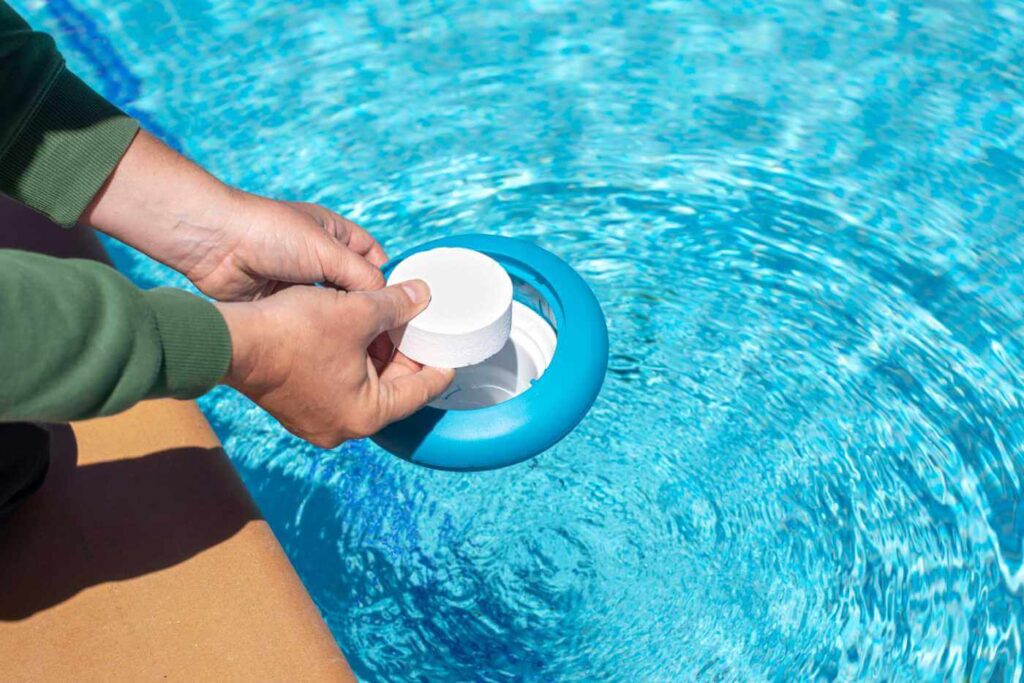
High cyanuric acid in a swimming pool is caused almost entirely by the routine use of stabilized chlorine products, specifically trichlor tablets and dichlor granules. Every time a chlorine tablet dissolves in the pool, it releases both chlorine and cyanuric acid into the water. The chlorine gets consumed sanitizing the pool, but the CYA stays behind and accumulates. According to Orenda Technologies, a pool chemistry company, trichlor is only 45.8% chlorine by weight, with the rest being CYA and other compounds. Over a single summer season of regular tablet use, CYA can easily climb from a healthy 30 to 50 ppm to 100 ppm or more.
Unlike chlorine, CYA does not evaporate, does not get consumed by sunlight, and does not break down through normal pool chemistry. It lingers in the water indefinitely unless physically removed. According to Swim University, a trusted pool education resource, CYA can even accumulate in the pool’s filtration system and plaster, making it persistent even after a partial water change. Liquid chlorine (sodium hypochlorite), cal-hypo shock (calcium hypochlorite), and salt-generated chlorine do not contain CYA and do not contribute to this buildup.
Homeowners in the Jefferson, Georgia area who use chlorine tablets as their primary sanitizer through the hot summer months are the most likely to see CYA levels climb above safe limits by the end of the season. Switching to liquid chlorine for part of the season helps control this buildup. Regular pool cleaning services include water chemistry testing that catches rising CYA levels early.
What Is the Ideal Level of Cyanuric Acid in a Pool?
The ideal level of cyanuric acid in a pool is 30 to 50 ppm for standard chlorine pools and 60 to 80 ppm for saltwater pools. According to Swim University, your free chlorine should be approximately 7.5% of your CYA level to maintain effective sanitization. That means a pool with CYA at 40 ppm needs free chlorine at 3 ppm. A pool with CYA at 80 ppm needs free chlorine at 6 ppm to do the same job.
This relationship between CYA and chlorine is the core reason high CYA is dangerous. As CYA increases, the amount of free chlorine needed to keep the water sanitized also increases. At some point, the CYA becomes so high that maintaining enough active chlorine becomes impractical. According to the Portage County, Ohio Department of Environmental Health, CYA levels exceeding 70 ppm can reduce chlorine effectiveness, and the amount of time it takes to kill bacteria gets longer as CYA concentration increases.
A weekly water test that includes CYA is essential for every pool owner. Test strips that measure CYA are available at any pool supply store, but the “black dot” turbidity test used by pool professionals is more accurate at higher CYA levels.
Is CYA 100 Too High?
Yes, CYA at 100 ppm is too high for a residential swimming pool. At 100 ppm, chlorine effectiveness drops significantly, and the water may not be properly sanitized even if the chlorine test shows adequate levels. According to Aqua Clear Pool Care, a pool service company, once CYA reaches 100 ppm or more, pool owners risk “chlorine lock,” a condition where chlorine is present in the water but is too bound up by CYA to actively kill bacteria and algae.
In some municipalities, CYA above 100 ppm in a commercial or community pool triggers a mandatory closure until levels are reduced. While residential pools do not face the same enforcement, the health risks are the same. Algae can bloom, bacteria can thrive, and swimmers can be exposed to waterborne illness, all while the chlorine test appears normal. If your CYA test reads 100 ppm or higher, take action immediately.
What Happens When Cyanuric Acid Builds Up in a Pool?
When cyanuric acid builds up in a pool, it progressively weakens chlorine’s ability to sanitize. The more CYA in the water, the slower chlorine kills pathogens. According to Orenda Technologies, high CYA also affects the Langelier Saturation Index (LSI), which is the industry formula for predicting whether pool water will scale or corrode surfaces. More CYA lowers the LSI value, making the water more aggressive and more likely to etch plaster and corrode metal components.
Other consequences of high CYA include cloudy water that does not respond to shocking, persistent algae growth even with seemingly adequate chlorine levels, false water chemistry readings on standard test kits, and increased chemical costs as you add more and more chlorine trying to overcome the CYA barrier. High CYA also contributes to total alkalinity readings, which can make pH management more confusing. For homeowners in the Athens, Braselton, and Jefferson area, catching CYA buildup early through regular testing prevents these cascading problems.
How to Lower CYA in a Pool: Step by Step
Lowering CYA in a pool requires removing the CYA-laden water and replacing it with fresh water that contains no CYA. Here is the most effective process.
Method 1: Partial Drain and Refill (Most Effective)
A partial drain and refill is the fastest, most reliable, and most cost-effective method for lowering cyanuric acid. According to Poolonomics, a pool maintenance resource, dilution works by replacing over-stabilized water with fresh, unstabilized water. If your CYA is 30% too high, replacing approximately 30% of the water brings it down by that amount.
Step 1: Stop adding stabilized chlorine (trichlor tablets and dichlor granules) to the pool immediately. Switch to liquid chlorine or cal-hypo shock for sanitizing until CYA is corrected.
Step 2: Calculate how much water to drain. If CYA is at 100 ppm and your target is 50 ppm, you need to replace roughly 50% of the water. If CYA is at 80 ppm with a target of 50 ppm, you need to replace about 37% of the water.
Step 3: Use a submersible pump or your filter’s waste setting to drain the calculated amount. Mark the current water level with tape before draining so you know exactly how much to remove.
Step 4: Refill with fresh water from a garden hose. Run the pump for several hours to mix the new water thoroughly.
Step 5: Retest CYA levels. If still too high, repeat the process. Also retest and rebalance pH, alkalinity, calcium hardness, and chlorine after refilling.
For concrete and gunite pools in Jefferson, Georgia, do not drain more than one-third of the water at a time to avoid hydrostatic uplift from groundwater pressure. If CYA is extremely high and requires draining more than half the water, a pool repair professional should manage the process to prevent structural damage.
Method 2: Reverse Osmosis (RO) Filtration
Reverse osmosis filtration is a professional-grade method that recycles pool water through a mobile RO unit, removing CYA and other dissolved minerals without draining the pool. This method is more expensive (typically $500 to $1,500 depending on pool size and CYA level) but conserves water and is ideal for areas with water restrictions or very hard fill water. According to Poolie, a pool service resource, RO treatment can filter out CYA and other impurities, leaving pristine water behind.
Method 3: CYA Reducer Products
CYA reducer products use specialized bacteria or chemical processes to break down cyanuric acid in the water. According to Orenda Technologies, some products on the market use nitrifying bacteria that can break CYA into its nitrogen components. However, the pool must be dechlorinated during treatment, the water temperature must be warm enough for the bacteria to work, and results vary widely. Natural Chemistry offers a CYA Removal Kit that claims to treat pools up to 25,000 gallons with CYA levels up to 150 ppm, with results expected in 7 to 10 days.
Industry consensus, according to both Swim University and Orenda Technologies, is that these products are unreliable compared to dilution. A partial drain and refill remains the gold standard for CYA reduction.
CYA Level Correction Reference Table
| Current CYA (ppm) | Target CYA (ppm) | Approx. % Water to Replace | Required FC at Current CYA |
|---|---|---|---|
| 50 | 30 to 50 | 0% (in range) | 3 to 4 ppm |
| 80 | 50 | ~37% | 6 ppm |
| 100 | 50 | ~50% | 7.5 ppm |
| 150 | 50 | ~67% | 11 ppm |
| 200+ | 50 | ~75% or full drain | 15+ ppm (impractical) |
Sources: Swim University, Orenda Technologies, Poolonomics, Pool Day. Free chlorine (FC) calculated at 7.5% of CYA level.
Will CYA Go Down Over Time on Its Own?
No, CYA will not go down significantly on its own over time. Unlike chlorine, which is consumed by sunlight and bather use, cyanuric acid is extremely stable and persistent. According to Orenda Technologies, CYA will eventually be oxidized from the water, but this process takes months and requires high chlorine levels. In practical terms, the CYA level in a pool stays the same until water is physically removed and replaced. Splash-out, backwashing, and heavy rain can gradually dilute CYA over a long period, but these natural losses are small compared to the CYA added by even a few weeks of trichlor tablet use.
Does Rain Water Lower Cyanuric Acid in Pools?
Yes, rainwater lowers cyanuric acid in pools through dilution. Rainwater contains no CYA, so when it enters the pool, it dilutes the CYA concentration. However, the effect is small unless the rainfall is very heavy. A typical thunderstorm might raise the pool water level by half an inch to an inch, which dilutes CYA by only a few percent. According to Swim University, rainwater is naturally acidic (pH around 5.0), which means heavy rain can also disrupt pH and alkalinity, requiring chemical rebalancing afterward.
Homeowners in the Jefferson and North Georgia area who get significant spring and summer rain should test their pool chemistry after every major storm. The CYA dilution from rain is a small bonus, but the pH and alkalinity changes from acidic rainwater need prompt correction.
Is It Okay to Swim If Cyanuric Acid Is High?
It is technically possible to swim in a pool with high CYA, but the water may not be safe. High CYA reduces chlorine’s ability to kill bacteria and pathogens, which means the pool could harbor harmful microorganisms even if the chlorine test reads normal. According to the CDC, proper disinfection is the primary barrier against recreational water illnesses, and anything that reduces chlorine effectiveness puts swimmers at risk. If your CYA is above 100 ppm, the chlorine in the water may not be doing its job regardless of what the test strip shows.
The safest approach is to lower CYA to the recommended range (30 to 50 ppm) before allowing swimming, especially for children, elderly adults, and anyone with a compromised immune system. If you must swim before correcting CYA, increase the free chlorine level to match the higher CYA. At 100 ppm CYA, you need approximately 7.5 ppm free chlorine, which is above the comfortable range and can cause skin and eye irritation.
Can I Shock My Pool With High CYA?
Yes, you can shock your pool with high CYA, but the shock will be far less effective. When CYA is elevated, chlorine molecules are bound to CYA and are not free to actively kill bacteria and algae. To achieve breakpoint chlorination (the level needed to destroy contaminants), you need to add much more chlorine than normal. According to the Trouble Free Pool community, a widely respected pool maintenance resource, the recommended shock level is approximately 40% of the CYA reading. So at 100 ppm CYA, you would need to raise free chlorine to 40 ppm to achieve breakpoint, which is a massive and expensive amount of chlorine.
This is why lowering CYA through dilution is far more practical than trying to overcome it with higher chlorine doses. Shocking a pool with very high CYA is like trying to put out a fire with a water gun, it technically works but is wildly inefficient.
How Does Cyanuric Acid Get Too High in the Pool?
Cyanuric acid gets too high in the pool because stabilized chlorine products (trichlor and dichlor) continually add CYA every time they dissolve. According to Aqua Clear Pool Care, for an average summer season of routine chlorine tablet use, CYA can easily climb from the ideal 30 to 50 ppm range to 100 ppm or more. Each 3-inch trichlor tablet that dissolves adds roughly 6 ppm of CYA per 10,000 gallons. Over the course of a 20-week swim season with weekly tablet replacements, that adds up fast.
The key takeaway is that every stabilized chlorine product raises CYA. The only chlorine products that do not raise CYA are liquid chlorine (sodium hypochlorite), calcium hypochlorite (cal-hypo), and chlorine generated by a saltwater system’s salt cell. Pool owners who want to control CYA should use a combination of stabilized and non-stabilized chlorine throughout the season, or switch entirely to liquid chlorine once CYA reaches the target level.
Is Cyanuric Acid the Same as Baking Soda?
No, cyanuric acid is not the same as baking soda. They are completely different chemicals with different purposes. Cyanuric acid (C3H3N3O3) is a chlorine stabilizer that protects chlorine from UV degradation. Baking soda (sodium bicarbonate, NaHCO3) is an alkalinity increaser that raises total alkalinity and slightly raises pH. Adding baking soda to a pool will not lower CYA. Adding cyanuric acid to a pool will not raise alkalinity in the same way baking soda does. They are not interchangeable.
Does Pool Stabilizer Raise Cyanuric Acid?
Yes, pool stabilizer raises cyanuric acid because pool stabilizer IS cyanuric acid. The terms “pool stabilizer,” “pool conditioner,” and “cyanuric acid” all refer to the same chemical. When you add stabilizer to your pool, you are adding CYA directly. According to Swim University, the only time you should add pure CYA stabilizer is when starting up a new pool, after a partial drain and refill, or when CYA has dropped below 30 ppm. Never add stabilizer without testing CYA levels first.
Does High CYA Make a Pool Cloudy?
Yes, high CYA can make a pool cloudy, but indirectly. High CYA reduces chlorine effectiveness, which allows bacteria, algae spores, and fine organic particles to multiply in the water. These contaminants cause cloudiness. According to Swim University, when CYA is too high, your chlorine cannot sanitize effectively, and you will start to see cloudy water and possibly algae growth. The cloudiness is not caused by the CYA itself but by the biological contamination that chlorine can no longer control.
If your pool is cloudy and you have tested the water to find high CYA along with adequate chlorine levels, the CYA is the root cause. Lowering CYA through dilution restores chlorine’s ability to sanitize, which clears the water. Adding clarifier or extra chlorine without addressing CYA is a temporary fix at best. A pool inspection can diagnose persistent cloudiness and identify whether CYA is the underlying issue.
How to Prevent Cyanuric Acid From Building Up
Preventing cyanuric acid from building up requires managing the amount of stabilized chlorine you add to the pool. The most effective prevention strategies include using liquid chlorine (sodium hypochlorite) as the primary sanitizer instead of trichlor tablets, adding trichlor tablets only when CYA is below 30 ppm and stopping once it reaches 50 ppm, testing CYA at least once a month during swim season, using cal-hypo shock instead of dichlor shock because dichlor contains CYA, and partially draining and refilling the pool at the end of each season to reset water chemistry.
For saltwater pool owners in the Gainesville, Hoschton, and Jefferson area, the salt cell generates chlorine without adding CYA, which makes CYA management easier. However, if you add stabilizer manually at startup, be careful not to overshoot. Start with a small amount, test, and add more only if needed. A seasonal opening service includes CYA testing and adjusts the stabilizer level precisely for the start of the new season.
What Is a Cyanuric Acid Reducer?
A cyanuric acid reducer is a product that claims to break down CYA in pool water without draining. Most CYA reducers use specialized bacteria that consume cyanuric acid as a nitrogen source. According to Natural Chemistry, their CYA Removal Kit is a two-part system that first dechlorinates the water and then introduces CYA-reducing agents. The treatment takes 7 to 10 days and requires the pool pump to run 24 hours a day during the process. The chlorinator must be turned off, and only liquid chlorine can be used to maintain a minimal residual.
The results of CYA reducer products are mixed. Orenda Technologies notes that the nitrifying bacteria in these products cannot survive in chlorinated water, which is why the pool must be dechlorinated first. Some pool owners report success, while others see little or no change. Industry professionals generally recommend dilution as the more reliable option. CYA reducers may be worth trying for pool owners who cannot easily drain water due to water restrictions or structural concerns.
Will Shocking a Pool Lower Chlorine?
No, shocking a pool raises chlorine temporarily, it does not lower it. Pool shock is a concentrated dose of chlorine (or non-chlorine oxidizer) added to the pool to reach breakpoint chlorination and destroy organic contaminants, chloramines, and algae. After shocking, the chlorine level will be elevated for 12 to 24 hours and then gradually return to normal as the chlorine does its work. According to Swim University, you should wait until free chlorine drops below 5 ppm before swimming after a shock treatment.
If your chlorine is too high and you want to lower it, stop adding chlorine, let the pump run to circulate and expose the water to sunlight (which degrades chlorine), and wait. You can also add a chlorine neutralizer (sodium thiosulfate) for an immediate reduction. Do not confuse shocking (which raises chlorine) with draining (which lowers CYA). These are different processes that solve different problems.
What Time of Day Should You Shock Your Pool?
You should shock your pool at dusk or after sunset. Sunlight breaks down chlorine rapidly, and shocking during the day means a large portion of the chlorine you just added will be destroyed by UV rays before it can do its job. According to Swim University, shocking at night gives the chlorine the full overnight period (8 to 12 hours of darkness) to work without UV interference. Run the pump overnight after shocking to circulate the treated water throughout the pool.
This is especially important in the North Georgia summer, where long daylight hours and intense sun can degrade unprotected chlorine in minutes. If your CYA is in the proper 30 to 50 ppm range, it will protect some of the chlorine from UV loss during the next day. But the initial shock treatment is always most effective when applied at night.
How to Balance Cyanuric Acid in a Pool
Balancing cyanuric acid in a pool means keeping it within the ideal range (30 to 50 ppm for chlorine pools, 60 to 80 ppm for saltwater pools) and adjusting free chlorine to match. According to iopool, a pool chemistry resource, if CYA is too low, add 13 ounces of granular CYA stabilizer per 10,000 gallons to raise it by 10 ppm. For vinyl and fiberglass pools, dissolve the stabilizer in a bucket of warm water first. For concrete pools, it can be broadcast directly and brushed across the floor.
If CYA is too high, partially drain and refill. After any CYA adjustment, retest all other chemistry parameters and adjust accordingly. Maintaining the 7.5% ratio between free chlorine and CYA keeps sanitization effective. At 40 ppm CYA, keep free chlorine at 3 ppm. At 50 ppm CYA, keep free chlorine at 4 ppm. This ratio ensures chlorine has enough active power to keep the water safe. A professional pool cleaning service manages this balance as part of regular weekly or biweekly visits.
Frequently Asked Questions
How Often Should I Test CYA in My Pool in Jefferson, Georgia?
You should test CYA in your pool in Jefferson, Georgia at least once a month during swim season and after any significant water addition or drain. If you use trichlor tablets as your primary sanitizer, test every two weeks because CYA accumulates with each tablet. The hot, sunny North Georgia summer accelerates chlorine consumption, which means more tablets and faster CYA buildup. Catching a rising CYA level at 60 ppm is much easier to correct than waiting until it hits 150 ppm.
Does CYA Affect Saltwater Pools in the Athens, Georgia Area?
Yes, CYA affects saltwater pools in the Athens, Georgia area, but the buildup happens more slowly because salt cells generate chlorine without adding CYA. Saltwater pool owners still need CYA (60 to 80 ppm) to protect the chlorine from UV degradation. The CYA is added manually during startup and occasionally supplemented. The risk comes if the owner also uses stabilized chlorine tablets as a supplement, which adds CYA on top of the manually added amount. Stick to liquid chlorine for any supplemental dosing.
Can I Add CYA and Chlorine at the Same Time?
You can add CYA and chlorine at the same time, but it is better to add them separately and several hours apart. Adding granular CYA directly to the pool can create a temporary localized area of very high CYA that binds nearby chlorine before it has a chance to circulate. Add the CYA, run the pump for 4 to 6 hours, then test and add chlorine as needed.
What Happens If I Drain Too Much Water Trying to Lower CYA?
If you drain too much water from a concrete pool, hydrostatic pressure from groundwater can push the pool shell upward, causing cracking or even lifting the pool out of the ground. Never drain more than one-third of the water from a concrete pool at a time without professional supervision. If CYA requires more than a one-third drain, do it in stages over several days, refilling between each drain. For pools in North Georgia where heavy spring rains saturate the ground, the risk of hydrostatic uplift is higher than average.
Should I Use Liquid Chlorine or Tablets to Avoid High CYA in Braselton, Georgia?
You should use liquid chlorine as your primary sanitizer to avoid high CYA in Braselton, Georgia. Liquid chlorine (sodium hypochlorite) contains zero cyanuric acid and will never raise CYA levels. Use a small amount of granular CYA stabilizer at the start of the season to bring CYA to 30 to 50 ppm, then maintain chlorine with liquid chlorine for the rest of the summer. This approach gives you full UV protection without the CYA buildup that comes from daily tablet use.
Does a Pool Closing Service Include CYA Testing?
Yes, a professional pool closing service typically includes a full water chemistry test, which covers CYA, pH, alkalinity, calcium hardness, and chlorine. If CYA is elevated at the end of the season, the technician can recommend a partial drain and refill before closing the pool for winter. Starting the next season with balanced CYA saves time and money on chemicals when the pool is reopened in spring.
How Long After Lowering CYA Can I Swim?
You can swim as soon as the pool is refilled, the water is fully circulated (at least 4 to 6 hours of pump run time), and all chemistry levels are balanced. After a partial drain and refill, test pH (7.2 to 7.8), free chlorine (1 to 3 ppm based on CYA level), alkalinity (80 to 120 ppm), and CYA (30 to 50 ppm) before anyone enters the water. If all readings are in range, the pool is safe to swim in.
Final Thoughts
High cyanuric acid is one of the most common and most misunderstood pool chemistry problems. It creeps up silently over weeks and months of normal chlorine tablet use, and by the time most homeowners notice something is wrong, the CYA level is already well above safe limits. The fix is straightforward: stop adding stabilized chlorine, partially drain and refill the pool, and switch to liquid chlorine for ongoing sanitization. For homeowners in Jefferson, Georgia and across the North Georgia area, regular CYA testing and a proactive approach to chlorine management keep the pool safe, clear, and enjoyable all season long.
If your pool water is cloudy, your chlorine seems to disappear overnight, or algae keeps coming back no matter how much you shock, high CYA is likely the culprit. Sandals Luxury Pools has been helping homeowners across Jefferson, Athens, Gainesville, Braselton, and the surrounding communities maintain perfect pool chemistry for over a decade. From professional pool maintenance to equipment upgrades and full water chemistry overhauls, their team is ready to help. Contact them today to schedule a consultation and get your pool back to crystal clear.
