
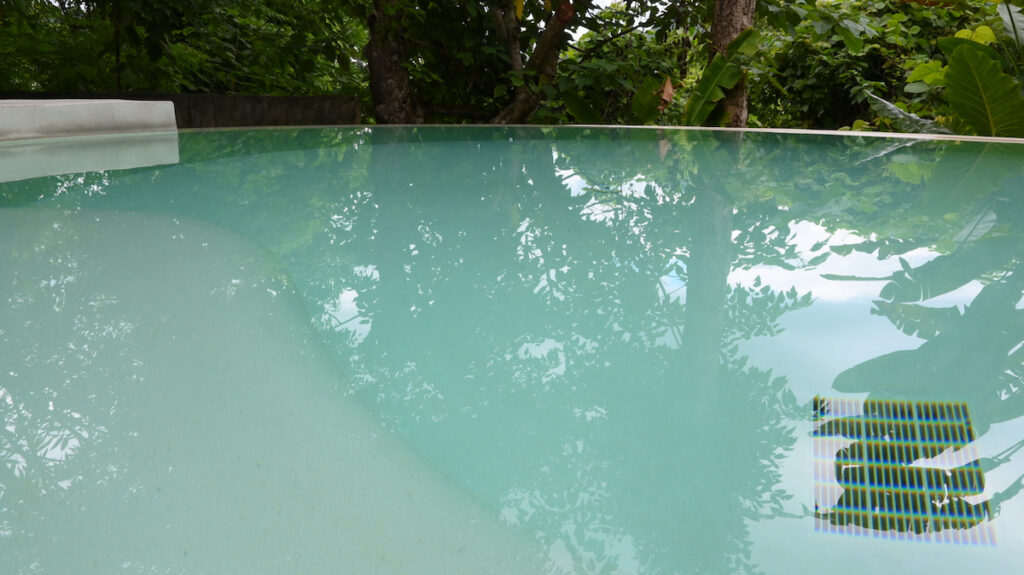
Yes, you can fix cloudy pool water quickly by testing your water chemistry, balancing pH and chlorine levels, running your filter for 24 hours, and using a pool clarifier or flocculant. Most cloudy pools clear up within 24 to 72 hours when you treat the root cause. Cloudy water is one of the most common pool problems for homeowners in Jefferson, Georgia, and across the country. According to the Pool and Hot Tub Alliance, there are over 10.7 million residential pools in the United States, and nearly every pool owner deals with cloudy water at some point. This guide walks through every step to diagnose and fix cloudy pool water fast, so you can get back to enjoying your backyard.
What Causes Cloudy Pool Water?
The most common causes of cloudy pool water are chemical imbalances, poor filtration, environmental contaminants, and heavy swimmer use. Cloudy water happens when tiny particles get suspended in the water and scatter light instead of letting it pass through. These particles can include dead algae, bacteria, dirt, calcium deposits, body oils, and sunscreen.
Pool owners in Jefferson and surrounding areas like Braselton, Hoschton, and Athens deal with specific challenges. North Georgia’s red clay soil, heavy pine pollen, and summer thunderstorms all introduce contaminants that make pool water cloudy faster than in other parts of the country. Pools near wooded lots and agricultural areas face even more debris from trees, fertilizer runoff, and organic material.
According to a CDC surveillance report, 208 outbreaks linked to treated recreational water occurred in the United States between 2015 and 2019, resulting in over 3,600 cases of illness. Many of these outbreaks were tied to poor water chemistry and inadequate filtration. That means cloudy pool water is not just ugly, it is a real health risk.
What Is the Most Common Cause of Cloudy Pool Water?
The most common cause of cloudy pool water is improper water chemistry, especially low free chlorine levels and high pH. When chlorine drops below 1.0 ppm, bacteria and organic material build up in the water and create a hazy, dull appearance. When pH climbs above 7.8, chlorine loses much of its power, and calcium can start to scale and cloud the water.
According to the Pool Calculator, at a pH of 8.0, free chlorine is only about 20% effective at killing contaminants. Drop that pH to 7.0, and chlorine jumps to about 66% effectiveness. That is a massive difference, and it explains why so many pools turn cloudy even when the chlorine level looks fine on a test strip. The pH is quietly working against the sanitizer.
Homeowners in the Gainesville, Braselton, and Winder areas who fill their pools with well water often deal with high calcium hardness and elevated pH right from the start. If you have well water, test it before adding it to your pool, because it can throw off your balance immediately and cause cloudiness within hours.
How Do I Make My Pool Water Crystal Clear Fast?
You make your pool water crystal clear fast by following a simple five-step process: test the water, balance the chemicals, clean the filter, shock the pool, and add a clarifier or flocculant. Each step targets a different cause of cloudiness, and doing all five together gives you the fastest results.
Step 1: Test Your Pool Water
Start by testing your water with a reliable test kit or test strips. You need to check free chlorine, pH, total alkalinity, calcium hardness, and cyanuric acid. Here are the ideal ranges according to the Pool and Hot Tub Alliance and CDC guidelines:
Free chlorine should sit between 1.0 and 3.0 ppm. pH should be between 7.2 and 7.6 for best results. Total alkalinity should be between 80 and 120 ppm. Calcium hardness should be between 200 and 400 ppm. Cyanuric acid should be between 30 and 50 ppm for standard chlorine pools.
If any of these numbers are off, they could be causing the cloudiness. Getting a professional pool inspection can also help pinpoint problems you might miss with a home test kit.
Step 2: Balance Your Water Chemistry
Adjust your chemicals based on the test results. If pH is high, add a pH decreaser like sodium bisulfate or muriatic acid. If pH is low, add soda ash or sodium bicarbonate. Pool owners in Jefferson, Georgia, who want detailed guidance on lowering pH in a pool the right way can find step-by-step instructions that work for North Georgia’s water conditions.
Total alkalinity acts as a buffer for pH. According to industry standards, keeping alkalinity between 80 and 120 ppm prevents pH from swinging wildly, which makes it easier to keep chlorine working at full strength. If alkalinity is too high, it pushes pH up and makes the water cloudy and resistant to correction.
Step 3: Clean or Backwash Your Filter
A dirty filter cannot remove the tiny particles that cause cloudy water. Sand filters need backwashing when pressure rises 8 to 10 psi above the normal starting pressure. Cartridge filters need to be removed and rinsed. DE filters need fresh diatomaceous earth after each backwash. According to Swim University, filter sand should be replaced every five years, and cartridge filters should be swapped every two to three years to keep filtration at its best.
Run your filter for at least 24 hours straight after cleaning it. The goal is to pass all of your pool water through the filter at least once, and for most residential pools, that takes 8 to 12 hours at normal flow rates. Running it for a full day gives you a double pass and much better results.
Step 4: Shock Your Pool
Pool shock is a concentrated dose of chlorine that kills bacteria, destroys chloramines, and clears organic contaminants. For cloudy water, use one pound of calcium hypochlorite shock per 10,000 gallons of water. For severe cloudiness or early algae, double or triple that dose. According to In The Swim, a chlorine level of 10 to 30 ppm sustained for several hours is needed to remove algae, bacteria, and chloramines effectively.
Always shock your pool at dusk or nighttime. Sunlight breaks down unstabilized chlorine quickly, and shocking during the day wastes a large portion of the treatment. Keep the pump running for at least 8 hours after shocking to circulate the chlorine throughout the entire pool.
Step 5: Add a Clarifier or Flocculant
If the water is still hazy after balancing chemicals and shocking, add a pool clarifier or flocculant. These products bind to the tiny particles in the water and either help the filter catch them or sink them to the bottom for vacuuming. Families in the Athens, Dacula, and Buford areas often need this extra step after heavy spring pollen or summer storms dump debris into the pool.
What Is the Fastest Way To Clear a Cloudy Pool?
The fastest way to clear a cloudy pool is to use a pool flocculant. Flocculant clumps suspended particles together into heavy masses that sink to the pool floor within hours. You then vacuum the settled debris to waste, bypassing the filter entirely. According to Pool Marvel, flocculant can clear cloudy pool water in less than 24 hours, making it the fastest chemical option available.
Flocculant works best with sand or DE filters where you can set the multiport valve to waste. Cartridge filter owners cannot use flocculant because the heavy clumps clog the cartridge. If you have a cartridge filter, use a pool clarifier instead, which takes two to three days but works with any filter type.
Pool owners throughout Jackson County and surrounding North Georgia communities often need fast results before a weekend gathering or holiday. Flocculant is the best option when time is tight, but keep in mind that vacuuming to waste lowers the water level, so you will need to top off the pool with a garden hose afterward and rebalance the chemistry.
Will Shock Clear a Cloudy Pool?
Yes, shock will clear a cloudy pool if the cloudiness is caused by low chlorine, bacteria, algae, or chloramines. Shock treatment raises the free chlorine to a level high enough to break down organic contaminants and restore water clarity. According to the Indiana State Department of Health, breakpoint chlorination requires adding ten times the amount of combined chlorine present in the water. For most situations, reaching 30 ppm of free chlorine hits the breakpoint threshold needed to destroy chloramines and pathogens.
Shock alone may not fix cloudiness caused by high calcium hardness, high pH, or clogged filters. If your chlorine levels are already in the normal range and the water is still cloudy, the problem is likely a chemical imbalance or filtration issue rather than a sanitizer deficiency. Test your water first before adding shock, because shocking a pool with high pH wastes the treatment. At a pH of 8.0, over half of the shock becomes inactive, according to In The Swim.
How Long Does It Take for a Pool To Go From Cloudy To Clear?
It takes 24 to 72 hours for a pool to go from cloudy to clear, depending on the cause and treatment method. Mild cloudiness from a chemical imbalance can clear in 24 hours after balancing and running the filter. Moderate cloudiness from heavy rain or swimmer load usually takes 48 hours with shock treatment and filtration. Severe cloudiness from algae or major contamination can take 72 hours or longer with multiple shock treatments and clarifier.
According to Corey Coughenour, director of operations at Anthony and Sylvan Pools, it usually takes between two to three days to clear a cloudy pool. Running the pump and filter for at least 8 hours a day during swimming season, and up to 24 hours during treatment, speeds up the process significantly.
Pool maintenance matters year-round in Jefferson and across North Georgia. Homeowners who keep up with regular pool cleaning services rarely deal with severe cloudiness because small issues get caught before they become big problems.
Can Too Much Chlorine Make a Pool Cloudy?
Yes, too much chlorine can make a pool cloudy, though it is less common than cloudiness from too little chlorine. When chlorine levels spike above 5.0 ppm, especially after a heavy shock treatment, the excess chemicals can temporarily cloud the water. Calcium hypochlorite shock adds calcium to the water with every use, and if calcium hardness exceeds 400 ppm, it causes scaling and persistent cloudiness.
According to Clorox Pool and Spa, each pound of cal-hypo shock adds roughly 0.8 ppm of calcium to the water. Over time, repeated shocking can push calcium levels into the danger zone, particularly in areas with naturally hard well water like parts of Jackson County and Barrow County. If your calcium hardness is already high, consider using a dichlor or non-chlorine shock to avoid adding even more calcium.
The cloudiness from excess chlorine usually fades within 24 to 48 hours as the chlorine dissipates. Running the filter and allowing sunlight to break down the extra chlorine speeds up the process.
Is It Okay To Swim in a Cloudy Pool?
No, it is not okay to swim in a cloudy pool. Cloudy pool water is a safety hazard for two important reasons: reduced visibility and potential contamination. If you cannot see the drain at the bottom of the deep end, you cannot see a person who might be in distress underwater. According to the CDC, drowning often happens without splashing or screaming, and cloudy water makes it nearly impossible to spot someone in trouble.
The CDC also reported that between 2000 and 2014, 493 outbreaks linked to treated recreational water caused over 27,000 cases of illness and eight deaths across the United States. Cryptosporidium alone accounted for 89% of those illness cases. Cloudy water often means the sanitizer is not working properly, which allows dangerous pathogens to survive and multiply.
Stay out of the pool until the water is clear enough to see the main drain from the pool deck. Test the water to confirm chlorine is between 1.0 and 3.0 ppm and pH is between 7.2 and 7.8 before anyone swims.
Does Cloudy Water Mean Bacteria?
Cloudy water does not always mean bacteria, but it is a strong warning sign that bacteria could be present. Cloudiness can come from mineral deposits, fine dirt particles, dead algae, or chemical imbalances, none of which are harmful on their own. However, the conditions that cause cloudiness, especially low chlorine and poor filtration, also create an environment where bacteria thrive.
The American Academy of Family Physicians published research showing that at least 2,000 people per year in the United States contract illness from recreational water, with roughly 10% requiring hospitalization. Cryptosporidium and Giardia account for over 50% of all reported recreational waterborne illnesses, and both organisms can survive in water with inadequate chlorine levels.
If your pool is cloudy and you have not tested the water recently, assume bacteria may be present. Test immediately, shock the pool, and wait until the water clears and chlorine levels stabilize before swimming. Families with young children, elderly swimmers, or anyone with a weakened immune system should be especially careful.
Why Is My Pool Still Cloudy After Shocking?
Your pool is still cloudy after shocking because of one or more of these reasons: the pH was too high during shocking, the filter is dirty or not running long enough, calcium hardness spiked from the shock, cyanuric acid levels are too high, or there are still particles in the water that need a clarifier to remove.
A high pH above 7.8 dramatically reduces the effectiveness of chlorine shock. At 7.2, chlorine is about 66% effective. At 7.8, it drops to roughly 22%. Always test and lower pH before shocking. Pools in areas like Hoschton, Nicholson, and Gainesville with naturally alkaline well water often have pH issues that sabotage shock treatments.
High cyanuric acid, also called stabilizer, above 50 ppm can also weaken chlorine’s sanitizing power and make shock treatments less effective. If cyanuric acid is above 80 ppm, the only reliable fix is to drain some water and refill with fresh water to dilute it. If your pool struggles with persistent cloudiness after shocking, professional pool repair services can diagnose equipment problems like a failing pump, cracked filter housing, or leaking plumbing that keep water from circulating properly.
What Chemical Will Clear a Cloudy Pool?
The chemical that will clear a cloudy pool depends on the cause. Chlorine shock clears cloudiness caused by bacteria, algae, and organic contaminants. A pH decreaser clears cloudiness caused by high pH and calcium scaling. A pool clarifier or flocculant clears cloudiness caused by fine suspended particles that the filter cannot catch on its own.
| Chemical | Best For | Time To Clear | Filter Compatibility |
|---|---|---|---|
| Calcium Hypochlorite Shock | Low chlorine, bacteria, algae | 24-48 hours | All filter types |
| Non-Chlorine Shock | Chloramines, mild organic buildup | 24 hours | All filter types |
| Pool Clarifier | Fine particles, mild cloudiness | 2-3 days | All filter types |
| Pool Flocculant | Heavy cloudiness, fast results | 8-24 hours | Sand and DE filters only |
| pH Decreaser (Muriatic Acid) | High pH, calcium scaling | 6-24 hours | All filter types |
| Algaecide | Early-stage algae causing haze | 24-72 hours | All filter types |
Data compiled from Swim University, Leslie’s Pool Supplies, Clorox Pool and Spa, and Pool Calculator. Specific clearing times depend on pool size, water temperature, and severity of cloudiness.
For pools in Jefferson and across North Georgia, a combination approach works best. Start with balancing pH and alkalinity, then shock, and finish with a clarifier if needed. If early-stage algae is contributing to the haze, an algaecide used after shocking helps prevent algae growth from returning.
Can You Put Too Much Clarifier in a Pool?
Yes, you can put too much clarifier in a pool, and it will actually make the cloudiness worse. Overdosing clarifier causes the opposite of the intended effect. Instead of clumping particles together, excess clarifier causes particles to repel each other, keeping them suspended in the water longer. According to Leslie’s Pool Supplies, overdosing clarifier is one of the most common mistakes pool owners make when trying to clear cloudy water fast.
Always follow the manufacturer’s dosage instructions based on your pool’s volume. Most liquid clarifiers require about one ounce per 5,000 gallons of water. If one dose does not clear the pool within 48 to 72 hours, do not add more. Instead, check your filter, run the pump longer, and retest the water chemistry.
Will Baking Soda Clear a Cloudy Pool?
No, baking soda will not clear a cloudy pool on its own. Baking soda, which is sodium bicarbonate, raises total alkalinity and slightly raises pH. If your pool is cloudy because alkalinity is too low and pH is unstable, baking soda can help stabilize the water, which may improve clarity over time. But if cloudiness is caused by low chlorine, algae, fine particles, or high calcium, baking soda does nothing to fix those problems.
According to The Home Depot, baking soda has a pH of 8, which means adding it will push your pH upward. If your pH is already high, adding baking soda makes the problem worse and can cause even more cloudiness. Only add baking soda when a water test shows low total alkalinity below 80 ppm.
Homeowners in Braselton and Commerce sometimes add baking soda because they heard it is a cheap fix. It can help in specific situations, but it is not a replacement for proper chemical treatment, shock, or filtration.
Will Muriatic Acid Clear a Cloudy Pool?
Yes, muriatic acid will clear a cloudy pool if the cloudiness is caused by high pH, high alkalinity, or calcium scaling. Muriatic acid lowers both pH and total alkalinity, which improves chlorine effectiveness and reduces the calcium precipitation that causes milky, cloudy water. Many pools in North Georgia develop high pH from well water and alkaline fill water, making muriatic acid a common and effective treatment.
Add muriatic acid slowly to the deep end of the pool with the pump running. Never dump it all in one spot. Retest the water after 6 hours of circulation and adjust as needed. The target pH should be between 7.2 and 7.6 for best water clarity and chlorine performance.
How Many Bags of Shock Do I Need for a Cloudy Pool?
The number of bags of shock you need for a cloudy pool depends on the pool size, the severity of the cloudiness, and the type of shock you use. As a general rule, use one pound of calcium hypochlorite shock per 10,000 gallons for mild cloudiness. For moderate cloudiness, use two pounds per 10,000 gallons. For severe cloudiness with algae, use three to six pounds per 10,000 gallons.
A standard residential pool in Jefferson holds between 15,000 and 25,000 gallons. That means a mildly cloudy 20,000-gallon pool needs about two pounds of shock. A severely cloudy pool with green tint needs six to twelve pounds. According to In The Swim, if you can see the shallow end floor, a double dose of shock is enough. If you can only see 12 to 24 inches into the water, use a triple to six-times dose to reach breakpoint chlorination.
Always check pH before shocking. A pH above 7.8 wastes shock, and you will need even more product to get results. Lower pH first, then shock at dusk for maximum effectiveness.
How Do You Clear Up Cloudy Water in Your Pool After Rain?
You clear up cloudy water in your pool after rain by testing the water, rebalancing chemicals, shocking, and running the filter for 24 hours. Rain dilutes chlorine, lowers pH, and washes dirt, pollen, and organic debris into the pool. All of these changes cause cloudiness. Summer thunderstorms in Jefferson, Athens, and the surrounding North Georgia foothills bring red clay runoff, lawn fertilizer, and tree debris that overwhelm pool chemistry quickly.
After heavy rain, skim the surface to remove leaves and floating debris. Brush the walls and floor to loosen settled dirt. Test and adjust pH, alkalinity, and chlorine. Then shock the pool at the standard dose of one pound per 10,000 gallons. Run the filter for at least 24 hours and backwash when pressure rises. Keeping up with seasonal pool maintenance helps your pool handle storms better because the equipment stays clean and the chemistry stays closer to ideal.
What Can I Put in My Pool To Make It Crystal Clear?
You can put chlorine shock, pool clarifier, pH decreaser, algaecide, or flocculant in your pool to make it crystal clear, depending on what is causing the problem. The best approach is to test the water first and then treat the specific issue. Dumping random chemicals into a pool without testing is the number one cause of persistent water problems.
For long-term crystal clear water, the most important things are consistent chlorine levels between 1.0 and 3.0 ppm, pH between 7.2 and 7.6, clean filters, and good circulation. Pool owners who test their water weekly and adjust chemicals as needed rarely deal with cloudy water. According to HomeGuide, homeowners typically spend between $3,000 and $6,000 per year on pool maintenance, but most of that cost goes toward preventing problems rather than fixing emergencies.
Residents in Winder, Statham, and Loganville who deal with heavy spring pollen benefit from running clarifier regularly during March through May to keep particles from building up in the water.
Why Is My Pool Water Cloudy but Chemicals Are Balanced?
Your pool water is cloudy but chemicals are balanced because of a filtration problem, fine particles the filter cannot catch, or early-stage algae that has not yet shown as green. The most common hidden culprit is a filter that looks clean but has worn-out media. Sand filters lose effectiveness after five years because the sand grains become smooth and cannot trap particles. Cartridge filters degrade after two to three years and develop micro-tears that let particles pass through.
Another cause is inadequate run time. Most pools need 8 to 12 hours of pump run time per day to filter all the water at least once. During hot summer months in North Georgia, 10 to 12 hours is better. If your pump only runs 4 to 6 hours, particles accumulate faster than the filter can remove them.
Dead algae particles are another common cause. After a shock treatment kills algae, the dead cells remain in the water as fine white or gray particles. These are too small for some filters to catch without a clarifier. Adding a clarifier after shocking helps the filter grab these leftover particles and clear the water completely. Pool owners who recently dealt with an algae bloom can learn more about the full treatment process from resources on getting rid of algae in your pool effectively.
How Long Does It Take for Chlorine To Clear a Cloudy Pool?
It takes 24 to 48 hours for chlorine to clear a cloudy pool after a proper shock treatment with adequate filtration. The chlorine needs time to oxidize organic material, kill bacteria, and break apart chloramines. The filter then needs to physically remove the dead contaminants from the water. Running the pump continuously after shocking gives the fastest results.
If the pool does not improve after 48 hours, the shock treatment may not have reached breakpoint chlorination. Test the free chlorine level. If it has dropped back to zero within 12 hours, there is still a heavy demand from contaminants, and you need to shock again at a higher dose. According to the Indiana State Department of Health, reaching breakpoint requires adding enough chlorine to raise the free chlorine by ten times the combined chlorine level. Not adding enough actually makes the problem worse by creating more chloramines.
Can You Use a Pool Clarifier and Shock at the Same Time?
Yes, you can use a pool clarifier and shock at the same time, but it is better to shock first and add the clarifier the next day. Shocking raises the chlorine level dramatically, and the high chlorine concentration can reduce the effectiveness of some clarifiers. By waiting 12 to 24 hours after shocking, you let the chlorine do its job first. Then the clarifier can work on the remaining fine particles without interference.
Never add clarifier and flocculant at the same time. Clarifier requires the filter to run continuously, while flocculant requires the filter to be turned off so particles can settle. Using both together cancels out the benefits of each product.
Frequently Asked Questions
How Often Should You Shock Your Pool in Jefferson, Georgia?
You should shock your pool once every one to two weeks during swimming season in Jefferson, Georgia. The hot and humid summers in North Georgia, combined with heavy pollen, summer storms, and high swimmer loads, put extra demand on chlorine. Shock after every heavy rainstorm, after pool parties, and anytime you notice a strong chlorine smell, which actually signals chloramines rather than excess chlorine. According to Swim University, most pools need weekly shocking during peak summer use.
Does Running the Pool Pump Longer Help Clear Cloudy Water?
Yes, running the pool pump longer helps clear cloudy water significantly. During normal conditions, 8 to 12 hours of daily pump time is enough. When treating cloudy water, run the pump for 24 hours straight to give the filter maximum contact time with the water. Every pass through the filter removes more particles. Pool owners in Braselton, Dacula, and Hoschton with variable-speed pumps can run them at a lower speed for longer hours to save on electricity while still getting great filtration.
What Is the Best Pool Filter for Preventing Cloudy Water?
The best pool filter for preventing cloudy water is a DE (diatomaceous earth) filter, which can capture particles as small as 2 to 5 microns. Cartridge filters catch particles down to 10 to 15 microns, and sand filters capture particles around 20 to 40 microns. According to the Pool and Hot Tub Alliance, DE filters provide the finest filtration for residential pools. However, all filter types work well when properly maintained. The most important thing is regular cleaning and timely media replacement.
Can Yellow or Mustard Algae Cause Cloudy Pool Water?
Yes, yellow or mustard algae can cause cloudy pool water. Unlike green algae, which turns the water visibly green, yellow algae in a swimming pool often appears as a subtle haze before it becomes visible on walls and floors. Mustard algae is chlorine-resistant and requires aggressive treatment with a triple dose of shock, thorough brushing, and disinfection of all pool toys and equipment. Pools near wooded areas in Jackson County and Hall County are especially prone to mustard algae because of the organic matter that constantly enters the water.
Should You Drain Your Pool To Fix Severe Cloudiness?
No, you should not drain your pool to fix severe cloudiness unless the total dissolved solids (TDS) exceed 2,500 ppm or the cyanuric acid is above 100 ppm. Draining a pool in Jefferson, Georgia, can cause the shell to pop out of the ground from hydrostatic pressure, especially during rainy seasons when the water table rises. A partial drain of 25% to 50% of the water, followed by refilling with fresh water, is safer and usually enough to dilute high chemical levels. Talk to a professional before draining any pool.
When Should You Call a Professional for Cloudy Pool Water in North Georgia?
You should call a professional for cloudy pool water in North Georgia if the water does not clear after 72 hours of treatment, if the filter pressure remains abnormally high after cleaning, if you notice equipment leaks or unusual pump noises, or if the water has a strong odor that will not go away. These signs point to equipment problems or severe contamination that need expert diagnosis. Families throughout Jefferson, Athens, and Gainesville rely on experienced pool teams to handle complex water problems quickly.
How Can Pool Owners in Jefferson Prevent Cloudy Water Year-Round?
Pool owners in Jefferson can prevent cloudy water year-round by testing water chemistry weekly, maintaining chlorine between 1.0 and 3.0 ppm, keeping pH between 7.2 and 7.6, running the pump 8 to 12 hours daily, cleaning the filter on schedule, brushing and skimming regularly, and shocking the pool weekly during summer. Proper pool winterization in the fall also prevents spring cloudiness by keeping the water balanced during the off-season. According to the Pool and Hot Tub Alliance, approximately 8% of U.S. households own a pool, and the ones that stay crystal clear year-round are the ones with consistent maintenance routines.
Final Thoughts
Cloudy pool water is frustrating, but it is almost always fixable within a few days when you follow the right steps. Test first, balance the chemistry, clean the filter, shock the pool, and use a clarifier or flocculant when needed. North Georgia’s climate brings specific challenges like red clay, pollen, and summer storms, but consistent maintenance keeps those issues under control. The key is not to wait until the water gets bad. Weekly testing and small adjustments prevent the big problems that take days to fix.
If your pool in Jefferson, Georgia, or the surrounding areas needs help, Sandals Luxury Pools has served the North Georgia community for over a decade with expert pool building, maintenance, and repair. Whether you need a one-time professional pool cleaning to get your water back to crystal clear or ongoing maintenance to keep it that way, the team at Sandals Luxury Pools is ready to help. Call today to schedule a consultation and get your pool sparkling again.
