
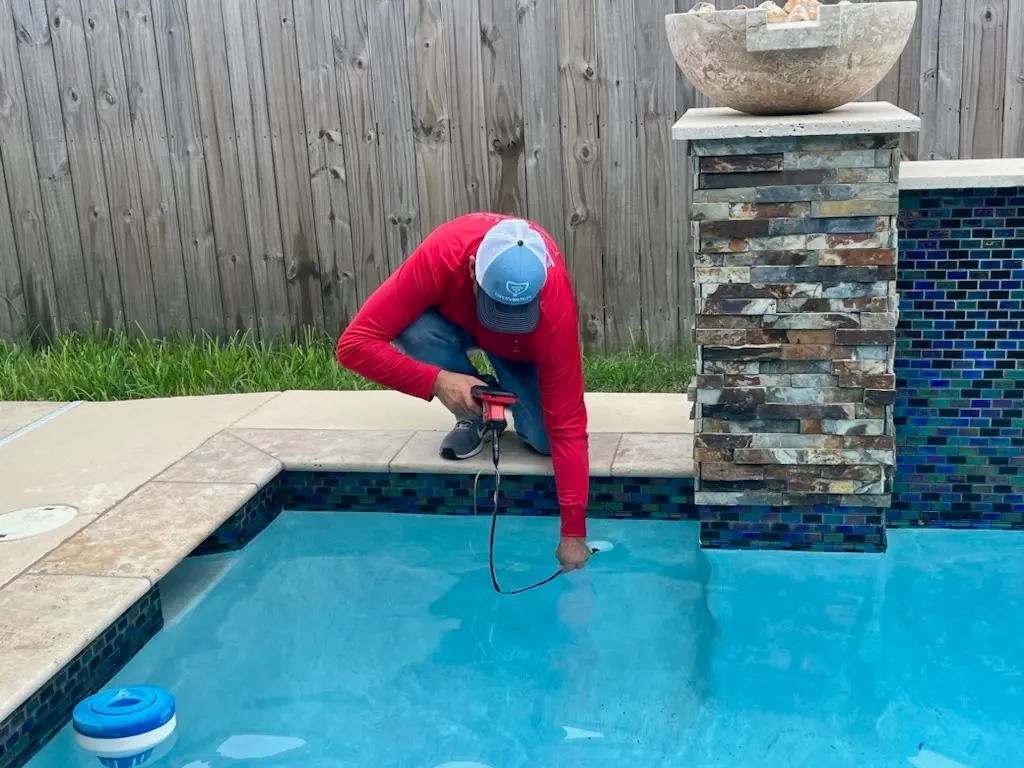
Yes, you can find a leak in your swimming pool by using two simple tests: the bucket test and the dye test. The bucket test tells you if your pool is actually leaking or just losing water to evaporation. The dye test helps you pinpoint the exact spot where the leak is hiding. According to the Pool & Hot Tub Alliance, there are over 10.7 million swimming pools in the United States, and leaks are one of the most common issues pool owners face. This guide covers everything you need to know about spotting the signs of a pool leak, running the tests yourself, and knowing when to call a professional for help.
How Do You Tell Where Your Pool Is Leaking?
You tell where your pool is leaking by looking for visible signs first, then using tests to narrow down the exact location. Start with a walk around your pool and equipment pad. Look for wet spots in the yard, cracks in the pool surface, loose tiles along the waterline, and soggy ground near the deck.
Homeowners in Jefferson, Georgia and surrounding areas should pay close attention to the ground around their pool after heavy rain. Georgia’s clay-heavy soil can shift and settle, which puts stress on pool shells and plumbing lines. According to Angi, a pool that loses more than a quarter inch of water per day beyond normal evaporation likely has a leak that needs attention.
Check your pool equipment pad next. Inspect the pump, filter, heater, chlorinator, and all O-rings or fittings for any dripping or moisture. A pool inspection can catch these problems early before they turn into bigger, more expensive repairs.
Also keep an eye on your water bill. A sudden spike with no other explanation is a strong signal that your pool is losing water through a leak. According to data from the U.S. Environmental Protection Agency, the average American household uses about 300 gallons of water per day, so any unusual jump in usage should raise a red flag.
What Is the Most Common Pool Leak?
The most common pool leak is a separation between the skimmer and the pool shell. According to In The Swim, a leading pool supply resource, skimmer-to-shell separations are the number one repair they encounter. This happens because the plastic skimmer and the concrete or gunite shell expand and contract at different rates over time.
Other common leak locations include the area around pool lights, return fittings, main drains, and any spot where plumbing meets the pool structure. Vinyl liner pools are especially prone to tears near fittings, steps, and corners where the liner is stretched tighter than normal. Pools in the Jefferson, Georgia area that are more than 10 years old should be inspected regularly for these common issues.
How Much Water Should a Pool Lose Every Week?
A pool should lose no more than about 1 to 1.75 inches of water per week from normal evaporation. According to the National Weather Service and pool industry professionals, the average residential pool loses roughly a quarter inch of water per day in warm weather. That adds up to about 1.75 inches per week under hot, sunny conditions.
In humid climates like North Georgia, daily evaporation usually falls between one-eighth and one-quarter of an inch. According to data published by PoolGuard USA, uncovered pools in humid regions typically lose 7,000 to 12,000 gallons per year just from evaporation. If your pool is losing more than 2 inches per week, that is a strong sign of a leak.
One inch of water in a standard-sized pool equals roughly 500 gallons, according to In The Swim. So even a small leak adds up fast in both water waste and cost.
Is It Normal To Add Water To a Pool Every Day?
No, it is not normal to add water to a pool every day. Topping off your pool once a week during hot summer months is typical. If you find yourself filling the pool daily, you are likely dealing with a leak, not just evaporation.
Homeowners across Athens, Braselton, and the greater Jefferson, Georgia area often blame Georgia’s hot summers for their water loss. And while summer heat does speed up evaporation, needing to add water every single day goes beyond what is expected. According to Aquaman Leak Detection, a small leak can cause a pool to lose 100 gallons or more per day, and that number climbs quickly with larger cracks or plumbing issues.
How To Find a Leak in a Pool With the Bucket Test
You find a leak in a pool with the bucket test by comparing the water level in a bucket to the water level in your pool over 24 hours. This is the first and most important step in pool leak detection.
How Do You Perform the Bucket Test Step By Step?
You perform the bucket test step by step with these actions. Fill a 5-gallon bucket with pool water and set it on the second step of your pool so it sits about 5 to 6 inches deep. Use a marker or piece of tape to mark the water level both inside and outside the bucket. Leave the bucket in place for 24 hours. Do not use the pool during this time.
After 24 hours, compare the two water levels. If the pool water dropped more than the water inside the bucket, you have a leak. If both levels dropped about the same amount, the water loss is from evaporation. According to American Leak Detection, you should check the bucket at exactly the 24-hour mark for the most accurate results.
For best results, repeat the test twice. Run it once with the pump off, then again for another 24-hour period with the pump on. If the pool loses more water when the pump is running, the leak is likely in the plumbing or filtration system on the pressure side. If the loss is the same with the pump on and off, the leak is more likely in the pool shell or fittings. Families in Gainesville and Hoschton, Georgia who suspect a leak should try this test before calling a professional, as it gives helpful information about where the problem might be.
How Can You Tell Where a Water Leak Is Coming From?
You can tell where a water leak is coming from by using leak detection dye near the areas you suspect. The dye test is the next step after the bucket test confirms you have a leak.
Turn off the pool pump and all water features so the water is perfectly still. Take a bottle of pool leak detection dye or even dark food coloring and slowly squeeze a small amount near the suspected area. If there is a leak nearby, you will see the dye get pulled toward the crack or gap like a tiny current. Mark the spot with waterproof tape so you can find it again for pool repair.
Test around the skimmer, return jets, pool light, main drain, and any visible cracks or gaps in the shell. If you need to check the bottom of the pool, put on goggles and swim down to apply the dye near the drain and floor.
Where Are Most Pool Leaks Found?
Most pool leaks are found at the skimmer, around pool lights, at return fittings, and along the tile line. These are the spots where different materials meet and create natural weak points. According to pool repair professionals, corners, steps, and any area where a fitting passes through the pool wall are high-risk zones.
In concrete and gunite pools, cracks in the plaster surface are another common culprit. Over time, the plaster can deteriorate through a process called spalling, where the surface chips and flakes away. In vinyl liner pools, tears near fittings and at the waterline are the most frequent source of leaks. According to Leak Science, vinyl pools are almost certain to develop liner tears at some point during their lifespan.
Pool owners in the Jefferson, Georgia region should also inspect the area where the pool deck meets the coping. Ground movement from Georgia’s freeze-thaw cycles in winter can shift the deck and create gaps that lead to leaks.
Why Is My Inground Pool Losing Water But No Leak?
Your inground pool is losing water but showing no visible leak because of evaporation, splash-out, or backwash water loss. These three factors account for most water loss that is not caused by an actual leak.
Evaporation is the biggest cause. According to Latham Pool Products, pools can lose 1 to 3 inches of water overnight during late summer when the pool water is warm and the night air cools down quickly. For a 20-foot by 40-foot pool, that can be over 500 gallons gone by morning.
Splash-out from swimming, diving, and playing adds up over a week. Backwashing your filter also removes water from the pool. If you run the bucket test and both levels drop evenly, evaporation is the cause, not a leak. A pool cleaning service that includes routine water level monitoring can help you track these losses over time.
Why Is My Pool Losing 2 Inches of Water a Day?
Your pool is losing 2 inches of water a day because it almost certainly has a leak. Normal evaporation only accounts for about a quarter inch per day in most climates. Two inches per day is roughly eight times the normal rate, which points to a significant crack, plumbing break, or fitting failure.
According to Aquaman Leak Detection, a 32-foot by 18-foot pool that loses 2 inches per day is shedding about 718 gallons every 24 hours. That is nearly 30 gallons per hour going straight into the ground. Over the course of a 20-week pool season, that adds up to over 100,000 gallons of wasted water.
A loss this large usually means the leak is in the plumbing, not just the shell. Underground pipe breaks, failed connections at the pump or filter, or a cracked main drain line are all likely suspects. This level of water loss requires professional leak detection equipment, including pressure testing and electronic listening devices.
How Do They Fix Pool Leaks?
They fix pool leaks with different methods depending on the type and location of the leak. Small cracks in plaster or gunite can be repaired with pool putty or hydraulic cement applied directly to the damaged area, even underwater in many cases. Vinyl liner tears are patched with vinyl repair kits that bond to the liner using waterproof adhesive.
For more serious issues, professionals use specialized equipment. Electronic leak detection tools can pick up the sound waves created by water escaping through a crack. Pressure testing is used to check each plumbing line for integrity. According to the Angi 2025 Cost vs. Value Report, professional leak detection typically runs between $100 and $500, while the actual repairs range based on the severity of the damage, with 80% of homeowners spending under $2,500 when the leak is caught early.
Larger structural repairs, like resurfacing a cracked pool shell or replacing corroded plumbing lines, are more involved. Homeowners in Jefferson and across North Georgia who catch leaks early can save thousands of dollars compared to those who wait. The team at Sandals Luxury Pools can assess the damage and recommend the right fix for your situation.
Can a Pool Leak Cause a Sinkhole?
Yes, a pool leak can cause a sinkhole. When water continuously seeps from a pool into the surrounding soil, it erodes the ground underneath over time. According to Leak Science, leaking water is one of the most common causes of sinkholes. The water dissolves and washes away soil and soft rock layers beneath the surface, creating voids that can eventually collapse.
According to the U.S. Geological Survey, areas with soluble bedrock like limestone, gypsum, or salt deposits are most vulnerable. These types of rock cover about 40% of the bedrock in the United States. States in the Southeast, including Georgia, have regions with limestone-based geology that make sinkholes a real concern for pool owners.
Even a slow leak that goes unnoticed for months or years can saturate the soil enough to cause settling, deck cracking, and eventually a dangerous collapse. This is one of the biggest reasons why prompt leak detection matters for homeowners in the Jefferson, Georgia area.
What Happens If a Pool Leak Is Ignored?
If a pool leak is ignored, the damage gets worse over time and the repair costs climb. Water loss is just the beginning. A steady leak causes the soil around the pool to become saturated and shift, which can crack the pool deck and damage the pool’s foundation.
Chemical balance becomes nearly impossible to maintain because fresh water constantly dilutes the treated pool water. This leads to algae growth, cloudy water, and higher chemical costs. According to pool industry data, a moderate leak can add over $100 per month to water bills in areas where water costs $3 to $5 per 1,000 gallons.
The pool’s pump and filtration system also suffer. If the water level drops below the skimmer intake, the pump draws in air instead of water. This can burn out the motor and damage internal components. A seasonal opening service that includes a leak check is a smart way to catch problems before they spiral.
How To Stop a Pool Leak With Flex Tape
You stop a pool leak with flex tape by applying it as a temporary patch over small cracks or tears. Clean and dry the area around the leak as much as possible, cut the tape to size, and press it firmly over the damaged spot. This works best on above-ground pools and minor vinyl liner tears.
Flex tape is not a permanent fix. It can buy you time, but it will not hold up long-term against water pressure, pool chemicals, and temperature changes. For a lasting solution, use a proper vinyl patch kit for liner pools or pool putty and hydraulic cement for concrete and gunite surfaces.
Pool owners in Monroe, Winder, and other communities near Jefferson, Georgia should treat flex tape as a short-term emergency measure and schedule a professional repair as soon as possible.
Can You Fix a Pool Leak Without Draining?
Yes, you can fix a pool leak without draining the pool in many cases. Underwater vinyl patch kits, pool putty, and epoxy compounds are all designed to be applied while the pool is full of water. These products bond to wet surfaces and cure underwater.
For vinyl liner pools, wet-applied patch kits use a special adhesive that activates in water. Cut the patch about 2 inches larger than the tear on all sides, apply the adhesive, fold the patch in half, swim to the tear, and press it firmly in place. Hold it for at least 30 seconds.
For plaster and concrete pools, pool putty or two-part epoxy can be pressed directly into cracks without draining. According to In The Swim, they have successfully patched vinyl liner tears as long as 18 inches without draining the pool. However, if the leak is in the underground plumbing, the water may need to be lowered or the area excavated for a proper repair.
How Can I Tell If My Inground Pool Is Leaking?
You can tell if your inground pool is leaking by watching for these warning signs: your water level drops more than a quarter inch per day, you see wet or mushy spots in the yard near the pool, your pool chemicals are hard to keep balanced, you notice cracks in the pool deck or tiles, or your water bill suddenly goes up without explanation.
According to Angi, inconsistent chemical levels are one of the most overlooked signs of a pool leak. When treated water leaks out and fresh water comes in, the chemical balance gets thrown off. You end up using more chlorine, more stabilizer, and more acid just to keep the water safe.
Another sign is air bubbles coming from the return jets or building up inside the filter tank. This often means there is a suction-side leak in the plumbing that is pulling air into the system. If you see bubbles in the pump basket through a clear lid, that is a strong clue. Getting a thorough professional pool inspection is the fastest way to confirm or rule out a leak.
Is There Something You Can Put in a Pool To Find a Leak?
Yes, there is something you can put in a pool to find a leak. Leak detection dye is a specially formulated liquid that you squirt near suspected areas. The dye does not disperse quickly in still water, which makes it easy to watch. If a leak is present, the dye gets drawn toward the opening like a tiny stream.
You can buy pool leak detection dye kits at most pool supply stores. Dark food coloring also works in a pinch, though it spreads faster and is harder to read. For the best results, turn off all pumps and water features before testing so the water is completely still.
Squirt the dye near the skimmer, returns, lights, drains, and any visible cracks. Watch closely. If the dye moves toward a specific spot instead of drifting naturally, that is where your leak is located.
Do Pools Leak More in Winter?
No, pools do not leak more in winter because of the season itself. However, winter conditions can create new leaks or make existing ones worse. Freeze-thaw cycles cause the ground to expand and contract, which can shift the pool shell and crack plumbing connections. According to Progressive Insurance, failure to properly winterize a pool can lead to cracks and leaks that homeowners insurance will not cover.
In North Georgia, winter temperatures regularly drop below freezing. Water left in plumbing lines, pump housings, and filter tanks can freeze, expand, and crack the equipment. A proper pool closing service that drains all lines and adds antifreeze to the plumbing is the best way to prevent freeze-related leaks.
Evaporation slows down in winter, so if you notice water loss during the colder months, a leak is the most likely cause.
What Are the Signs of an Unhealthy Pool?
The signs of an unhealthy pool are cloudy or green water, a strong chemical smell, algae growth on the walls or floor, slimy surfaces, skin or eye irritation after swimming, and difficulty maintaining proper chemical levels.
A leaking pool can directly cause many of these problems. When treated water leaks out and gets replaced by untreated tap water, the chlorine and pH levels drop. Algae takes advantage of the weakened chemistry and begins to grow. According to pool industry professionals, leaks are one of the hidden causes of persistent water quality problems that many homeowners overlook.
Homeowners in Dacula, Lawrenceville, and other communities near Jefferson who struggle to keep their pool chemistry balanced should consider a leak test before adding more chemicals. Fixing the leak often solves the water quality issue at its root.
Does Home Insurance Cover Pool Leak Detection?
Home insurance does not typically cover pool leak detection or repairs caused by normal wear and tear. According to Progressive Insurance, standard homeowners policies exclude damage from gradual deterioration, lack of maintenance, or failure to properly winterize the pool.
However, if a covered event like a falling tree, fire, or severe storm damages your pool and causes a leak, your homeowners insurance may cover the repair. According to Inszone Insurance, insurers investigate whether a pool leak is sudden and accidental before approving a claim. A burst underground pipe may be covered, while a slow leak from an aging liner will not.
The best protection is prevention. Regular inspections, prompt repairs, and proper winterization keep your pool in good shape and avoid the frustration of denied claims. Pool owners in Jefferson, Georgia who invest in routine maintenance end up spending far less than those who wait for a catastrophic failure.
Pool Leak Detection Methods Comparison
| Detection Method | Best For | Skill Level | Accuracy |
|---|---|---|---|
| Bucket Test | Confirming if a leak exists | DIY / Beginner | Good for yes/no confirmation |
| Dye Test | Pinpointing leak location in shell or fittings | DIY / Beginner | High for surface leaks |
| Visual Inspection | Finding cracks, loose tiles, wet spots | DIY / Beginner | Moderate |
| Pressure Testing | Detecting leaks in plumbing lines | Professional | Very High |
| Electronic Leak Detection | Locating underground and hidden leaks | Professional | Very High |
| Thermal Imaging | Finding temperature differences from water seepage | Professional | High |
Sources: American Leak Detection, In The Swim, Angi 2025 Cost vs. Value Report
How To Trace a Leak in a Pool Using Professional Equipment
You trace a leak in a pool using professional equipment by hiring a trained leak detection specialist who uses electronic listening devices, pressure gauges, and sometimes camera systems to locate the exact source. These tools pick up sounds and pressure changes that human senses cannot detect.
Pressure testing is one of the most reliable methods. The technician plugs each plumbing line and pressurizes it individually. If a line does not hold pressure, the leak is in that section. For vinyl liner pools, some professionals use a small electrical charge placed in the water that travels toward any hole in the liner, then track it with directional listening equipment.
According to the Angi 2025 Cost vs. Value Report, professional detection services average between $100 and $500. That is a small investment compared to the cost of undetected water loss, which can run $1,000 or more per pool season in wasted water alone, according to data from Pool Tech. Homeowners in the North Georgia area who cannot find the leak themselves should bring in a professional before the damage gets worse.
What Is the Lifespan of a Pool?
The lifespan of a pool depends on the material it is made from. Concrete and gunite pools can last 50 years or more with proper maintenance. Fiberglass pool shells typically last 25 years or longer. Vinyl liner pools have the shortest lifespan, with the liner itself needing replacement every 5 to 9 years, though the structure can last much longer.
According to the Pool & Hot Tub Alliance, the U.S. pool and hot tub industry is a $62 billion market, and a large portion of that spending goes toward repair, renovation, and remodeling of aging pools. The PHTA’s Q4 2024 Pulse Survey found that 49% of remodeling companies reported increased revenue, showing that many homeowners are investing in upgrading existing pools rather than building new ones.
Regular maintenance extends the life of any pool. Homeowners in Jefferson, Georgia and across North Georgia who schedule routine pool cleaning and annual inspections get many more years out of their investment.
Should I Replace My Entire Pool Pump or Just the Motor?
You should replace just the motor if the pump housing, impeller, and seals are still in good condition. If the pump is more than 8 to 10 years old, or if the housing is cracked or corroded, replacing the entire pump is the better investment.
A leaking pump seal is one of the most common equipment-related causes of water loss around the pool pad. If you see water dripping from the pump, check the shaft seal first. Replacing the seal is far cheaper than buying a new pump.
If you are building a new pool or doing a major renovation, a variable-speed pump is worth considering. According to the U.S. Department of Energy, variable-speed pool pumps can reduce energy use by up to 70% compared to single-speed models. For homeowners planning a custom pool build, selecting the right pump from the start prevents headaches later.
Frequently Asked Questions
How Much Does It Cost To Find a Leak in a Pool?
The cost to find a leak in a pool ranges from $100 to $500 for professional detection services. According to the Angi 2025 Cost vs. Value Report, this is the typical range for residential pool leak detection across the United States. In the Jefferson, Georgia area, costs may vary based on pool size and the complexity of the plumbing system. DIY methods like the bucket test and dye test cost very little, usually under $20 for a dye kit.
How Expensive Is It To Fix a Pool Leak?
It is relatively affordable to fix a pool leak if it is caught early. Simple surface patches can be done for under $50 with a DIY kit. Professional repairs for more complex leaks range widely, with 80% of homeowners spending under $2,500, according to the Angi 2025 Cost vs. Value Report. Underground plumbing repairs and structural work cost more. Early detection is the key to keeping costs low.
What To Do If You Suspect Your Pool Has a Leak?
If you suspect your pool has a leak, the first thing to do is run a bucket test to confirm the water loss is not from evaporation. If the test confirms a leak, perform a dye test near the skimmer, returns, lights, and any visible cracks. If you cannot find the source, contact a professional pool repair service in the Jefferson, Georgia area to run pressure tests and electronic detection.
Why Do People Put Baking Soda in Their Swimming Pools?
People put baking soda in their swimming pools to raise the total alkalinity of the water. Baking soda, which is sodium bicarbonate, acts as a buffer that helps stabilize the pH level. It does not fix leaks, but it is a common and inexpensive way to keep water chemistry in balance. Homeowners in North Georgia who struggle with fluctuating pH should first rule out a leak before relying on chemical adjustments.
Which Pool Type Lasts the Longest?
Concrete and gunite pools last the longest, with lifespans of 50 years or more when properly maintained. Fiberglass shells typically last over 25 years. Vinyl liner pools have shorter liner lifespans of 5 to 9 years, though the underlying structure can last decades. Homeowners in Athens, Braselton, and across the Jefferson, Georgia area looking for long-term durability often choose gunite construction for its strength and repairability.
How Much Water Can a Pool Lose From a Small Leak?
A pool can lose at least 100 gallons per day from a small leak, according to Aquaman Leak Detection. The average backyard swimming pool holds about 20,000 gallons, so even a small leak drains the equivalent of the entire pool volume in about six months. Over a typical 20-week pool season, a moderate leak of 2 inches per day can waste nearly 140,000 gallons of water, according to calculations from Pool Tech.
Is Evaporation Worse in North Georgia During Summer?
Evaporation in North Georgia during summer is moderate compared to drier regions. Because Georgia has relatively high humidity, evaporation rates are lower than in the Southwest. According to PoolGuard USA, pools in humid climates typically lose one-eighth to one-quarter of an inch per day. If your pool near Jefferson, Georgia is losing more than that, a leak is the most likely explanation.
Final Thoughts
Finding a leak in your swimming pool does not have to be stressful. Start with the bucket test to confirm whether you are dealing with evaporation or an actual leak. Use the dye test to narrow down the location. Check the skimmer, returns, lights, and any visible cracks in the surface. And if the leak is hiding in the plumbing underground, bring in a professional with the right equipment to track it down.
The most important thing is to act fast. A small leak that costs a few dollars to fix today can turn into a sinkhole, a cracked deck, or a burned-out pump if left alone. According to industry data, catching a leak early saves homeowners thousands of dollars in water bills, chemical costs, and structural repairs.
If you are a pool owner in Jefferson, Georgia or anywhere in the North Georgia area and you suspect a leak, the team at Sandals Luxury Pools is ready to help. With over a decade of experience building and servicing luxury pools across Metro Atlanta, they have the skills and equipment to find and fix the problem fast. Contact Sandals Luxury Pools for pool repair today to schedule an inspection and protect your investment.
