
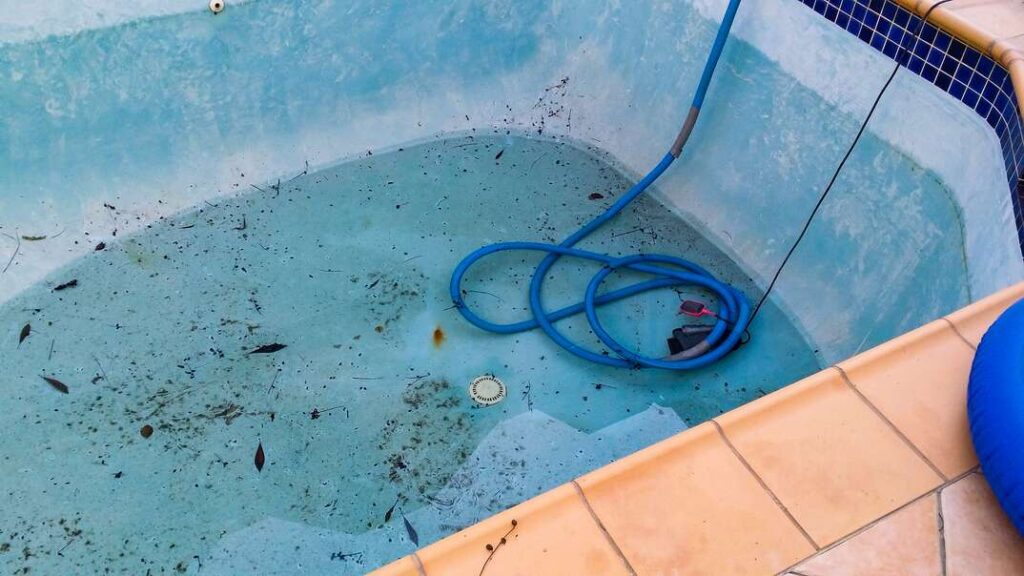
Yes, you can drain a pool without damaging the liner, but only if you do it the right way. The key is to never fully drain a vinyl liner pool. You should always leave at least 6 to 12 inches of water covering the shallow end floor to keep the liner weighted down and in place. A standard residential pool holds between 10,000 and 20,000 gallons of water, according to industry data. That much water creates a huge amount of downward pressure that holds your liner secure against the walls and floor. Remove all of it at once, and the liner can shift, shrink, wrinkle, or even tear beyond repair. This guide covers the safest methods to drain your pool, common mistakes that ruin liners, when you actually need to drain, and what to do if something goes wrong. Pool owners in Jefferson, Georgia and across North Georgia will find this especially useful given our region’s clay-heavy soil and seasonal rain patterns.
Is It Okay to Drain a Pool With a Liner?
It is okay to drain a pool with a liner only if you drain it partially, not completely. According to River Pools, the average inground vinyl pool liner lasts 5 to 9 years. A single bad drain can cut that lifespan in half or destroy the liner in minutes. Data from J&M Pool Company shows that poorly maintained vinyl liners can be ruined in as little as 8 to 12 minutes under the wrong conditions.
The weight of the water inside your pool is what keeps the liner pressed tight against the walls and floor. A typical 16-by-32-foot pool filled to a 4.5-foot average depth holds roughly 17,280 gallons of water. According to the U.S. Geological Survey, a gallon of water weighs about 8.34 pounds. That means the water in an average pool weighs well over 140,000 pounds. When you remove that weight, the liner has nothing holding it in position.
Homeowners across North Georgia, from Braselton to Athens, often think a full drain is the fastest way to deal with algae or cloudy water. But in most cases, a partial drain and chemical treatment will fix the problem without putting the liner at risk. If your pool does need professional pool repair, a trained technician will know how to safely manage water levels during the job.
Why Can’t You Drain a Liner Pool Completely?
You can’t drain a liner pool completely because the liner will lose its shape, shrink, wrinkle, or pull away from the walls once the water weight is removed. According to Latham Pool Products, draining all of the water from a vinyl pool can cause bubbles and wrinkles in the liner, making it more likely to tear. The liner stays in place because of the massive downward force of the water, not because of the coping track alone.
Vinyl liner material is like a large elastic band. When the pool is new, the liner has some stretch and flexibility. But data from Swimming Pool Steve shows that after about seven years, a vinyl liner loses almost all of its original elasticity due to chemical and UV exposure. If you drain an older liner and try to refill, it will not stretch back to its original shape. You will see tight spots in the corners, wrinkles along the floor, and possibly tears where the vinyl has become brittle.
In areas like Jefferson, Georgia and Gainesville, our clay-heavy soils hold moisture longer than sandy soils do. This means groundwater pressure is a bigger concern here. If you drain your pool after a heavy rain, the saturated soil around the pool can push against the shell, causing the liner to float or bubble from underneath. This type of damage often means a complete liner replacement.
How Do You Drain a Pool Without Damage?
You drain a pool without damage by using a submersible pump, lowering the water slowly, and never removing more than one-third to one-half of the total volume at a time. According to In The Swim, the safest approach for vinyl pools is to drain one-third to one-half and then refill quickly. This protects the liner while still letting you address water quality issues or do minor repairs.
Before you start, check the pH of the water. The pH should be between 6.0 and 8.0, and chlorine levels should not be extremely high. High chemical concentrations sitting on an exposed liner can cause chemical burns, bleaching, and permanent wrinkles. Data from Kayden Liners confirms that if the pH level rises above 7.8, calcium can form and stick to the liner surface, causing lasting damage.
Place your submersible pump in the deepest part of the pool. Run the discharge hose to a spot that is downhill from the pool, ideally toward a storm drain or an area that drains away from your home’s foundation. Many municipalities in Georgia have rules about where pool water can be discharged, so check with your local water authority in Jackson County or your specific city before you begin.
Families in Hoschton and Winder who handle regular pool cleaning themselves should keep this rule of thumb: if you can solve the problem without draining, do not drain. Vacuuming to waste, chemical shock treatments, and filtration adjustments can fix most water quality problems without lowering the water level at all.
What Is the Safest Way to Drain a Pool?
The safest way to drain a pool is to do a partial drain using a submersible pump on a dry, mild-weather day with temperatures between 55 and 85 degrees Fahrenheit. According to In The Swim, warm weather within this range is best for any pool draining because cold temperatures can damage exposed pool surfaces and liner material.
Here is a step-by-step process for a safe partial drain:
First, turn off all pool equipment, including pumps, heaters, lights, and automatic cleaners. Second, set up your submersible pump in the deep end and attach a long garden hose or discharge hose. Third, direct the discharge water downhill and away from the pool. Fourth, monitor the water level carefully and stop the pump once the water is reduced by no more than one-third to one-half. Fifth, begin refilling the pool immediately. Do not leave a partially drained vinyl pool sitting for hours or overnight.
For inground pools, the risk of hydrostatic pressure is real. According to Pool Research, when a pool is full of water, the internal pressure and the external groundwater pressure cancel each other out. When you remove the water, groundwater can push upward against the pool floor with enough force to crack, shift, or even pop the entire pool out of the ground. The U.S. Geological Survey’s National Water Information System tracks groundwater levels across the country, and areas with high water tables face the greatest risk.
Homeowners in the Athens, Georgia area should pay extra attention to this during spring, when rainfall is heaviest and the ground is fully saturated. If you are not sure about your local water table, a professional pool inspection can identify risk factors before any draining takes place.
Is It Better to Drain a Pool With a Pump?
Yes, it is better to drain a pool with a pump than with a garden hose siphon. A submersible pump gives you much more control over how fast the water leaves the pool. According to HowStuffWorks, an electric pump is one of the most efficient methods for draining because you can monitor the process in real time and stop it the moment you reach the right level.
The garden hose siphon method works but it is extremely slow. For a pool with 15,000 to 20,000 gallons, a siphon can take several days to remove even a third of the water. During that time, weather conditions can change and create problems. A sudden rainstorm in North Georgia, which is common from April through September, could saturate the ground and increase the risk of hydrostatic pressure damage while your pool is partially empty.
A submersible pump rated for 1,500 to 3,000 gallons per hour can safely lower your pool to the target level in just a few hours. Always stay nearby to watch the water level drop. Never walk away and leave the pump running unattended.
Is It Safe to Drain Pool Water Into the Yard?
It is safe to drain pool water into the yard only if the water chemistry is properly balanced and the water flows away from the pool structure. According to Angi, your municipality sets pool draining laws to prevent erosion, water contamination, and storm drain overflow. Many towns require you to test the pH before discharging treated pool water.
Chlorinated water can harm grass, plants, and local ecosystems if the chemical levels are too high. Before draining into the yard, let the chlorine level drop below 1.0 parts per million. You can speed this up by simply turning off the chlorinator and waiting a few days. Also, direct the water away from landscaping beds, vegetable gardens, and your neighbor’s property.
In Jefferson, Georgia and surrounding Jackson County communities, it is smart to confirm local discharge rules before you start. Some areas require you to drain into the sanitary sewer system rather than onto the ground. If you send thousands of gallons into a clogged sewer line, the water can back up and flood the area around your pool, creating even bigger problems.
How Long Can a Pool Stay Drained?
A vinyl liner pool should never stay fully drained for any length of time. Even a partially drained pool should be refilled as quickly as possible, ideally the same day. According to Georgia Classic Pool, concrete pools should not be left empty for more than two weeks due to hydrostatic pressure risks. For vinyl liner pools, the timeframe is much shorter because the liner begins to dry out, shrink, and crack once exposed to air and sunlight.
Data from Swimmingpool.com confirms that when exposed to air, vinyl will shrink and crack as it dries out, especially in older liners where the material has become weak and brittle. Direct sun exposure on a hot Georgia summer day, where temperatures regularly hit the mid-90s, can accelerate this damage within hours.
If your pool needs work that requires it to be empty, plan ahead. Have all your supplies, tools, and contractors ready to go before you drain a single gallon. The seasonal opening service team at Sandals Luxury Pools can coordinate repair work so that your pool spends the least amount of time at reduced water levels.
What Happens If You Don’t Drain Your Pool for Winter?
If you don’t drain your pool for winter, that is actually the correct approach for vinyl liner pools. You should never fully drain a vinyl liner pool for winter. According to Latham Pool Products, when winterizing a pool, you should only lower the water level to approximately 1 inch below the skimmer. This keeps enough weight on the liner to hold it in place through the cold months.
Frozen water expands, so you do need to lower the level slightly to give ice room. But the remaining water is what protects the liner from shifting, floating, and cracking. Pool owners in Oakwood, Georgia and Chestnut Mountain who winterize their pools properly avoid the most common spring repair issues like wrinkled liners, torn corners, and pulled coping.
A proper pool closing service includes adjusting the water level, balancing chemicals, draining the pump and filter lines, adding antifreeze to the plumbing, and installing a winter cover. This protects both the liner and the equipment through Georgia’s occasional freezing temperatures.
Can Draining a Pool Cause a Sinkhole?
Draining a pool can contribute to ground instability, though true sinkholes are rare. The bigger risk is soil erosion and settling around the pool. According to Envista Forensics, discharging thousands of gallons of water near the pool area can change the groundwater level and cause the surrounding soil to shift. This can lead to deck cracking, uneven surfaces, and structural damage to the pool walls.
In parts of North Georgia where the soil is a mix of red clay and decomposed granite, saturated ground can become unstable quickly. If you drain water toward the pool area instead of away from it, you risk washing out the backfill that supports the pool walls. According to Swimming Pool Steve, water that escapes through a deficient liner can dissolve dirt behind the pool walls, causing paving stone decks to sink and concrete decks to crack over time.
Always direct your discharge hose far downhill from the pool. If your property is flat, run the hose to the lowest point on the lot or into a storm drain or sewer cleanout.
Is It Normal to Lose Half an Inch of Water a Day in a Pool?
Losing half an inch of water a day is on the high end of normal during hot, dry, windy summer weather. According to American Leak Detection, swimming pools lose about a quarter of an inch of water per day on average due to evaporation. The rate can go higher based on wind, humidity, temperature, and sun exposure.
Data from the California Spa and Pool Industry Education Council estimates that pools lose between half an inch and two inches of water per week under typical conditions. A 400-square-foot pool can lose roughly 19,664 gallons per year to evaporation alone if left uncovered. If you are losing more than half an inch a day consistently, especially during cooler or calmer weather, you likely have a leak rather than normal evaporation.
The bucket test is the simplest way to check. Place a bucket on a pool step, fill it to match the pool water level, and wait 24 to 48 hours. If the pool water drops more than the bucket water, you have a leak. Pool owners across Barrow County, Walton County, and Jackson County can schedule a pool inspection to get a definitive answer.
What Destroys a Pool Liner?
The things that destroy a pool liner are improper water chemistry, UV exposure, complete draining, sharp objects, and pet damage. According to Cool Breeze Pools, UV radiation deteriorates vinyl through a process called photodegradation, and liners in southern regions with intense sunlight typically last 1 to 3 years less than identical liners in northern areas.
Chemical imbalance is the number one killer. Data from Swimmingpool.com shows that high chlorine levels degrade pool liners faster, especially when granular chlorine is added directly to the pool without being dissolved first. Letting chlorine tablets sit on the liner surface causes chemical burns that create permanent, irreparable wrinkles. The ideal pH range for liner protection is between 7.2 and 7.6, according to multiple pool industry sources.
Complete draining, as we have covered throughout this article, is another major destroyer. But even partial neglect adds up. According to Angi, the average pool liner lifespan is 10 years, but poor maintenance can cut that to just a few years. Consistent weekly cleaning, balanced chemicals, and prompt pool repair when you spot a small tear or leak will help you get the maximum life out of your liner.
Would You Leave a Vinyl Pool Completely Drained With a Cover?
No, you should not leave a vinyl pool completely drained with a cover. A cover does not replace the weight of the water. The liner still needs water pressing it against the pool floor and walls to stay in position. According to Latham Pool Products, even during winter, you should never fully drain your pool. The water is what prevents the liner from shifting, floating, and cracking.
A pool cover protects against debris, UV rays, and some evaporation loss. But it does nothing to counteract groundwater pressure from below. In areas like Jefferson, Georgia, where spring storms can dump inches of rain overnight, the ground around your pool can become saturated fast. Without the weight of the water inside the pool, that external pressure can push the liner up from underneath, creating bubbles and permanent damage.
Covering a drained pool also creates a false sense of security. Homeowners may think the pool is fine and leave it sitting empty for weeks. By the time they lift the cover, the liner may have already shrunken, cracked, or pulled loose from the coping.
How Often Should You Drain a Pool?
You should rarely need to drain a pool with a vinyl liner. Most experts recommend never fully draining a vinyl liner pool. A partial drain of one-third to one-half can be done every 3 to 5 years if your Total Dissolved Solids get too high or if you have extremely high cyanuric acid levels that cannot be reduced any other way.
According to In The Swim, very high TDS levels of 5,000 to 10,000 parts per million or cyanuric acid levels above 100 to 150 parts per million are valid reasons for a partial drain and refill. In most other situations, regular water testing, chemical adjustments, and good filtration will keep your pool water healthy without draining.
Pool owners across North Georgia, from Arcade to Statham, benefit from our warm but humid climate. The humidity slows evaporation compared to desert states, but it also creates conditions where algae can grow fast if chemicals are not kept in balance. Staying on top of weekly pool cleaning is the best way to avoid ever needing a drain.
How Far Down Should I Drain My Pool for Winter?
You should drain your pool for winter to about 1 inch below the bottom of the skimmer opening. This is the standard recommendation from Latham Pool Products and most pool industry professionals. Lowering the water to this level protects the skimmer from ice damage while keeping enough water in the pool to anchor the liner.
For most residential pools in the Jefferson, Georgia area, this means removing only a few inches of water from the normal operating level. That small reduction gives ice room to expand without cracking the skimmer, while the remaining thousands of gallons keep the liner stable through winter.
If you have a coved floor, where the pool floor slopes up to meet the wall, make sure the water level stays a few inches above where the cove meets the wall. This prevents the liner from pulling away at the transition point between floor and wall during temperature swings through the winter months.
How to Clean a Pool Liner After Draining?
To clean a pool liner after draining, use a soft-bristled brush, mild cleanser, and work quickly while keeping the liner wet. Do not use abrasive tools, household cleaners, or high-pressure washers directly on the vinyl at close range. According to In The Swim, a light application of a pressure washer is acceptable, but it must be done gently. A small amount of pool-safe degreaser like TSP or Simple Green works well for stubborn stains.
If you are doing a partial drain for cleaning, leave enough water to cover the shallow end floor by at least 6 to 12 inches. Brush the exposed walls above the waterline. For the submerged portion, use a pool vacuum to remove sediment and debris without further lowering the water level.
Time matters. Do not let the exposed liner sit in the sun for hours while you scrub. Work in sections, clean quickly, and begin refilling as soon as you are done. Pool owners in Dacula and Monroe who schedule their cleaning and liner repair work during spring or fall get the benefit of milder temperatures, which reduces the risk of sun damage to exposed vinyl.
What Is the Average Lifespan of a Pool Liner?
The average lifespan of a pool liner is 5 to 12 years for inground vinyl liners and 6 to 10 years for above-ground liners. According to River Pools, the average inground pool liner lasts 5 to 9 years, while Angi reports an overall average of about 10 years. Premium liners with proper care can reach 15 to 20 years in some cases.
Several factors affect how long your liner lasts. Liner thickness, water chemistry, UV exposure, frequency of use, and quality of installation all play a role. According to Angi, reputable manufacturers include UV inhibitors in their vinyl to resist sun degradation, but even treated liners break down over time. Pool liners in Georgia’s sunny climate face more UV stress than liners in northern states, which can shorten the expected lifespan by 1 to 3 years, according to Cool Breeze Pools.
The biggest controllable factor is water chemistry. Keeping pH between 7.2 and 7.6, chlorine at recommended levels, and calcium hardness in the proper range will give your liner its best chance at a long life. Regular testing, at least 2 to 3 times per week during swim season, is essential.
| Factor | Impact on Liner Lifespan | Key Data |
|---|---|---|
| Water Chemistry (pH, Chlorine) | High. Improper balance causes rapid degradation. | pH should stay between 7.2 and 7.6. High chlorine causes brittleness. (Kayden Liners, Swimmingpool.com) |
| UV Exposure | High. Causes photodegradation, fading, cracking. | Southern region liners last 1 to 3 years less than northern liners. (Cool Breeze Pools) |
| Complete Draining | Very High. Can destroy a liner instantly. | Liners can be ruined in 8 to 12 minutes under wrong conditions. (J&M Pool Company) |
| Liner Age and Elasticity | High. Older liners cannot stretch back. | Most liners lose nearly all elasticity after about 7 years. (Swimming Pool Steve) |
| Groundwater Pressure | Moderate to High. Causes floating and bubbling. | Pool popping occurs in less than 1% of fully drained pools. (JustAnswer Pool Experts) |
| Average Liner Lifespan | Varies widely based on above factors. | Inground: 5 to 12 years. Above-ground: 6 to 10 years. (River Pools, Angi, Latham Pool) |
Sources: River Pools, Angi, Latham Pool Products, Cool Breeze Pools, J&M Pool Company, Swimming Pool Steve, Kayden Liners, Swimmingpool.com, JustAnswer Pool Experts
Does Homeowners Insurance Cover Pool Liner Damage?
Homeowners insurance may cover pool liner damage, but only if the damage was caused by a sudden, accidental event like a storm, falling tree, or vandalism. Most standard policies do not cover damage from normal wear and tear, improper maintenance, or gradual deterioration. According to Envista Forensics, insurance claims related to pool damage often require investigation into whether the damage was caused by a covered peril or by owner negligence.
If you drain your pool yourself and the liner wrinkles, tears, or floats due to groundwater pressure, your insurance will most likely deny the claim. Pool professionals note that draining a pool on your own can void your warranty and cause damage that insurance will not cover.
The best way to protect yourself is to hire a professional when draining or major repair work is needed. Homeowners in Commerce, Georgia and Nicholson who invest in a thorough pool inspection before any draining work can document the pool’s condition ahead of time, which helps if an insurance claim ever becomes necessary.
Frequently Asked Questions
Can You Drain a Pool in Jefferson, Georgia Without a Permit?
You can usually drain a pool in Jefferson, Georgia without a specific permit, but you must follow local water discharge rules. Jackson County and the City of Jefferson have regulations about where treated pool water can be released. Always check with your local utility or code enforcement office before draining to avoid fines. Directing water toward storm drains or the sanitary sewer system is typically required rather than letting it flow freely across your yard.
How Much Does It Cost to Replace a Vinyl Pool Liner in North Georgia?
The cost to replace a vinyl pool liner in North Georgia varies based on pool size, liner thickness, and labor. According to River Pools, the liner material alone typically runs around $1,700 for a standard inground pool, but total replacement costs including labor, water refill, and related work can exceed $4,000. Getting multiple quotes from local pool professionals in Jefferson, Athens, or Gainesville is the best way to get an accurate number for your specific pool.
What Time of Year Is Best to Drain a Pool in Georgia?
The best time of year to drain a pool in Georgia is spring or fall when temperatures are mild, between 55 and 85 degrees Fahrenheit. Avoid draining during the hottest summer months because direct sun exposure can damage exposed liner surfaces within hours. Also avoid draining during or right after heavy rain, which is common in North Georgia from April through September, because saturated soil increases groundwater pressure and the risk of liner floating.
Is It Safe to Use a Garden Hose to Siphon Pool Water?
It is safe to use a garden hose to siphon pool water for a very small water level reduction, but it is not practical for larger drains. A siphon is extremely slow compared to a submersible pump. For pool owners in Buford or Braselton dealing with high TDS or cyanuric acid, a submersible pump rated at 1,500 gallons per hour or more will get the job done in a fraction of the time, with better control over the water level.
How Do I Know If My Pool Liner Is Too Old to Drain Safely?
You know your pool liner is too old to drain safely if it is more than 7 years old, shows visible fading, has become stiff or brittle to the touch, or has existing tears or patches. According to Swimming Pool Steve, most modern vinyl liners lose their elasticity after about seven years. If you drain an older liner even partially, it may not stretch back into place when refilled. A professional inspection can tell you whether your liner can handle a partial drain.
What Should Pool Owners in Gainesville, GA Do Before Draining?
Pool owners in Gainesville, GA should test their water chemistry, check the weather forecast for at least three dry days, confirm local discharge rules with Hall County utilities, and have all repair supplies ready before draining. They should also inspect the liner for existing damage. If the liner already has tears, wrinkles, or heavy fading, draining could make the damage worse. Calling a professional pool service in the North Georgia area is the safest choice for any drain that goes beyond a few inches.
Final Thoughts
Draining a pool with a vinyl liner is one of the riskiest things a pool owner can do. The data is clear: liners can be destroyed in minutes if drained incorrectly, older liners lose their elasticity and cannot bounce back, and groundwater pressure can cause catastrophic damage to the pool structure itself. The safest approach is to avoid full draining entirely. When a partial drain is necessary, use a submersible pump, keep at least 6 to 12 inches of water on the shallow end floor, work on a mild and dry day, and refill as fast as possible.
Pool owners across North Georgia, from Jefferson and Athens to Braselton and Winder, deal with clay soils, humid summers, and unpredictable spring rains that make draining even riskier than it is in drier climates. Working with a professional team is the best way to protect your investment. Sandals Luxury Pools has served the North Georgia area for over a decade, building and maintaining luxury pools with the care and expertise your backyard deserves. If your pool needs draining, repairs, or a full liner evaluation, contact the pool repair team at Sandals Luxury Pools today to schedule a consultation and keep your pool in top condition for years to come.
