
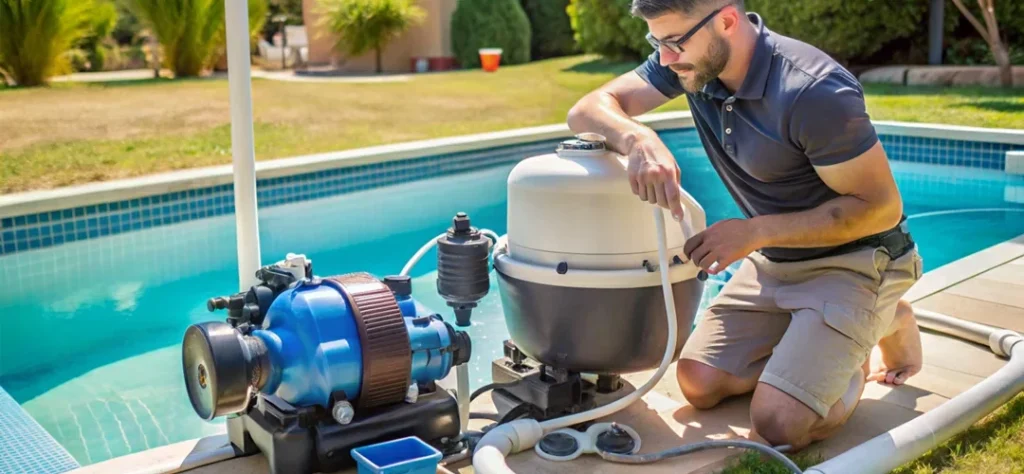
You should run a pool pump for about 8 hours per day during the summer to filter all the water in your pool at least once. The exact run time depends on your pool size, pump type, flow rate, and weather conditions. Running the pump long enough each day prevents algae growth, distributes chemicals evenly, and keeps the water clear and safe. This guide covers everything pool owners need to know about daily pump run time, including how to calculate the right schedule, when to run the pump, and how to save money on electricity while keeping the water in great shape.
How Many Hours Per Day Should a Pool Pump Run?
A pool pump should run for at least 8 hours per day during swim season. This is the amount of time most residential pools need to complete one full turnover, which means every drop of water in the pool passes through the filter one time. Industry standards from the Pool & Hot Tub Alliance recommend a minimum target turnover rate of 6 to 8 hours and at least 2 turnovers per 24 hours for commercial pools. For residential pools, one full turnover per day is the standard minimum.
Pool owners across Jefferson, Georgia and North Georgia deal with hot summers that push water temperatures into the mid-80s and above. Higher water temperatures speed up algae growth and increase chlorine demand. That means running the pump for the full 8 hours is especially important during June, July, and August. If your pool gets heavy use or sits in direct sunlight all day, you may need to bump that up to 10 or even 12 hours.
According to the U.S. Department of Energy, pool pumps are the second largest energy consumer in homes that have a pool, right behind the air conditioning system. That makes finding the right run time a balance between clean water and affordable energy bills. The good news is that you do not have to run the pump for 8 consecutive hours. You can split the time into two or three blocks throughout the day and get the same results.
How Long Is Too Long to Run a Pool Pump?
Running a pool pump longer than necessary is not harmful to the water, but it is harmful to your wallet. A standard single-speed pool pump uses between 1,500 and 2,500 watts of electricity. According to Energy Star, pool owners can spend anywhere from $40 to $150 per month on pump electricity alone. Running the pump 24 hours a day doubles or triples that cost compared to an 8-hour schedule.
Running a pump continuously also creates more wear and tear on the motor, seals, and bearings. Most residential pump motors last 8 to 12 years with normal use. Running them around the clock shortens that lifespan and leads to more frequent pool repair visits. The only time you should run a pump 24 hours straight is when you are treating a serious algae bloom or dealing with cloudy water after a shock treatment.
Is 6 Hours Enough for a Pool Pump?
Yes, 6 hours can be enough for a pool pump if you have a properly sized pump with a high enough flow rate to turn over all the water in that time. Smaller pools under 15,000 gallons with a strong pump can often complete a full turnover in 6 hours or less. The U.S. Department of Energy actually recommends starting at 6 hours per day and increasing by 30-minute increments until the water stays clear.
For most standard residential pools in the Jefferson, Georgia area, which typically hold 15,000 to 25,000 gallons, 6 hours may cut it a little close with a single-speed pump. If the water stays crystal clear and your chemical levels hold steady, 6 hours is fine. If you notice cloudiness or a slight green tint developing, add more run time. Every pool is a little different, and the right answer depends on your specific setup.
How Do You Calculate Pool Pump Run Time?
You calculate pool pump run time by dividing your total pool volume in gallons by your pump’s flow rate in gallons per hour. The goal is to find out how many hours it takes for all the water in your pool to pass through the filter one time. That number is your minimum daily run time.
Start by finding your pool volume. For a rectangular pool, multiply the length by the width by the average depth, then multiply that number by 7.5. For example, a pool that is 16 feet long, 32 feet wide, and 5 feet deep on average holds about 19,200 gallons (16 x 32 x 5 x 7.5 = 19,200). According to the Pool & Hot Tub Alliance, the United States has about 10.7 million swimming pools, and the average residential in-ground pool holds between 15,000 and 25,000 gallons.
Next, check your pump’s flow rate. This is listed on the pump label or in the owner’s manual, usually measured in gallons per minute (GPM). Multiply the GPM by 60 to get gallons per hour (GPH). Then divide your pool volume by the GPH. For a 20,000-gallon pool with a pump running at 40 GPM (2,400 GPH), the turnover time is about 8.3 hours (20,000 / 2,400 = 8.33). That means you need to run the pump for about 8.5 hours per day.
Homeowners who are not sure about their pool volume or pump specifications can schedule a pool inspection to get an accurate assessment and a recommended run time tailored to their specific system.
What Is the Best Schedule for a Pool Pump?
The best schedule for a pool pump is to split the run time between a morning block and an evening block, with the pump running during off-peak electricity hours when possible. For example, you might run the pump from 6:00 AM to 10:00 AM and again from 8:00 PM to midnight. This covers the full 8 hours while keeping costs lower and hitting two important windows: early morning before heavy sun exposure and evening after chemicals have been added.
According to Leslie’s Pool Supplies, the general rule of thumb for single-speed pumps is to run the pump one hour for every 10 degrees of outside air temperature. On a 90-degree day in North Georgia, that means 9 hours of run time. On a cooler 70-degree day in spring or fall, 7 hours may be plenty.
Variable-speed pump owners in the Braselton, Gainesville, and Athens areas often set their pump to run 12 or more hours per day at a low speed, with a short burst of high speed during the hottest part of the afternoon. This approach provides better filtration at a fraction of the energy cost of running a single-speed pump for 8 hours.
Should I Turn My Pool Pump Off at Night?
Yes, you can turn your pool pump off at night as long as it has already run for the full 8 hours during the day. However, many pool professionals recommend running the pump at night instead of, or in addition to, daytime operation. There are good reasons for both approaches.
Running the pump at night is ideal after adding shock or other chemicals. Chlorine works best without UV interference, and circulating the treated water overnight gives the chemicals time to distribute evenly throughout the pool. Running the pump overnight also takes advantage of lower electricity rates in many areas. Georgia Power and other utilities in the Jefferson area often charge less during off-peak nighttime hours.
The downside of running only at night is that during the day, when the pool is exposed to sun, heat, and swimmers, the water sits stagnant. This can allow debris to settle and algae to start forming before the pump kicks on again. Splitting the run time between day and night is the best compromise for most pool owners in North Georgia.
Should You Turn Your Pool Pump Off When It Rains?
No, you should not turn your pool pump off when it rains. In fact, running the pump during and after a rainstorm is a good idea. Rain introduces contaminants, dilutes chlorine, and changes the pH of the pool water. Running the pump helps the filter remove debris carried in by the rain and circulates the freshly diluted water so you can test it and add chemicals if needed.
North Georgia gets an average of about 50 inches of rain per year, according to the National Weather Service. That means pool owners in Jefferson, Winder, and Monroe deal with frequent summer thunderstorms that can throw off water chemistry in a hurry. Keep the pump running during storms, and test the water as soon as the rain stops. You may need to add shock and adjust pH after a heavy downpour.
Consistent water circulation during and after rain is one of the key habits that keeps a pool healthy all season. Professional pool cleaning services include post-storm water testing and rebalancing as part of routine maintenance.
What Happens If You Don’t Run Your Pool Pump?
If you don’t run your pool pump, the water becomes stagnant, chlorine stops circulating, algae begins to grow, and bacteria can reach unsafe levels within just a few days. Stagnant water creates dead spots where debris sinks to the bottom and organic material starts to decompose. This leads to cloudy, green, or even black water that is unsafe to swim in.
The CDC reports that 208 outbreaks linked to treated recreational water occurred in the United States between 2015 and 2019. Many of these outbreaks were connected to poor water circulation and inadequate chemical distribution, exactly the problems that happen when a pump is not running. Without circulation, even if you add chlorine to the pool, it will not spread evenly. Some areas will have too much chlorine and others will have almost none.
Stagnant water also damages pool equipment over time. Pipes can develop buildup, filters become clogged with settled debris, and the pool surface itself can stain from algae. Pool owners in the North Georgia area who leave their pump off for extended periods often end up spending far more on cleanup and repairs than they would have spent on electricity to keep the pump running.
How to Make a Cloudy Pool Clear?
To make a cloudy pool clear, run the pump 24 hours a day until the water clears up, check and balance the pH and chlorine levels, clean or backwash the filter, and shock the pool if needed. Cloudy water usually means the filter is not catching enough particles, the water chemistry is off, or both.
Start by testing the water. The pH should be between 7.2 and 7.6. Free chlorine should be between 1 and 3 ppm. If the pH is too high, chlorine loses its sanitizing power. According to the National Swimming Pool Foundation, chlorine is about 65% active at a pH of 7.2 but only about 22% active at a pH of 8.0. Fixing the pH alone can sometimes clear up a cloudy pool within 24 to 48 hours.
If the water is still cloudy after balancing the chemistry, the filter may be the issue. A dirty or worn-out filter cannot trap fine particles. Check the filter pressure gauge. If the pressure is 8 to 10 psi above the clean starting pressure, it is time to clean or replace the filter. Homeowners who suspect a pump or filter problem should look into professional pool equipment repair to get the system working properly again.
Can a Pool Pump Cause an Electric Bill to Go Up?
Yes, a pool pump can cause an electric bill to go up significantly. According to Energy Star, the pool pump is the second largest electricity consumer in homes with pools, trailing only the HVAC system. A standard single-speed 1.5 HP pump running 8 hours per day uses about 12 to 16 kWh of electricity daily. At the national average electricity rate of about $0.16 per kWh, that works out to roughly $60 to $80 per month just for the pump.
The type of pump makes the biggest difference. A single-speed pump running 8 hours per day costs roughly $60 to $100 per month in electricity. A variable-speed pump running 8 to 12 hours per day on low speed costs only about $10 to $25 per month. That is a savings of $500 to $800 per year, according to multiple industry sources including Pentair and the U.S. Department of Energy.
Pool owners in Jefferson, Georgia who notice a big jump in their summer electric bill should check their pump run time first. Running the pump longer than needed is one of the fastest ways to waste electricity and money.
How to Save Electricity on a Pool Pump?
The most effective ways to save electricity on a pool pump are to upgrade to a variable-speed pump, reduce run time to the minimum needed for one full turnover, run the pump during off-peak electricity hours, and keep the filter clean so the pump does not have to work as hard.
Variable-speed pumps are the gold standard for energy savings. Due to a principle called the Pump Affinity Law, reducing a pump’s speed by just 50% cuts energy use by about 87%. A study published by the National Renewable Energy Laboratory found that a variable-speed pump set at a low flow rate of 22 GPM consumed only 116 watts per hour, compared to 2,240 watts for a single-speed pump running at full speed. That is a savings of about 3,796 kWh per year.
Since July 2021, the U.S. Department of Energy requires that all newly manufactured pool pumps above a certain horsepower threshold meet minimum energy efficiency standards. In practice, this means that most new in-ground pool pumps sold today are variable-speed models. If your pump was installed before 2021, upgrading to a variable-speed model is one of the smartest investments you can make for long-term savings.
| Pump Type | Average Wattage | Daily Run Time | Monthly kWh | Estimated Monthly Cost |
|---|---|---|---|---|
| Single-Speed (1.5 HP) | 1,500 – 2,500 W | 8 hours | 360 – 600 kWh | $60 – $100 |
| Dual-Speed (Low Setting) | 400 – 800 W | 8 – 10 hours | 96 – 240 kWh | $20 – $40 |
| Variable-Speed (Low Speed) | 200 – 500 W | 8 – 12 hours | 48 – 180 kWh | $10 – $25 |
Sources: U.S. Department of Energy, Energy Star, National Renewable Energy Laboratory, ElectricityPlans.com. Monthly cost estimated at $0.16/kWh national average.
How Much Electricity Does a Pool Pump Use Per Month?
A pool pump uses between 48 and 600 kWh per month depending on the pump type, speed settings, and daily run time. A standard single-speed pump running 8 hours per day uses about 480 kWh per month at 2,000 watts. A variable-speed pump running at low speed for 8 hours per day uses roughly 72 kWh per month at 300 watts. That is an 85% reduction in electricity consumption.
According to the U.S. Energy Information Administration, the average residential electricity rate in Georgia is about $0.13 per kWh, which is slightly below the national average. At that rate, a single-speed pump costs about $62 per month, while a variable-speed pump costs about $9 per month. Over a 6-month swim season, that adds up to a difference of roughly $318 in electricity costs.
Pool owners across North Georgia who spend $87.50 per month on pool chemicals, according to Jobera industry data, can offset a big chunk of that spending simply by switching to an energy-efficient pump and optimizing run time.
How Long Should You Run a Pool Pump in the Winter?
You should run a pool pump for 4 to 6 hours per day in the winter if the pool stays open, or run it continuously when temperatures drop below freezing to prevent pipes from cracking. During cooler months, algae growth slows down and the pool needs less filtration. But the pump still needs to circulate water enough to prevent stagnation and distribute any chemicals in the water.
In Jefferson, Georgia, winter temperatures regularly dip below freezing overnight between December and February. When the temperature drops to 32 degrees or below, running the pump continuously keeps the water moving through the pipes and prevents ice from forming. Frozen pipes are one of the most expensive pool repairs a homeowner can face, with damage often running into the thousands of dollars.
Pool owners who close their pool for winter should have the system properly winterized, including draining pipes, blowing out lines, and adding winter chemicals. A professional pool closing service handles all of these steps and protects the pool from freeze damage during the off-season.
Should I Turn My Pool Pump Off in Freezing Weather?
No, you should never turn your pool pump off in freezing weather. When water inside the pipes, pump housing, and filter stops moving, it can freeze and expand, cracking PVC pipes, damaging the pump impeller, and rupturing the filter tank. These repairs are costly and completely preventable.
According to industry data, winterizing a pool in cold climates prevents $2,000 or more in potential pipe damage. Pool owners in the Athens, Braselton, and Gainesville areas should keep the pump running any time the air temperature is expected to drop below 35 degrees Fahrenheit. Many modern variable-speed pumps have a built-in freeze protection mode that automatically turns the pump on when temperatures reach a set threshold.
At What Temperature Do Pool Pipes Freeze?
Pool pipes can begin to freeze when the air temperature stays at or below 32 degrees Fahrenheit (0 degrees Celsius) for several consecutive hours. The actual freeze point depends on factors like wind chill, whether the pipes are above ground or underground, and whether the pipes have any insulation. Above-ground pipes and exposed equipment are the most vulnerable.
Water inside a pipe freezes faster when it is not moving. A running pump keeps the water flowing, which prevents ice crystals from forming even when the air temperature dips below 32 degrees. Homeowners across North Georgia should have a freeze protection plan in place by late November. This might include a timer override on the pump, pipe insulation, or a freeze guard sensor that automatically activates the pump.
How Much Will Pool Temperature Drop Overnight?
Pool temperature typically drops 2 to 5 degrees Fahrenheit overnight, depending on the air temperature, wind, humidity, and whether the pool has a cover. Pools without covers lose heat faster through evaporation, which also wastes water and chemicals. According to the U.S. Department of Energy, a pool cover can reduce heat loss by up to 70% and cut chemical consumption by 35% to 60%.
In the summer months around Jefferson, Georgia, overnight lows in the mid-60s to low-70s mean that an uncovered pool at 85 degrees during the day may cool to 80 or 81 degrees by morning. That is not a major change. But in early spring or late fall, when overnight lows drop into the 40s and 50s, an uncovered pool can lose 5 to 8 degrees overnight. Using a cover during those shoulder seasons keeps the water warmer and reduces the energy needed if you are using a pool heater.
What Is the Most Expensive Part of a Pool?
The most expensive part of owning a pool over time is ongoing maintenance, which includes electricity for the pump, chemicals, cleaning, and equipment repairs. According to data from Angi and HomeAdvisor, homeowners typically spend between $3,000 and $6,000 per year on pool maintenance. The pump’s electricity cost is the single biggest recurring expense for most pool owners.
The initial construction cost is obviously a large expense. The average in-ground pool in the United States costs about $65,000, according to Angi. But over a 20-year lifespan, total maintenance costs can easily match or exceed the original construction cost. That is why choosing energy-efficient equipment, maintaining a proper pump schedule, and staying on top of routine care makes such a big financial difference.
Pool owners in North Georgia who invest in a well-designed custom pool with energy-efficient equipment from the start save thousands of dollars in operating costs over the life of the pool.
Do Pools Lose More Water at Night?
No, pools generally lose less water at night than during the day. Evaporation is the main cause of water loss in pools, and it is driven by heat, sunlight, wind, and low humidity. During the day, all four of those factors are stronger. At night, cooler temperatures and calmer air slow evaporation significantly.
A typical uncovered pool can lose about 1/4 inch of water per day from evaporation alone. In hot, dry conditions, that number can go higher. According to the American Leak Detection company, losing more than 1/4 inch per day consistently may indicate a leak in the pool shell, plumbing, or equipment.
If you notice that your pool is losing water faster than normal, do a simple bucket test. Fill a bucket with pool water, place it on the pool step, mark the water level inside the bucket and on the pool wall, and check again after 24 hours. If the pool level drops more than the bucket level, you likely have a leak that should be found during a professional pool inspection.
Is It Normal to Add Water to a Pool Every Day?
It is normal to add a small amount of water to a pool every few days during hot weather, but adding water every single day is not typical. Normal evaporation in the summer may require you to top off the pool once or twice a week. If you are adding a noticeable amount of water daily, especially more than an inch per day, that points to a possible leak.
Backwashing the filter, splash-out from swimmers, and heavy rain can all change your water level. But if none of those factors explain the loss, get a leak test done. Small leaks can waste thousands of gallons of water over a season and drive up your water bill. They can also undermine the pool structure and the surrounding deck if left unchecked.
Is It Better to Shock Your Pool During the Day or at Night?
It is better to shock your pool at night. Chlorine-based shock is an unstabilized form of chlorine that breaks down quickly when exposed to UV rays from the sun. Adding shock at dusk or after dark gives the chemicals 8 to 12 hours to work without UV interference. Run the pump after shocking so the treated water circulates throughout the entire pool.
According to Leslie’s Pool Supplies, the oxidation-reduction potential (ORP) of chlorine in pool water drops at sunrise and rises at nightfall. This means chlorine works more efficiently in the dark. Shocking at night and running the pump overnight is the most effective way to kill algae, destroy chloramines, and restore clean water.
Homeowners in the Jefferson area who want to stay on top of their shocking schedule without the hassle can benefit from regular pool cleaning and maintenance that includes weekly shock treatments and water testing.
How Often Should a Pool Pump Run Per Day?
A pool pump should run at least once per day for a long enough period to complete one full water turnover. For most pools, that is 8 hours. You can run the pump in one continuous block or split it into two or three shorter sessions throughout the day. The key is reaching the total number of hours needed for a full turnover.
Splitting the run time is often smarter. Running the pump for 4 hours in the morning and 4 hours in the evening prevents the water from sitting stagnant for long stretches during the day. It also gives you two windows of circulation, one for daytime debris and one for overnight chemical distribution.
Can I Pull My Filter Out and Just Run the Pool Pump?
No, you should not run a pool pump without a filter in place. The filter is what actually cleans the water by trapping debris, bacteria, and fine particles. Without the filter, the pump is just pushing dirty water around in a circle. It creates circulation, which is helpful for chemical distribution, but it does nothing to remove contaminants from the water.
Running a pump without a filter can also allow debris to enter and damage the pump’s internal components. Dirt and small particles can wear down the impeller and seals over time. If your filter needs to be cleaned or replaced, do so before turning the pump back on. Keeping the filter in good condition is one of the most important parts of pool maintenance.
At What Temperature Should I Leave My Pool Pump Running?
You should leave your pool pump running continuously any time the outside air temperature drops to 35 degrees Fahrenheit or below. This gives a small safety margin above the freezing point and accounts for wind chill and overnight temperature dips. During normal swim season temperatures of 70 to 95 degrees, running the pump for 8 to 12 hours per day on a schedule is sufficient.
The rule of thumb for single-speed pumps is one hour of run time for every 10 degrees of outside temperature. At 80 degrees, run the pump 8 hours. At 100 degrees, run it 10 hours. Variable-speed pumps can run longer at lower speeds for better efficiency. Many pool owners in Jefferson and surrounding North Georgia communities set their variable-speed pump to run 12 hours at low speed with a 2-hour high-speed boost during peak afternoon heat.
Having the right pump for your pool’s size and needs is essential. A seasonal opening service is a great time to have your equipment inspected and your pump schedule optimized for the year ahead.
Frequently Asked Questions
How Much Does It Cost to Run a Pool Pump in Jefferson, Georgia?
Running a pool pump in Jefferson, Georgia costs between $10 and $100 per month depending on the pump type. Georgia’s average residential electricity rate is about $0.13 per kWh, according to the U.S. Energy Information Administration. A single-speed pump running 8 hours per day costs roughly $50 to $65 per month. A variable-speed pump on low speed costs about $9 to $15 per month. Switching to a variable-speed pump is one of the fastest ways for North Georgia pool owners to lower their summer electric bill.
Is It Expensive to Run a Pool Pump 24 Hours a Day?
Yes, it is expensive to run a pool pump 24 hours a day. A single-speed pump running around the clock can cost $150 to $300 per month in electricity. That is double or triple what it costs to run the same pump for 8 hours. For most residential pools, 24-hour operation is only needed during algae treatment or extremely hot weather. Once the water is clear, return to a normal 8-hour schedule.
Can I Run My Pool Pump for 48 Hours?
Yes, you can run a pool pump for 48 hours straight if needed. This is sometimes necessary when treating heavy algae, clearing very cloudy water, or recovering from a long period without circulation. Running the pump continuously during treatment ensures the chemicals are distributed evenly and the filter catches dead algae and debris as fast as possible. Just make sure to monitor the filter pressure and backwash or clean the filter as needed during this period.
How Much Should a Pool Drop in a Week?
A pool should drop about 1 to 2 inches of water per week due to evaporation, depending on temperature, humidity, wind, and whether the pool has a cover. In the hot summer months around Jefferson, Georgia, losing up to 2 inches per week is common for an uncovered pool. Using a pool cover can reduce evaporation by up to 70%, according to the U.S. Department of Energy. If the pool is losing more than 2 inches per week with no obvious cause, you may have a leak.
Should Pool Owners in North Georgia Use a Timer for Their Pump?
Yes, pool owners in North Georgia should absolutely use a timer for their pump. A programmable timer lets you set the exact run times and takes the guesswork out of daily operation. You can program it to run during off-peak electricity hours, split the run time between morning and evening, and make sure the pump hits its full 8 hours every day without having to manually turn it on and off. Timers cost between $30 and $100 and pay for themselves quickly through energy savings.
What Is the Cheapest Time to Run a Pool Pump in Georgia?
The cheapest time to run a pool pump in Georgia is during off-peak hours, which are typically overnight between 9:00 PM and 7:00 AM. Utility providers in the Jefferson and Metro Atlanta area often charge lower rates during these hours because demand on the power grid is lowest. Running the pump overnight also coincides with the best time to add chemicals like chlorine shock, since UV rays are not present to break down the chlorine.
How Do I Know If My Pool Pump Is the Right Size?
You know your pool pump is the right size if it can turn over all the water in your pool within 8 hours at its normal operating speed. If your pump runs 8 hours per day and the water stays clear with good chemical balance, the pump is sized correctly. If the water is always slightly cloudy or you find yourself running the pump 12 or more hours just to keep up, the pump may be undersized. On the other hand, if the pump creates excessive noise, high pressure, or fast wear on the filter, it may be oversized. A qualified pool professional in the North Georgia area can evaluate your system and recommend the right pump for your pool.
Final Thoughts
Running your pool pump for the right amount of time each day is one of the simplest ways to keep the water clean, protect your equipment, and control your energy costs. For most residential pools in North Georgia, 8 hours per day is the sweet spot. Calculate your specific turnover time based on your pool volume and pump flow rate, split the run time into morning and evening blocks, and consider upgrading to a variable-speed pump if you have an older single-speed model. These small changes save hundreds of dollars per year and keep your pool looking great all season.
If you are not sure whether your pump is running long enough, your filter is working properly, or your pool needs attention, Sandals Luxury Pools is here to help. From routine maintenance and water testing to full pool cleaning services and equipment upgrades, our team serves pool owners across Jefferson, Athens, Braselton, Gainesville, and all of North Georgia. Call us at (770) 771-1839 or reach out through our contact page to schedule a consultation today.
