
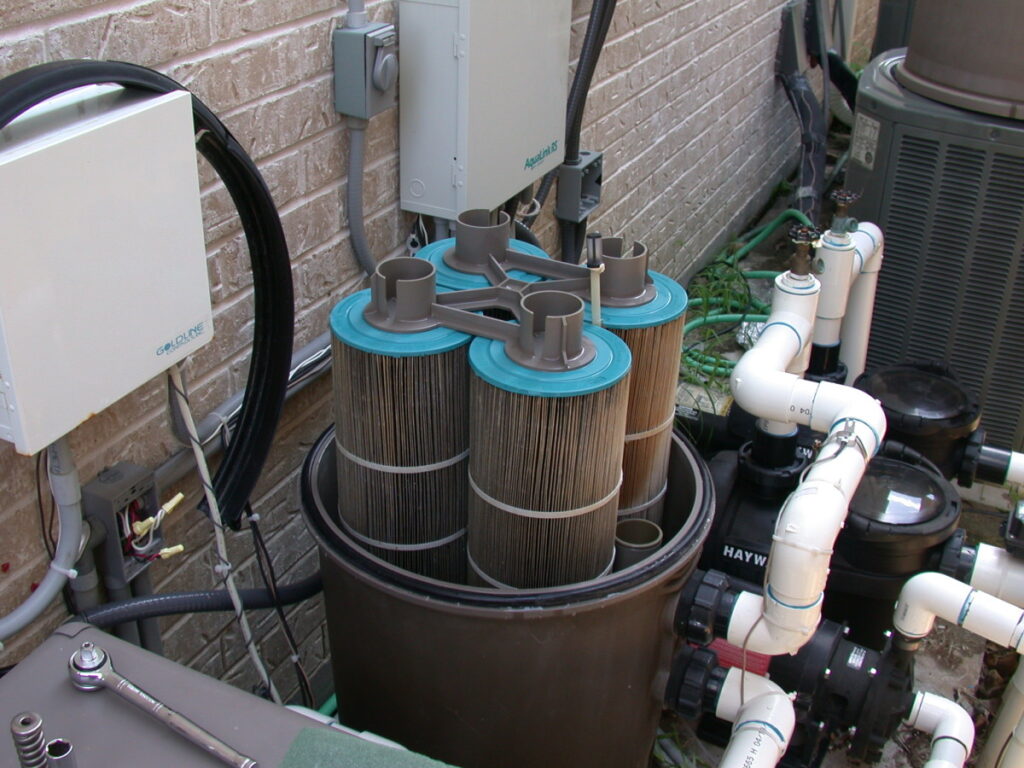
The three types of pool filters are sand filters, cartridge filters, and diatomaceous earth (D.E.) filters. Sand filters are the most affordable and easiest to maintain, filtering particles down to 20 to 40 microns. Cartridge filters offer better filtration at 10 to 20 microns without backwashing. D.E. filters provide the finest filtration at 3 to 5 microns, capturing even microscopic debris. The best pool filter for most residential pools in Jefferson, Georgia is a cartridge filter, which balances water clarity, low maintenance, and energy efficiency. This guide breaks down the pros, cons, sizing, and costs of each filter type so you can make the right choice for your pool.
What Are the Three Types of Pool Filters?
The three types of pool filters are sand filters, cartridge filters, and diatomaceous earth (D.E.) filters. Each uses a different filtering material (called media) to trap dirt, debris, and microscopic particles as water passes through. According to Leslie’s Pool Supplies, one of the largest pool retailers in the United States, all three filter types work with the pool pump to circulate and clean the water before returning it to the pool. The type you choose affects water clarity, maintenance effort, operating costs, and how long the filter media lasts.
Sand filters use silica sand to trap debris. Cartridge filters use pleated polyester fabric. D.E. filters use a fine powder made from fossilized diatoms (microscopic algae) coated on internal grids. Each has strengths and weaknesses that make it better suited for different pool sizes, budgets, and homeowner preferences. Homeowners in the Jefferson, Georgia area should choose a filter that matches both their pool size and the amount of debris common in North Georgia backyards, where pollen, leaves, and red clay dust are frequent contaminants.
No matter which filter type you choose, pairing it with the right pump and maintaining balanced water chemistry keeps the system running efficiently. Regular pool cleaning services include filter maintenance as part of a complete care program.
What Type of Pool Filter Is Most Effective?
The most effective type of pool filter for water clarity is a D.E. (diatomaceous earth) filter. D.E. filters capture particles as small as 3 to 5 microns, which is finer than anything a sand or cartridge filter can achieve. According to Leslie’s Pool Supplies, a human hair is about 75 microns across and a red blood cell is about 5 microns, so D.E. filters can trap debris that is essentially invisible to the naked eye. This level of filtration produces the clearest, most polished water of any residential filter type.
However, “most effective” does not always mean “best choice.” D.E. filters require more maintenance than the other two types. The D.E. powder must be replaced after every backwash, the grids need to be cleaned every 6 months, and the grids themselves need replacement every 2 to 3 years. D.E. filters also cost more upfront. For homeowners who want the absolute clearest water and do not mind the extra upkeep, D.E. is the top performer. For homeowners who want a balance of clarity and convenience, cartridge filters are the most popular choice for residential pools in 2025.
How Do I Know Which Pool Filter to Buy?
You know which pool filter to buy by matching the filter type and size to your pool’s volume, your pump’s flow rate, the type of debris your pool collects, your maintenance tolerance, and your budget. According to Leslie’s Pool Supplies, the correct filter size is determined by your pump’s gallons per minute (GPM) flow rate. The filter’s maximum flow rate must be equal to or greater than the pump’s output. A filter that is too small for the pump will be overpowered, leading to poor filtration, high pressure, and potential equipment damage.
The general sizing formula is straightforward. Divide your pool’s total gallons by 8 hours (the target turnover time), then divide by 60 to get GPM. For example, a 20,000-gallon pool needs a minimum turnover rate of about 42 GPM. Your filter must handle at least that flow rate. According to In The Swim, a pool supply retailer, going one size larger than the minimum is always a good idea because a larger filter provides better filtration, longer intervals between cleanings, and less strain on the system.
If you are building a new pool or replacing an old filter system, a pool inspection can assess your current equipment and recommend the right filter and pump combination for your specific setup.
Sand Filters: How They Work, Pros, and Cons
Sand filters work by passing pool water through a bed of specially graded silica sand (#20 grade) inside a large tank. As water flows down through the sand, debris and particles are trapped in the spaces between the sand grains. Clean water exits through a set of laterals at the bottom of the tank and returns to the pool. When the pressure gauge reads 8 to 10 psi above the starting (clean) pressure, it is time to backwash, which reverses the water flow to flush trapped debris out through a waste line.
Sand filters capture particles down to 20 to 40 microns. They are the least expensive filter type to purchase, the simplest to operate, and require the least hands-on maintenance. The sand itself lasts 3 to 5 years before needing replacement. According to In The Swim, for inground pools, a 30-inch tank diameter (holding about 600 pounds of sand) is recommended. For pools under 20,000 gallons, a 24-inch tank is acceptable.
The main downside of sand filters is that they produce the least clear water of the three types. They also waste water during backwashing, typically 200 to 300 gallons per cycle. For homeowners in the Gainesville and Buford area who have pools surrounded by heavy tree cover and primarily deal with larger debris like leaves and pollen, a sand filter can be an affordable, practical choice. Alternative media like zeolite or filter glass can be used in sand filter tanks to improve filtration efficiency to near-cartridge levels.
Cartridge Filters: How They Work, Pros, and Cons
Cartridge filters work by passing pool water through a pleated polyester fabric cartridge (or multiple cartridges) inside a cylindrical tank. The pleats create a large surface area that traps debris and particles as water flows through. When the pressure gauge rises 8 to 10 psi above the clean starting pressure, you remove the cartridge, rinse it with a garden hose, and reinstall it. No backwashing is needed, which saves hundreds of gallons of water per cleaning cycle.
Cartridge filters capture particles down to 10 to 20 microns, which is significantly finer than sand. They are more energy-efficient because they operate at lower pressure, which means the pump works less hard and uses less electricity. According to Leslie’s Pool Supplies, a good rule of thumb is 100 square feet of cartridge surface area per 10,000 gallons of pool water. A standard 20,000-gallon pool should use at least a 200-square-foot cartridge filter, though 300 to 400 square feet is better for longer intervals between cleanings.
Cartridge filters cost more upfront than sand filters, and the cartridges need replacement every 2 to 3 years. But the lower operating costs, water conservation, and better filtration make them the most popular choice for residential pools in 2025. Homeowners in the Athens and Jefferson area who want clear water with minimal effort find cartridge filters to be the best all-around option.
D.E. Filters: How They Work, Pros, and Cons
D.E. (diatomaceous earth) filters work by coating a set of internal grids with a fine white powder made from fossilized diatom skeletons. As pool water passes through the D.E.-coated grids, even the smallest particles are trapped. D.E. filters capture debris as small as 3 to 5 microns, producing the clearest water possible from any residential filter. When the pressure gauge rises 8 to 10 psi above clean, the filter is backwashed. After every backwash, fresh D.E. powder must be added through the skimmer to recoat the grids.
According to In The Swim, for the average inground pool, a 48-square-foot D.E. filter is the minimum recommended size. Pools over 25,000 gallons should use a 60-square-foot unit. D.E. filters produce the best water quality, but they require the most maintenance: backwashing plus D.E. recharging every few weeks, full grid cleaning every 6 months, and grid replacement every 2 to 3 years. They are also the most expensive filter type to purchase.
D.E. filters are the best choice for homeowners who demand resort-quality water clarity and do not mind the extra maintenance. They are also well-suited for pools with heavy use, pools prone to fine dust and debris, and saltwater pools where crystal-clear water is a priority. For homeowners in the Braselton and Hoschton area looking for the ultimate in water quality, a D.E. filter paired with a variable-speed pump delivers exceptional results.
Pool Filter Type Comparison Table
| Feature | Sand Filter | Cartridge Filter | D.E. Filter |
|---|---|---|---|
| Filtration Fineness | 20 to 40 microns | 10 to 20 microns | 3 to 5 microns |
| Upfront Cost | $200 to $600 | $300 to $900 | $500 to $1,200 |
| Cleaning Method | Backwash (uses water) | Hose rinse (no backwash) | Backwash + add fresh D.E. |
| Media Replacement | Every 3 to 5 years | Every 2 to 3 years | D.E. after each backwash; grids every 2 to 3 years |
| Water Conservation | Low (backwash wastes water) | High (no backwash needed) | Low (backwash wastes water) |
| Energy Efficiency | Moderate | High (lower operating pressure) | Moderate |
| Best For | Budget-conscious, large debris | Most residential pools, easy care | Crystal-clear water, heavy use |
Sources: Leslie’s Pool Supplies, In The Swim, Eco Outdoor, Vita Pool Supply
What Size Pool Filter Do I Need for a 20,000 Gallon Pool?
For a 20,000-gallon pool, you need a filter with a flow rate of at least 42 GPM. A 20,000-gallon pool divided by 8 hours equals 2,500 gallons per hour, divided by 60 minutes equals approximately 42 gallons per minute. According to Leslie’s Pool Supplies, the filter’s maximum rated flow rate must be higher than 42 GPM to avoid overloading the system. Going one size up from the minimum is recommended for better performance and longer intervals between cleanings.
For a sand filter, a 24-inch or 30-inch tank handles a 20,000-gallon pool well. For a cartridge filter, a unit with at least 200 square feet of filter area is the minimum, but 300 to 400 square feet is better. For a D.E. filter, a 48-square-foot unit is the standard recommendation. Always match the filter to the pump’s actual flow rate, not just the pool volume, because pipe size, distance from the pool, and the number of water features all affect the real flow.
What Size Pool Filter Do I Need for a 30,000 Gallon Pool?
For a 30,000-gallon pool, you need a filter rated for at least 63 GPM. The calculation is 30,000 gallons divided by 8 hours, divided by 60 minutes. According to In The Swim, a 30-inch sand filter, a 400-square-foot cartridge filter, or a 60-square-foot D.E. filter handles a 30,000-gallon pool comfortably. Pools this size may also need 2-inch plumbing instead of standard 1.5-inch pipes to handle the higher flow rate without excessive friction loss.
Large pools in the Winder, Loganville, and Jefferson area that include water features like sheer descents or spillover spas need even more flow capacity because these features draw water from the same circulation system.
Do I Need a 1 or 1.5 HP Pool Pump?
Whether you need a 1 or 1.5 HP pool pump depends on your pool size, plumbing diameter, total dynamic head (resistance in the system), and the filter’s rated flow. For most residential inground pools between 15,000 and 25,000 gallons with standard 1.5-inch plumbing and a basic setup (filter, skimmer, returns, no extra features), a 1 HP pump is sufficient. Pools above 25,000 gallons, pools with long plumbing runs, or pools with water features often need 1.5 HP or more.
According to the U.S. Department of Energy, variable-speed pumps save 50% to 70% on energy costs compared to single-speed pumps by running at lower speeds for most of the day and only ramping up when higher flow is needed. A variable-speed pump rated at 1.5 HP running on low speed can often do the same daily filtration work as a single-speed 1 HP pump while using far less electricity. For new pool builds and equipment replacements in the Jefferson, Georgia area, a variable-speed pump is the smartest long-term investment.
Is It Better to Backwash or Waste?
Backwash is better for routine filter cleaning because it reverses water flow through the filter to flush out trapped debris while keeping the water in the system. The “waste” setting on a multiport valve bypasses the filter entirely and sends water straight out of the pool to a drain. Waste mode is used for specific situations: lowering the water level after heavy rain, vacuuming heavy debris directly out of the pool without clogging the filter, or removing algae-laden water during a pool cleanup.
Use backwash for regular filter maintenance (every 2 to 4 weeks for sand and D.E. filters). Use waste only when you deliberately want to remove water from the pool without passing it through the filter. Running on waste too often lowers the pool water level and wastes water and chemicals. Cartridge filters do not have a backwash function at all, which is one of their advantages for water conservation.
Is It Better to Run Your Pool Pump at Night or in the Day?
It is better to run your pool pump during the day, especially during the hottest, sunniest hours. Sunlight breaks down chlorine, and running the pump during peak UV hours circulates freshly sanitized water throughout the pool when it is needed most. According to pool chemistry experts, chlorine is consumed fastest between 10 AM and 4 PM because of UV degradation and higher bather loads. Running the pump during these hours keeps the water cleaner and reduces the total amount of chlorine needed.
Some homeowners prefer to run the pump at night to take advantage of lower off-peak electricity rates. If your utility company offers time-of-use pricing, splitting the run time (some during the day and some at night) can balance chemical efficiency with energy savings. A variable-speed pump makes this easy by running at low speed during off-peak hours and ramping up during the day. For homeowners in the Dacula and Lawrenceville area, check with your local power company about time-of-use rate options.
How Long Do Pool Filters Last?
Pool filters last 7 to 15 years for the tank and housing, depending on the type and quality. The filter media inside, which does the actual cleaning, has a shorter lifespan. Sand media lasts 3 to 5 years. Cartridge elements last 2 to 3 years. D.E. grids last 2 to 3 years, with D.E. powder needing replacement after every backwash. According to Leslie’s Pool Supplies, regular cleaning and proper chemical balance extend the life of all filter types.
Signs that your filter needs replacement include consistently high pressure even after cleaning, cloudy water that does not clear with proper chemistry, visible cracks or damage to the tank or cartridges, and sand or D.E. powder blowing back into the pool through the return jets. A pool repair professional can evaluate your filter and recommend whether cleaning, media replacement, or a full system upgrade is the best option.
Can a Pool Filter Be Too Big?
No, a pool filter generally cannot be too big. A larger filter provides better filtration, longer intervals between cleanings, less strain on the pump, and a longer lifespan for the filter media. According to both Leslie’s Pool Supplies and In The Swim, oversizing the filter relative to the pump is always better than undersizing it. A filter that is too small for the pump creates dangerously high pressure, damages the filter media, and results in poor water quality.
The only practical downside of a very large filter is the higher upfront cost and the physical space it takes up on the equipment pad. For most residential pools in the Jefferson, Georgia area, going one size up from the calculated minimum is the best practice.
How Do I Get My Pool Crystal Clear?
Getting your pool crystal clear requires balanced water chemistry, a properly sized and clean filter, adequate pump run time, and regular maintenance. Test and adjust pH (7.2 to 7.8), alkalinity (80 to 120 ppm), and chlorine (1 to 3 ppm) at least once a week. Run the pump long enough to turn over all the water at least once per day (8 to 10 hours for most pools). Brush the walls and floor weekly. Clean the filter according to its type (backwash sand and D.E. when pressure rises 8 to 10 psi; rinse cartridges). Shock the pool weekly during heavy use or after rain.
If the water stays cloudy despite proper chemistry and filtration, the filter may be too small, the media may be worn out, or there may be a circulation dead spot in the pool. Adding a clarifier can help clump fine particles for the filter to catch. For persistent cloudiness, a professional assessment of the filtration system and water chemistry can identify the root cause. Professional pool cleaning keeps the water balanced and the filter in top condition all season long.
Is Pentair or Hayward Better?
Pentair and Hayward are both top-tier pool equipment manufacturers, and neither is universally better than the other. Pentair is known for its variable-speed pump technology and energy efficiency innovations. Hayward is respected for its reliability, wide product range, and affordability. According to multiple pool industry sources, the best brand depends on your specific needs, budget, and what equipment your pool builder recommends and services.
Both companies make sand, cartridge, and D.E. filters as well as pumps, heaters, and automation systems. Both offer products that meet current Department of Energy efficiency standards. The most important factor in choosing between Pentair and Hayward is finding a local service professional who is experienced with the brand you choose, because access to parts and knowledgeable repair technicians matters more than brand name over the long term.
Frequently Asked Questions
Which Pool Filter Is Best for Pools in Jefferson, Georgia?
The best pool filter for most pools in Jefferson, Georgia is a cartridge filter. It offers strong filtration (10 to 20 microns), does not waste water through backwashing, uses less energy than sand or D.E. filters, and is easy to maintain. The North Georgia climate produces heavy pollen in spring and leaf debris in fall, both of which a properly sized cartridge filter handles well with regular rinsing.
How Often Should I Clean My Pool Filter in North Georgia?
You should clean your pool filter in North Georgia every 2 to 4 weeks during swim season (April through October) and once a month during the off-season. For sand and D.E. filters, backwash when the pressure gauge reads 8 to 10 psi above the clean starting pressure. For cartridge filters, remove and rinse the cartridge with a garden hose when pressure rises. Deep-clean cartridges with a diluted acid soak every 3 to 4 months for best results.
What Is the Best Pool Filter for a Saltwater Pool Near Athens, Georgia?
The best pool filter for a saltwater pool near Athens, Georgia is a cartridge filter. Saltwater pools generate chlorine through a salt cell, and backwashing too frequently (as required with sand and D.E. filters) can dilute the salt concentration and throw off the system. Cartridge filters do not require backwashing, which keeps the salt levels stable and reduces the frequency of salt additions.
How Much Does a Pool Filter Replacement Cost?
A pool filter replacement costs $200 to $1,200 depending on the type. Sand filters range from $200 to $600. Cartridge filters range from $300 to $900. D.E. filters range from $500 to $1,200. These prices are for the filter unit itself. Installation labor adds $100 to $300. Replacement cartridges alone cost $30 to $150 each depending on the size and brand.
Is Schedule 40 or 80 Better for Pool Plumbing?
Schedule 40 PVC is better for most residential pool plumbing because it provides adequate pressure rating at a lower cost. Schedule 80 PVC has thicker walls and a higher pressure rating, but it costs more and is typically only needed for specific high-pressure applications or commercial installations. For the vast majority of residential pools in North Georgia, Schedule 40 PVC meets all code requirements and performance needs.
What Size Pump Is Needed for a 20,000 Gallon Pool?
A 20,000-gallon pool needs a pump that produces at least 42 GPM to achieve a full turnover in 8 hours. For most standard residential setups with 1.5-inch plumbing, a 1 HP single-speed pump or a 1.5 HP variable-speed pump running at medium speed provides this flow rate. Variable-speed pumps offer the added benefit of adjustable speeds for different tasks, from low-speed daily filtration to high-speed vacuuming or running water features.
Does a Seasonal Pool Opening Include Filter Service?
Yes, a professional seasonal pool opening typically includes filter inspection and cleaning as part of the service. The technician checks the filter for damage, cleans or backwashes it, checks the pressure gauge, inspects the pump for leaks, and verifies that the entire circulation system is working properly before balancing the water chemistry for the new season.
Final Thoughts
Choosing the right pool filter is one of the most important equipment decisions a pool owner makes. The filter is what stands between clean, inviting water and a cloudy, unhealthy pool. For most homeowners in Jefferson, Georgia and across the North Georgia area, a cartridge filter sized one step above the minimum delivers the best combination of water clarity, energy savings, and easy maintenance. Sand filters are a solid budget option, and D.E. filters are the gold standard for those who want the clearest possible water.
No matter which filter you choose, proper sizing, regular cleaning, and balanced water chemistry are what make the system work. If you need help selecting, installing, or maintaining a pool filter, Sandals Luxury Pools has been serving homeowners across Jefferson, Athens, Gainesville, Braselton, and the surrounding communities for over a decade. From custom pool builds to equipment upgrades and ongoing maintenance, their team makes sure your pool stays crystal clear all season. Contact them today to schedule a consultation.
